


Night diving in the Philippines: discovering underwater macro photography
Underwater macro photography reveals a hidden, fascinating, and almost surreal world. In the Philippines, the richness of marine life offers enthusiasts unique opportunities to observe and capture tiny and incredible creatures. A look back at an immersive experience in Anilao, where I tested the ‘black water’ diving technique for the first time with expert guide Dennis Corpuz.
Why choose the Philippines for macro photography?
The Philippines has quickly become my favorite destination for underwater photography. The dives are incredibly diverse, and the microscopic fauna abounds like nowhere else.
- An extraordinary biodiversity, ideal for macro
- Rare and fascinating subjects on every dive
- A perfect playground to refine photography techniques
What I love about macro is its ability to reveal worlds invisible to the naked eye. When developing the images, an infinity of details appears, offering a ‘second dive’ prolonged, dry in front of the computer!
First ‘black water’ experience: diving in the dark
In Anilao, I had the opportunity to participate in my first ‘black water’ dives. It’s a way of diving at nightfall, away from the bottom, where artificial light attracts deep-sea fauna to the 20-meter zone.
- Night water entry, just 200 meters from shore
- Installation of a buoy equipped with powerful lamps every 5 meters on a 20-meter depth
- The boat stays nearby for safety reasons
Entering the water was both exciting and slightly daunting: all visual cues disappear, except for the bright spot of the buoy, which becomes my sole anchor in the dark.
A unique sensory immersion
Focused behind the lens, it quickly becomes difficult not to lose track of reality as the underwater spectacle captures all attention. Fabulous creatures soon emerge in the light. Guaranteed fascination!
The challenge during these first trials was to adapt my settings to these unprecedented conditions – and to change the lens for more efficiency, thanks to the wise advice of Dennis Corpuz.
The magical encounter: a shrimp on a pyrosome
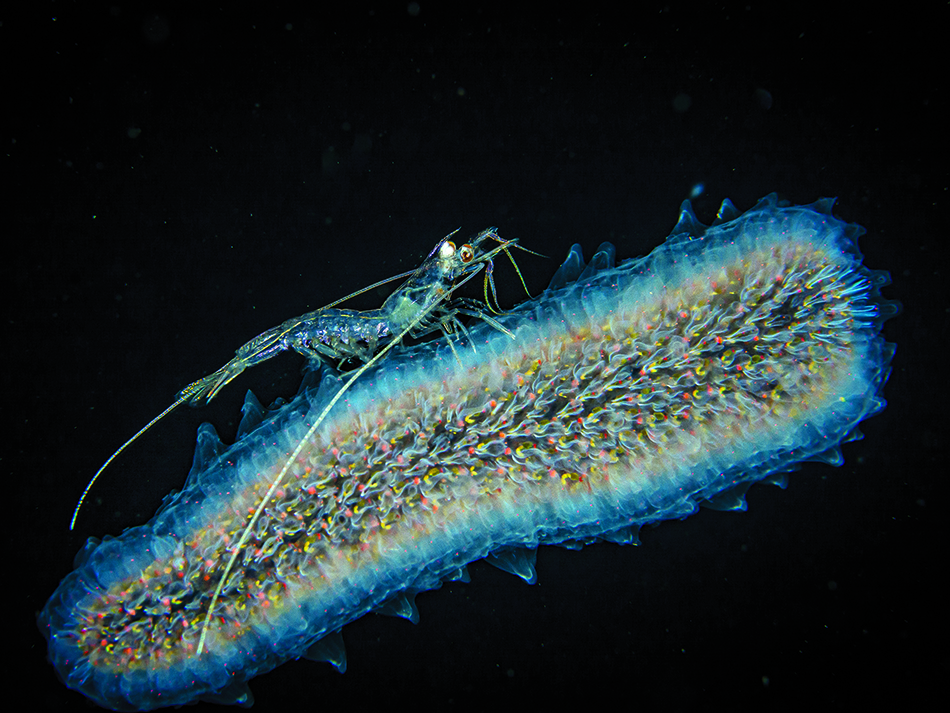
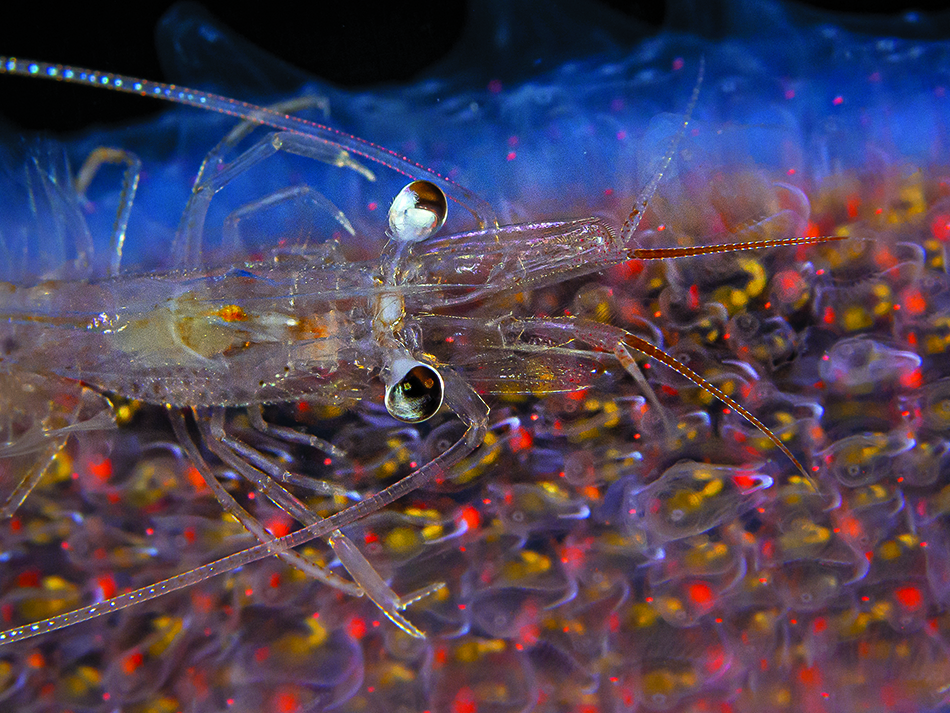
While fully concentrating, I spot a tiny shrimp perched on a pyrosome, creating a breathtaking scene as if it had come straight from another world. Zoom on this phenomenon:
- The pyrosome: a tunicate composed of thousands of ‘zooids’ forming a tube, sometimes immense, luminescent in the dark
- The tiny shrimp highlights the contrast with the giant organism, creating a strong and intriguing visual scene
- The duo illustrates the complexity and beauty of deep marine biodiversity
I’ve seen pyrosomes big enough to slip inside! But that night, my attention was on the shrimp, to highlight this rare scale and light play in underwater macro photography.
A visual testimony to deep biodiversity
Each image captured during these night dives reflects a surprise, an encounter, and a story of marine life. These photos invite us to contemplate the secret richness of our oceans, but also to think about their preservation.
The image of the shrimp on its pyrosome perfectly symbolizes the symbiosis, interconnection, and hidden magic of the underwater world. It is an invitation to explore further what lies beneath the surface, to better understand and protect this exceptional natural heritage.
The technical image
Shooting: Nikon D7100, 60mm lens. Settings: 1/320s – f/14 – ISO 320. Two Inon Z240 flashes used to reveal all the details of the scene.
For more information on ‘black water’ diving, see this specialized diving guide.
This article, initially written by Fanny Floirat-Lohyer, was adapted for the web. Photographer: Fanny Floirat-Lohyer.