


It’s a well-kept secret beneath the surface of tropical waters: there is so much to discover that you are never really told everything! Today, we head to the shore of a warm sea, lined with mangroves, for a fascinating exploration. Put on your mask and snorkel… and keep your eyes wide open, as it’s the details that make the magic of the marine world.
Observing Up Close: The Invisible Revealed
That morning, visibility isn’t great. It’s impossible to see far, so you need to get closer to the roots of a mangrove. There, it’s a surprise: a myriad of tiny bubbles cling to the submerged wood.
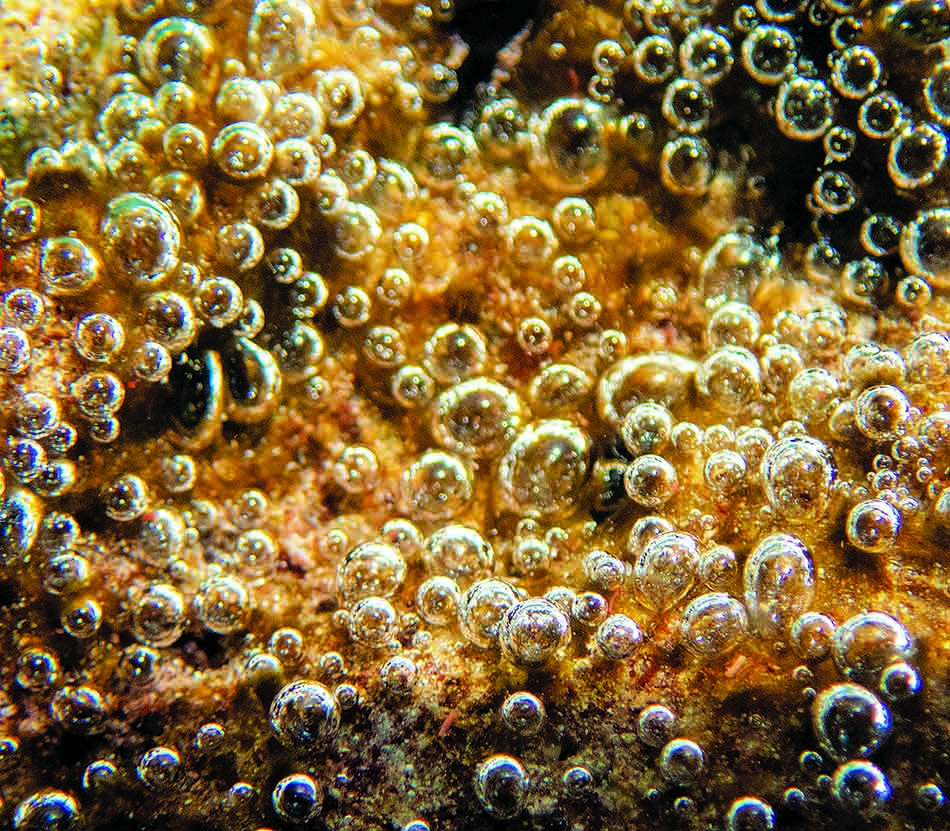
These bubbles are pure oxygen, also known as dioxygen (O₂). But where does this vital gas for all marine life come from? The answer lies in an invisible army of microalgae, almost impossible to distinguish with the naked eye.
These algae colonize roots, rocks, harbor walls, and boat hulls… Their main asset: chlorophyll, a true solar collector. It is what makes photosynthesis possible, this essential phenomenon for life on Earth.
- Did you know?
The key reaction of photosynthesis is as follows:
water + carbon dioxide + energy → organic matter + oxygen
By “organic matter,” simply understand the food produced. These algae are therefore classified as producers within the marine ecosystem. They create both food and… the oxygen that everyone needs. You are thus witnessing photosynthesis live through these bubbles that cover the roots.
In this “food” produced, the main energy sources are sugars and lipids. Thus, the entire marine food chain depends, at its base, on this discreet process.
The Termites: Architects of Submerged Wood
Let’s continue the journey in fins: an old tree trunk lies underwater. On its surface, strange little white tubes move slightly with the current.
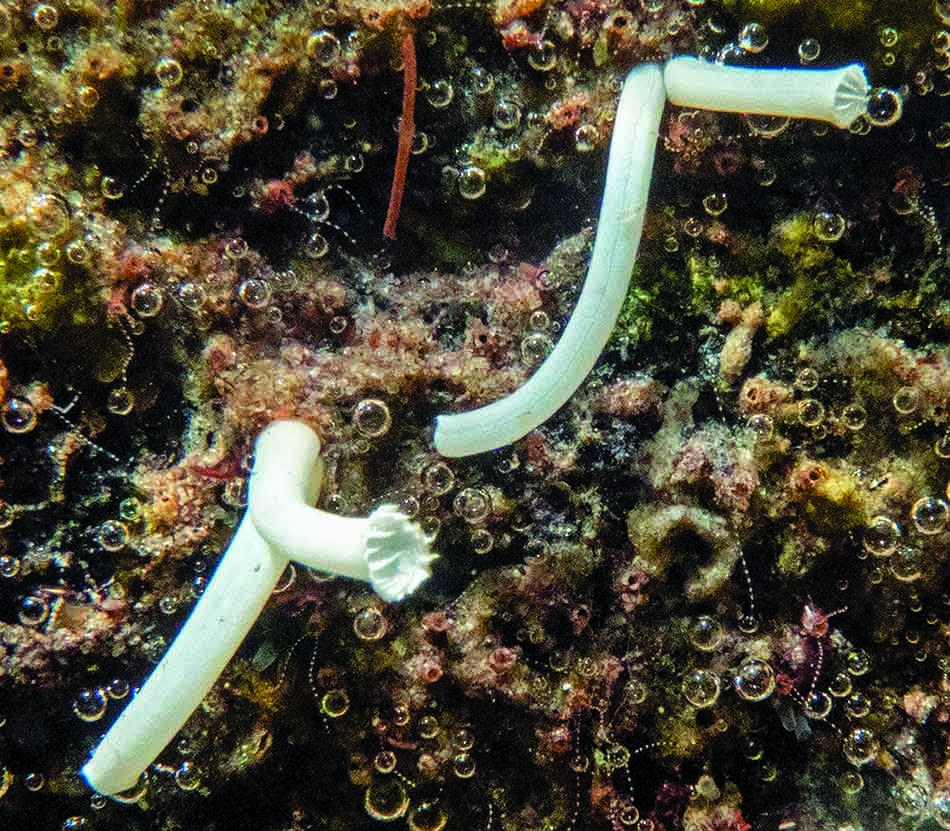
These are the siphons of two terites, bivalve mollusks specialized in boring into marine wood. They live hidden in the galleries they dig and only let these siphons protrude to filter the water.
Through their serrated siphon, terites suck in water, plankton, and, of course, the oxygen produced by microalgae. Inside their cells, food is “burned” to release the solar energy stored in organic form. But for this, oxygen is needed, provided by photosynthesis. This phenomenon is called cellular respiration.
- The principle of cellular respiration:
organic matter + oxygen → water + carbon dioxide + energy
Terites – like all animals – are consumers: they use the food and oxygen provided by the producers at the beginning of the chain.
The Ecological Loop: The Key Role of Decomposers
The story doesn’t stop there. Not all organic matter produced is consumed. Remains, dead leaves, fragments of algae, pieces of wood, are collected by another group of essential players: the decomposers.
A little further on, on dead leaves, we observe whitish, vaporous filaments.
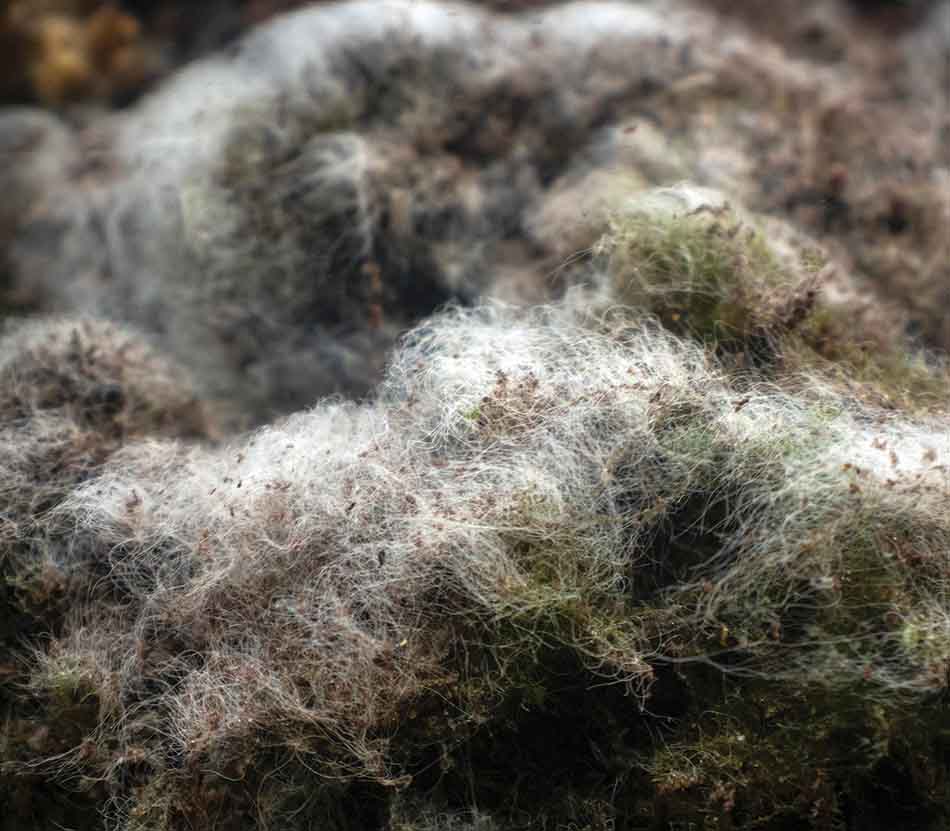
These are filamentous bacteria, experts in the art of transforming organic matter into mineral molecules like nitrates or phosphates. These elements will in turn stimulate the growth of producers, thus closing the cycle of marine life.
- To remember:
- Producers (microalgae) create food & oxygen.
- Consumers (animals like terites) use these resources.
- Decomposers close the chain by recycling organic matter.
The Natural Balance of the Marine Ecosystem
This short journey in fins (Fins-Mask-Snorkel) reveals one of the most beautiful natural balances there is. In less than thirty minutes of exploration, you will have witnessed, on a small scale, the three greatest phenomena that govern life on our planet: production, consumption, and decomposition.
Every dive, even the humblest, invites you to observe these extraordinary mechanisms. Take the time to scrutinize, to question, to admire: an invisible and fascinating world is offered to those who know how to look.
This article, originally written by Steven Weinberg for our print edition, has been adapted for the web.
Photos: Steven Weinberg.