


The world’s first under-ice photography exhibition has been open to visitors since mid-February beyond the Arctic Circle in the White Sea (Big Cross Island in Nilmoguba Bay). Martians, spaceships, or even aquanauts traveling by balloon through the sea – this is how photographer Viktor Lyagushkin shows the underwater world of the White Sea in his photographs. Thanks to a new photo technique of his invention – macros taken with a fisheye lens – he is able to present the tiny underwater inhabitants of the Arctic Ocean in their natural environment.
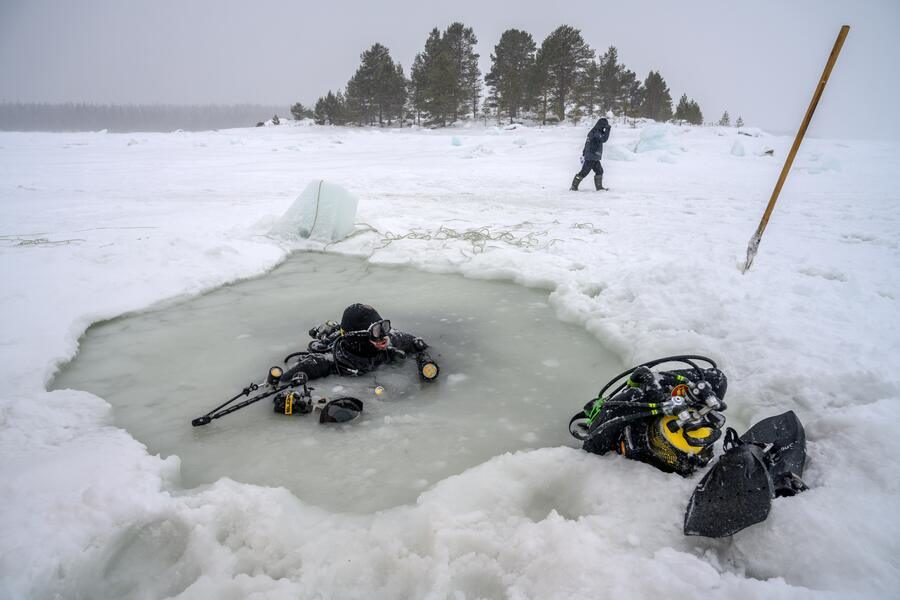


Photos « suspended » in icy waterThe photos were taken in March-September 2018, in the same place where they are now exhibited – in the White Sea. 10 photos are visible under the ice, including a portrait of Viktor Lyagushkin with his photo equipment. But how can you leave images in icy, salty water for several months?
After considering fixing the images from below, the photographer realized it would be easier to do the opposite: he suspended them in the water by weighting them with lead. With discreet coloring, the cords are almost invisible underwater, giving the impression that the photos are suspended in the water.
« When I saw my photos underwater, they seemed to gain additional depth that was not perceptible on the surface« , says Viktor Lyagushkin. « When I saw this, I realized that I had done something more powerful than just an unusual exhibition in an unusual place. I was also guided by the idea of drawing attention to the issue of climate change. Arctic ice is melting at a catastrophic rate and Russia thinks very little about it, and the level of public awareness is near zero. »


Until the ice meltsThe exhibition « Until The Ice Melts » is part of a major project by this world-renowned photographer (winner of numerous competitions, Nikon Ambassador, National Geographic photographer) on documenting the animals of the White Sea.
« The world is changing before our eyes, Arctic ice is melting, the climate is changing, species are disappearing« , says Viktor Lyagushkin. « My goal is to show people this wonderful world under the ice so that humanity understands what we are going to lose in the near future if we do not turn our attention to this problem. »
The exhibition will last until the ice begins to melt. Divers and free-divers who want to discover it can contact the Arctic Circle dive lodge and center.


