


The Moses sole, known scientifically as Pardachirus marmoratus, is a fascinating and unique fish. Contrary to some misconceptions, it is not a half fish, but rather a remarkable example of evolutionary adaptation to its environment. Where does this flat shape come from? Why and how did it evolve?
Morphology and characteristics
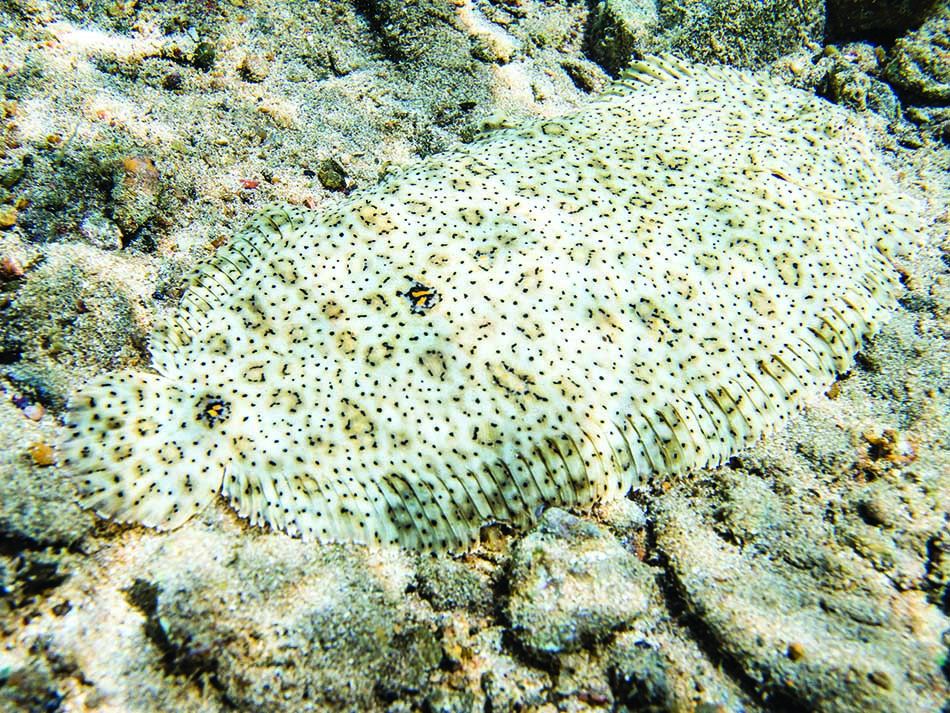
Also called milk sole, the Moses sole is distinguished by its compressed and oval shape, which can reach up to 25 cm in length at adulthood. Like all species of flatfish, it belongs to the order Pleuronectiformes, characterized by lateral compression rather than a true flattening.
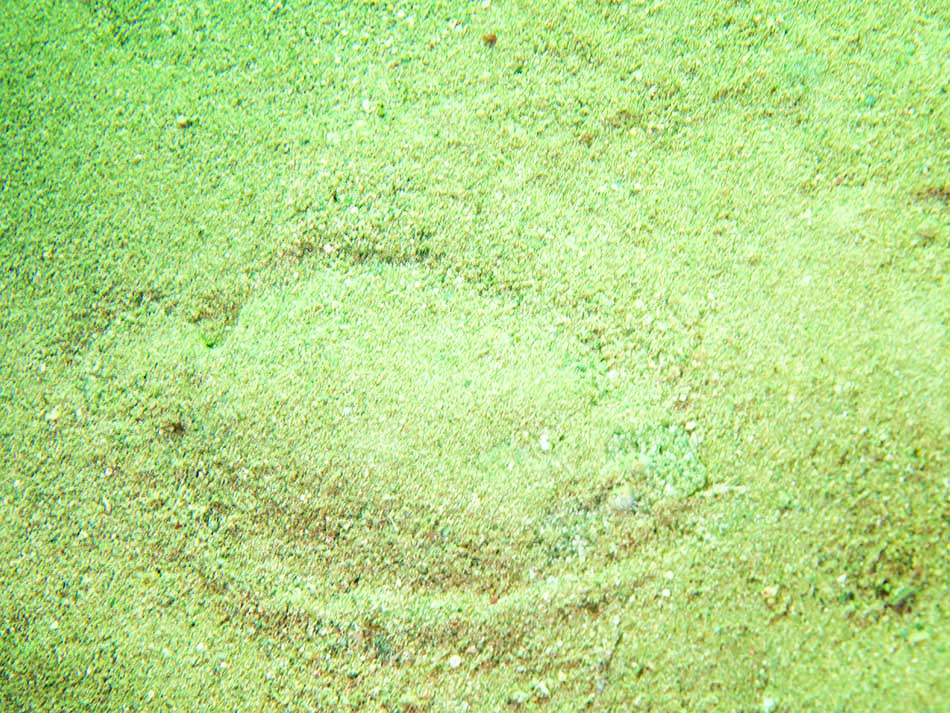
Its body coloration varies depending on the type of substrate, ranging from light to dark brown tones, according to the sand. Its marbled skin is adorned with pale spots, often bordered with a darker area, with shades of yellow. The patterns also extend over its fins, while its ventral side is white, allowing it to blend into the seabed.
It should be noted that the Moses sole does not have pectoral fins. Instead, its dorsal and anal fins extend along the entire length of its body, stopping just before the tail. Small skin excrescences are also visible on the edge of the head.
Metamorphoses and adaptation
At birth, Moses sole fry resemble classic fish but undergo transformations as they grow. The skull is remodeled, and one eye migrates to one side of their body. For members of the Soleidae family, this migration is to the right side. The adult form is thus asymmetrical, with the left eye having migrated to the right. This disposition gives it an expanded field of vision.
The evolution of flatfish results from a slow adaptation, supported by flatfish fossils dating back 45 million years. The Moses sole is therefore a perfect example of this adaptability, having managed to effectively camouflage itself in its environment.
Habitat and behavior
The Moses sole is found in shallow coastal waters, preferring sandy and muddy bottoms at depths ranging from 0 to 15 meters. It is frequently observed in the Red Sea and the Indian Ocean, extending from the Persian Gulf to Sri Lanka, and to the Australian coasts and New Caledonia.
These fish primarily move along the bottom (benthic organisms) and can burrow into the substrate, sometimes leaving only their eyes exposed. They adopt a discreet hunting technique, feeding on small fish, crustaceans, worms, and other invertebrates.
Camouflage and survival strategy
One of the major assets of the Moses sole is its ability to camouflage. Its flat shape and colors similar to the sand allow it to blend into its environment, escaping the watchful eyes of predators and prey alike.
Etymology
The genus name, Pardachirus, comes from the Latin « pardus » meaning leopard and « acheir », referring to the absence of pectoral fins. Its species name, marmoratus, refers to its marbled appearance.
Dextral and chemical defense
The term dextral indicates that both of its eyes are positioned on its right side, which means it rests on its left side when at rest.
To defend itself, the Moses sole secretes an ichthyotoxic substance, produced at the base of the rays of its dorsal and anal fins. This substance acts as a repellent for its predators.
Natural repellent against sharks
The pardaxin, in combination with other chemical substances, not only irritates the gills of predators but also acts as a powerful repellent for sharks.
Classification of Pleuronectiformes
The Pleuronectiformes, etymologically the order of « fish with dissimilar sides », includes about ten families, among which are soles, flounders, plaices, turbots, and plaices, totaling more than 700 species.
A toxic species
Like other species of soles, the Moses sole produces toxic substances that act as repellents against its predators. By secreting a milky ichthyotoxic substance, it defends itself effectively, especially against small fish.
A danger to humans?
Because of its size, the Moses sole poses no danger to divers. It remains discreet and relies on its camouflage to escape attention. If spotted, it tends to flee.
This article, originally written by Jean-Christophe Grignard for the print edition of DIVE!, was adapted for the web.
Photos © Jean-Christophe Grignard, Illustration © Cyril Girard.