


The Calanques National Park attracts divers from around the world thanks to its exceptional sites, including the Riou archipelago, the only uninhabited archipelago on the French coast. At the southwestern tip of Riou Island, facing Moyade islet, lies the Boulégeade calanque, also known as Moyade de Terre. This beautiful cove is home to one of the best diving spots in the region, suitable for all levels and tastes.
Sheltered from the east wind
The Boulégeade stands out as a flagship site of the Calanques National Park, especially when the east wind is weak. This place showcases the diversity and beauty of the Marseille underwater world. Divers can explore a multitude of varied routes adapted to different levels, current strength, visibility, and personal preferences. The depth of the calanque ranges from 5 to 7 meters, ideal for discovering rich marine life including rainbow wrasses, scorpionfish, moray eels, sargos, mullets, bass, and seabreams, perfect for an introductory dive.
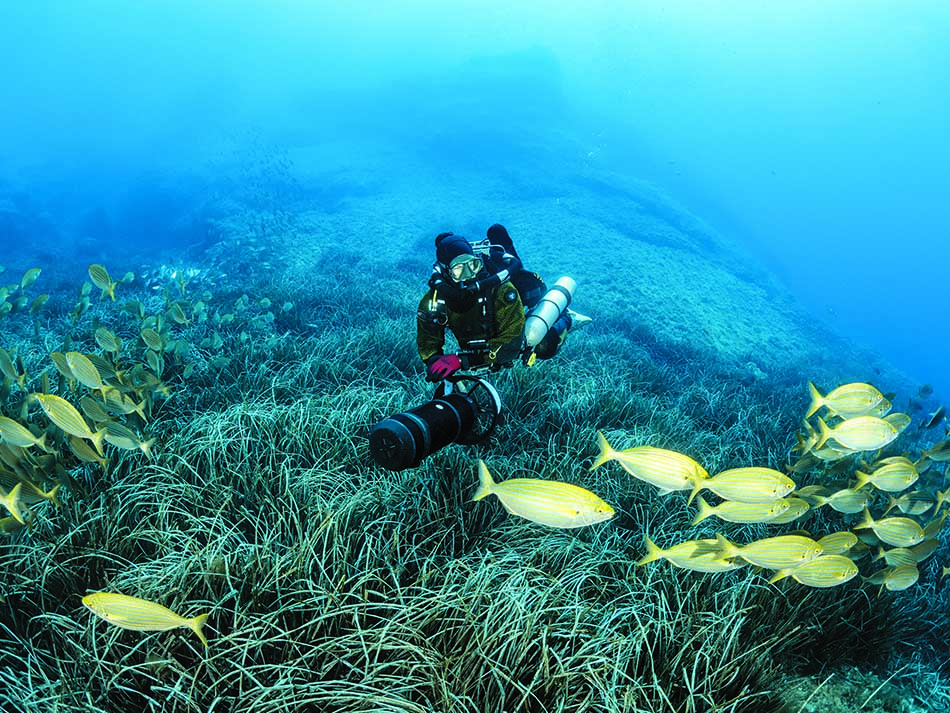
A dive suitable for all levels
Whether you are a PE20 (guided diver up to 20 m) or PA20 (autonomous diver up to 20 m), this dive starts to the left of the tip of Riou Island. You will be accompanied along rocky tongues between 10 and 15 meters, leading to a platform at about 20 meters, where there is a lookout and a magnificent arch. The view from this point offers a striking spectacle with captivating blue, ideal for immersion. Before exploring deeper, it is advised to enjoy the shallow waters, where groupers and barracudas are often present.
The Boulégeade arch
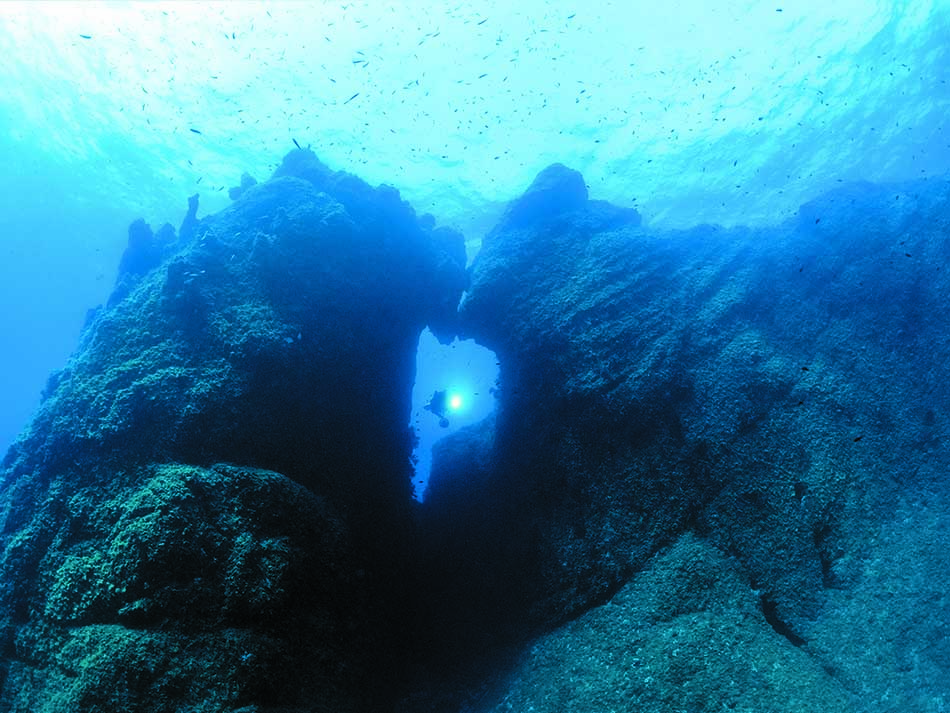
To cross the arch, one must navigate through swarms of damselfish, taking care not to disturb the anthias and sargos. The walls are adorned with yellow anemones, although only a few rare purple gorgonians survived the August 2022 heatwave. Following the wall on the left, level 2 divers (PE40) or autonomous divers (PA40) can glide along a smooth wall, descending to a white sandy bottom, in harmony with the deep blue of the surrounding waters. Between 20 and 24 meters, two large openings reveal access to a cave. The small adjacent plateau is beautified by blocks covered with coralligenous and marine algae, inhabited by nudibranchs, lobsters, comber, and scorpionfish.
A fascinating cave, adorned with red coral
The Boulégeade cave is entirely lined with red coral. When the polyps bloom, the spectacle is enchanting. Divers can also search for a rarity: a branch of albino red coral. The floor, composed of sand and posidonia debris, requires special attention to maintain visibility and protect this Mediterranean treasure. To exit the cave, a dark turn must be navigated, highlighting the importance of a flashlight to illuminate the path. Once exploration of the cavern is complete, the return to the calanque occurs through the shallow depths, while observing schools of fish dancing with the waves.
The rocky formations offer opportunities to observe numerous scorpionfish, groupers, corb, and vast schools of salemas. The posidonia seagrass bed, a Mediterranean marine plant, thrives here, serving as a habitat, food source, and breeding area for several species.
The Moyades Pass
For those diving independently or with an experienced guide, exploring the pass between the Moyade islet and the Boulégeade calanque is a must. When conditions are optimal, this area transforms into a true underwater festival, especially during warm seasons. Magnificent groupers lead an aquatic ballet with barracudas, amberjacks, and dentex. Since the creation of the Calanques National Park in 2012, the Boulégeade is a no-take zone, preserving marine life. This regulation allows divers to discover the preserved richness of the Mediterranean seabed.
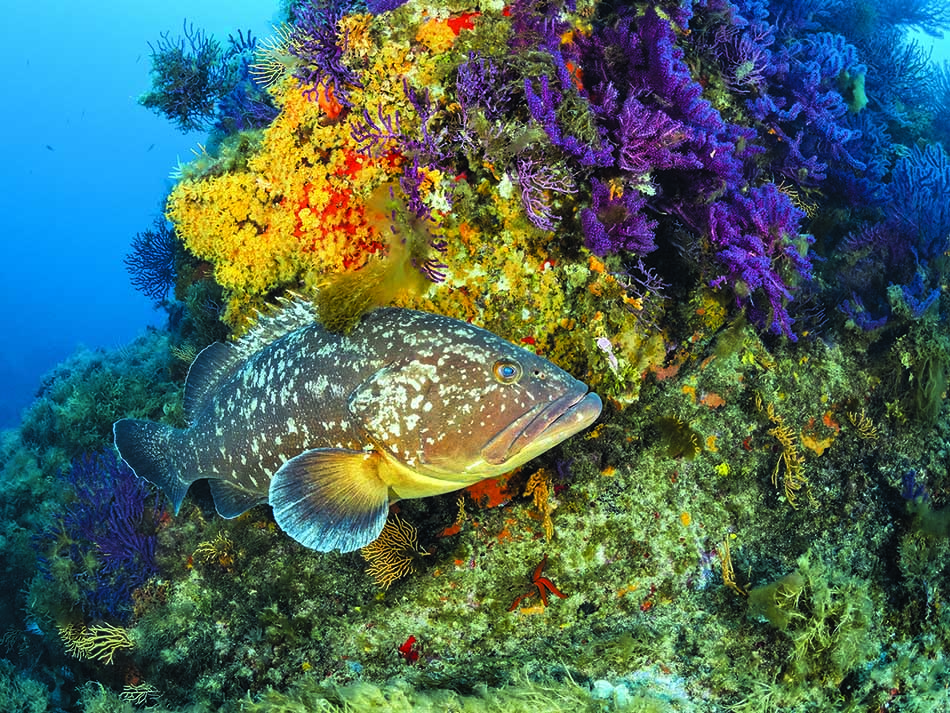
Why « Boulégeade »?
The name of the calanque might come from an ancient fishing technique, involving placing a net between two points with a stone to frighten the fish. Additionally, in the south of France, the verb « bouléguer » means to stir. This connection is often shared by diving instructors with their students. Is it a fact or a legend?
Did you know?
For millennia, Mediterranean red coral has been coveted. According to Greek mythology, it was born from the blood of Medusa, severed by Perseus. In antiquity, its medicinal virtues were recognized. Used as a currency, it was particularly exported by Marseille. Today, red coral is highly prized for making jewelry and decorative objects, which has led to its overexploitation, even though it grows very slowly, at a rate of 3 to 4 cm every 10 years.
This article, originally written by Fabrice Dudenhofer for the print edition of DIVE!, has been adapted for the web.
Photos © Fabrice Dudenhofer.