


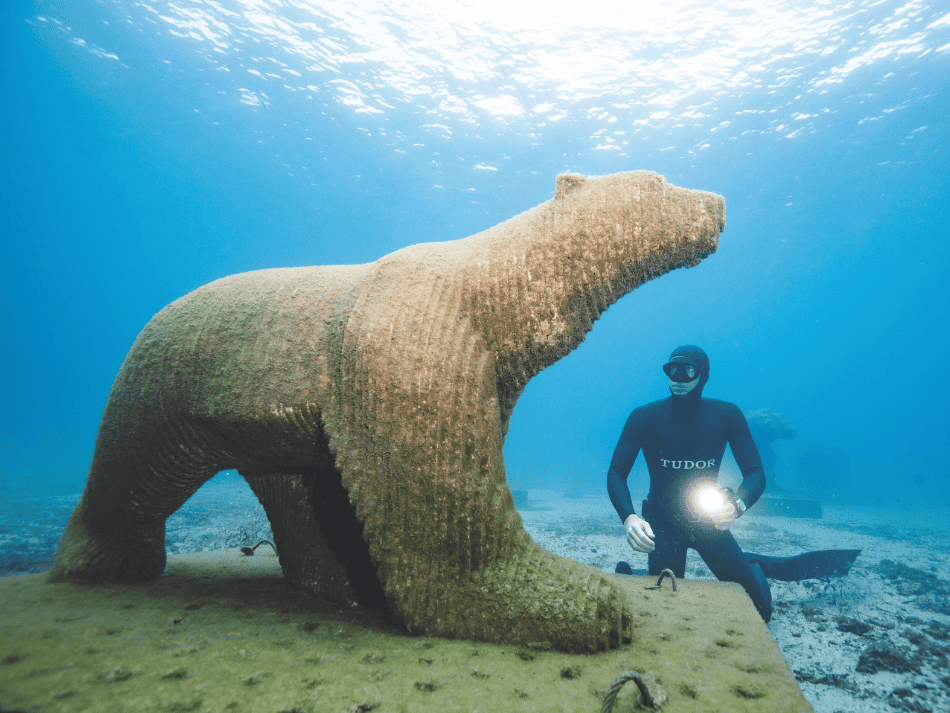
For about fifteen years, a dynamic initiated by British sculptor Jason deCaires Taylor has seen the emergence of collections of underwater artworks across all oceans. These underwater museums, typically located at shallow depths, offer the opportunity to discover sculpture art while conveying a strong message of environmental preservation.
The genesis of underwater museums
In 2004, Hurricane Ivan, nicknamed « the terrible, » struck the Lesser Antilles, including the island of Grenada. In this context of devastation, Jason deCaires Taylor, a British sculptor also holding a diving instructor certification, decided to create an artificial reef. In Molinere, he designed sculptures made from durable concrete (cement, sand, and micro silica) with a neutral pH that offers a rough and textured surface for coral polyps. The folds of his characters’ clothing become refuges for fish and crustaceans.
The installation, carried out in 2006, is meticulously timed. The sculptures must be submerged before the coral larvae reproduction period, but not too early to avoid other marine species colonizing them. Grace Reef, the first series, consists of sixteen female bodies resting at ten meters deep, followed by The Lost Correspondent, evoking the eruption of Vesuvius and the Cuban Crisis, and Vicissitudes, an iconic work representing a circle of twenty-six children, symbolizing unity and honoring the slaves who perished during the Atlantic crossing. Aware of the ecological value of this reef, authorities have decided to protect the area, now home to around 600 sculptures over 800 m².
Did you enjoy this excerpt?
Read the full article.
READING TIME ≈ 7 min
Dive into the heart of PLONGEZ! Magazine
To enjoy this article and its exclusive content, a modest contribution is required.