


The winners of the prestigious Wildlife Photographer of the Year competition, organized by the Natural History Museum of London, were announced in October.
American photographer Karine Aigner was named Photographer of the Year for her remarkable image of a ball of cactus bees swirling on the hot sand of a Texas ranch. In her close-up, all the bees except one are males trying to mate with the single female at the center.
The award for Young Wildlife Photographer of the Year 2022 was awarded to Katanyou Wuttichaitanakorn, a 16-year-old from Thailand. When a Bryde’s whale approached the boat, Katanyou was intrigued by the contrast of colors and textures of its dark skin, pink gum, and brush-like baleen mass.
As every year, the underwater world is well represented among the competition winners with several honored photos, including images by the French photographer !
19 winners were named in various categories that showcase the natural world in all its wonder and diversity. Through an intense process, 38,575 entries from 93 countries were judged anonymously by an international panel of experts for their originality, storytelling, technical excellence, and ethical practice.
Doug Gurr, director of the Natural History Museum, said: « !
19 winners were named in various categories that showcase the natural world in all its wonder and diversity. Through an intense process, 38,575 entries from 93 countries were judged anonymously by an international panel of experts for their originality, storytelling, technical excellence, and ethical practice.
Doug Gurr, director of the Natural History Museum, said: « !
19 gagnants ont été désignés dans différentes catégories qui mettent en valeur le monde naturel dans toute sa merveille et sa diversité. Au cours d’un processus intensif, 38 575 candidatures provenant de 93 pays ont été jugées de manière anonyme par un panel international d’experts sur leur originalité, leur narration, leur excellence technique et leur pratique éthique.
Doug Gurr, directeur du Museum d’histoire naturelle, a déclaré : « Wildlife photographers offer us unforgettable glimpses into the lives of wild species, sharing unseen details, fascinating behaviors, and frontline reporting on climate and biodiversity crises. These images reflect their admiration and appreciation of the natural world and the urgency to act to protect it. »
The Natural History Museum inaugurated the Wildlife Photographer of the Year exhibition on this occasion, showcasing the award-winning images. It will be on display until July 2, 2023. To see the complete list of this competition, head to the competition’s website. The 59th edition of the Wildlife Photographer of the Year competition has been open for entries from photographers of all ages, nationalities, and levels since October 17.
Discover part of the 2022 Wildlife Photographer of the Year ranking.
Wildlife Photographer of the Year – Invertebrate Behavior Award – The Big Buzz by Karine Aigner, USA
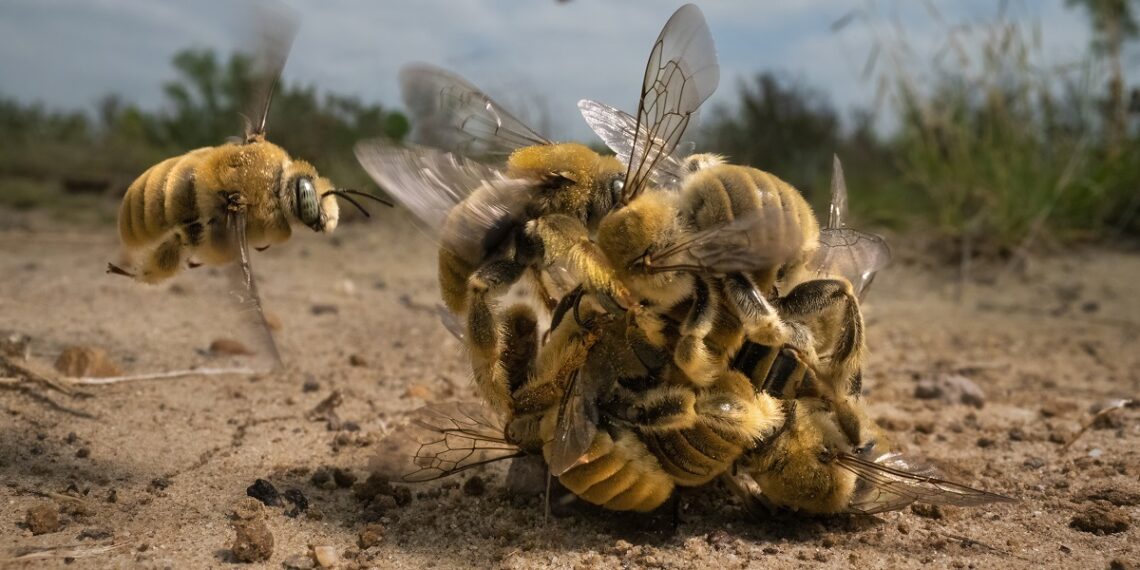
Karine Aigner got close to the action as a group of bees vied to mate. Using a macro lens, she captured the whirlwind of activity of a ball of bees spinning on the hot sand. After a few minutes, the pair at its center – a male clinging to the melee’s lone female – took off to mate.
Bees worldwide are threatened by habitat loss, pesticides, and climate change. Since 70% of bee species nest underground, it is increasingly important that natural soil areas remain undisturbed.
South Texas, USA.
Young Wildlife Photographer of the Year – 15-17 years award – The Beauty of the Baleen by Katanyou Wuttichaitanakorn, Thailand
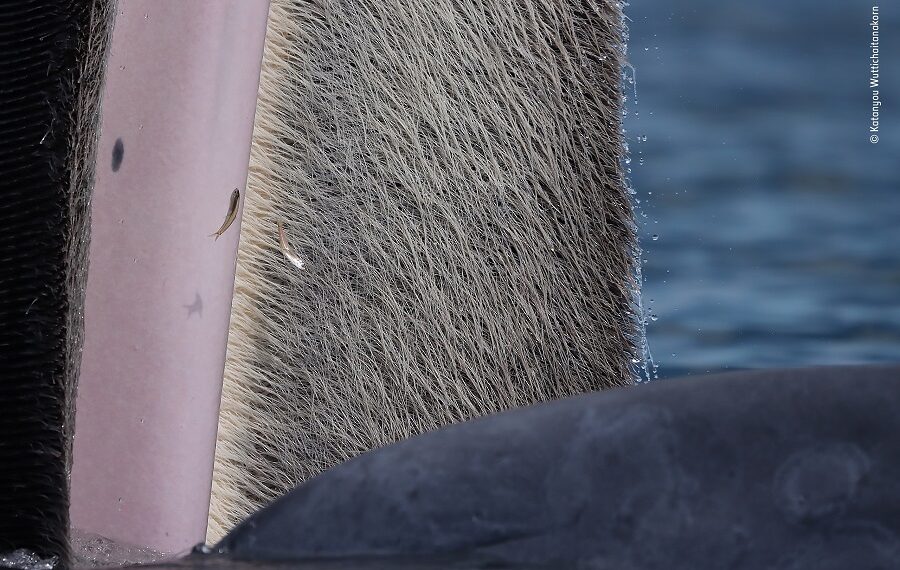
Katanyou Wuttichaitanakorn was intrigued by the contrast of colors and textures of a Bryde’s whale, surfacing nearby. Following government tourism guidelines, the excursion boat Katanyou was on shut its engine when the whale appeared nearby. Katanyou had to stabilize his hands to capture this close-up composition as the boat swayed in the swell. Bryde’s whales have up to 370 pairs of gray-colored baleen plates inside their upper jaws. These plates are made of keratin, a protein that also forms human hair and nails, and serve to filter small prey from the ocean.
Upper Gulf of Thailand, Phetchaburi, Thailand.
Animal Behavior Award – The Thinness of the Spectacled Bear by Daniel Mideros, Ecuador
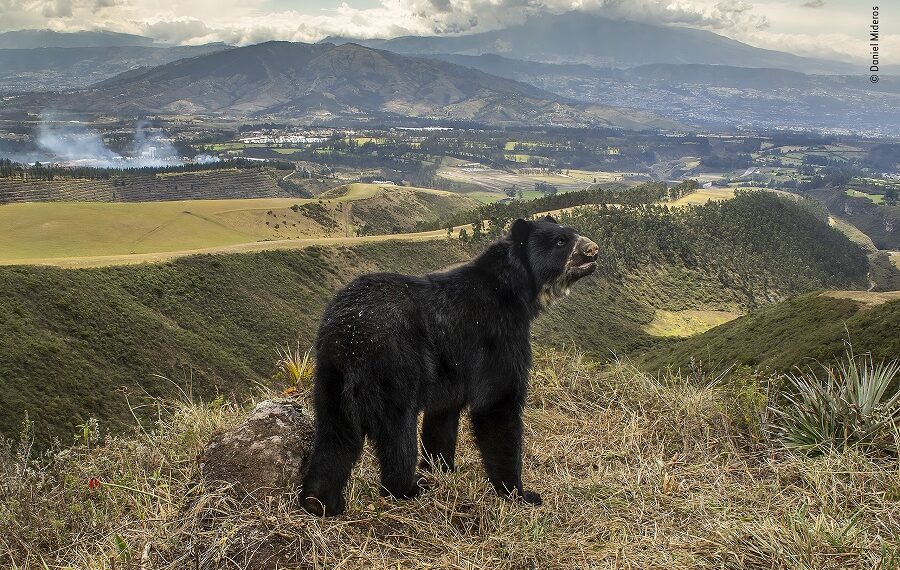
Daniel Mideros paints a poignant portrait of an endangered habitat and its inhabitants. He set up cameras along a wildlife corridor used to reach high-altitude plateaus. He positioned them to show the disappearing natural landscape, with the bear framed at the heart of the image. These bears, found from western Venezuela to Bolivia, have suffered a massive decline due to habitat fragmentation and loss. Worldwide, as humans continue to build and farm, space for wildlife is increasingly reduced.
Peñas Blancas, Quito, Ecuador
Bird Behavior Award – The Listening Bird by Nick Kanakis, USA
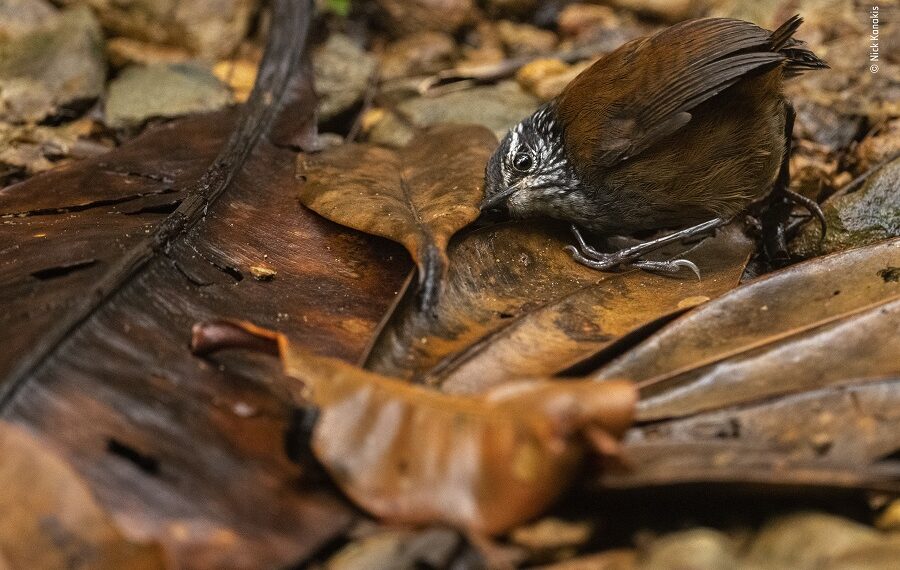
Nick Kanakis glimpses the secret life of wrens. Nick spotted the juvenile gray-breasted wood-wren foraging. Knowing it would vanish into the forest if he approached, he found a cleared corner of dead leaves and waited. Indeed, the little bird hopped into the frame, pressing its ear to the ground to listen for tiny insects.
This prey detection technique is used by other birds, including the blackbird. Gray-breasted wood-wrens are ground-dwelling birds often heard but not seen. They produce loud, melodious songs and raucous calls when hidden in the underbrush.
Tatamá National Park, Risaralda, Colombia
Oceans Award: An Overview – A New Life for the Tohorā by Richard Robinson, New Zealand
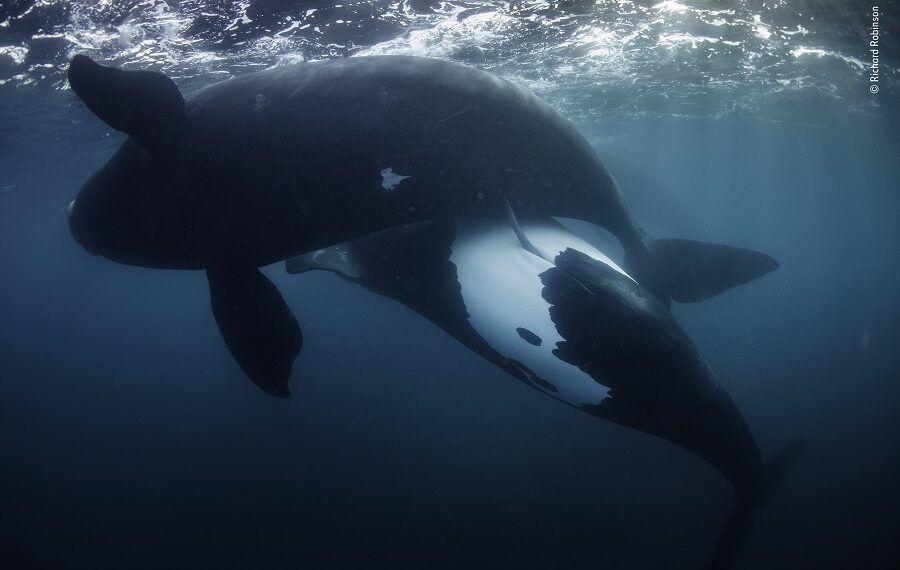
Richard Robinson captured a moment of hope for a whale population that survived against all odds. Hampered by poor visibility, Richard used a pole camera to photograph the whales as they gradually approached his boat. Pushing his camera to its limits in the dark water, he was relieved to find the image very sharp and the moment of copulation crystallized in time. When ready to mate, the female southern right whale turns on her back, forcing the male to extend his penis over the female’s body. Known to the Māori as tohorā, the New Zealand population was hunted to near extinction in the 1800s, so each new calf offers new hope.
Shot under New Zealand Ministry of Conservation permit no. 84845-MAR.
Deas Head, Auckland Islands, New Zealand
Amphibians and Reptiles Behavior Award – The Bat-Snatcher by Fernando Constantino Martínez Belmar, Mexico
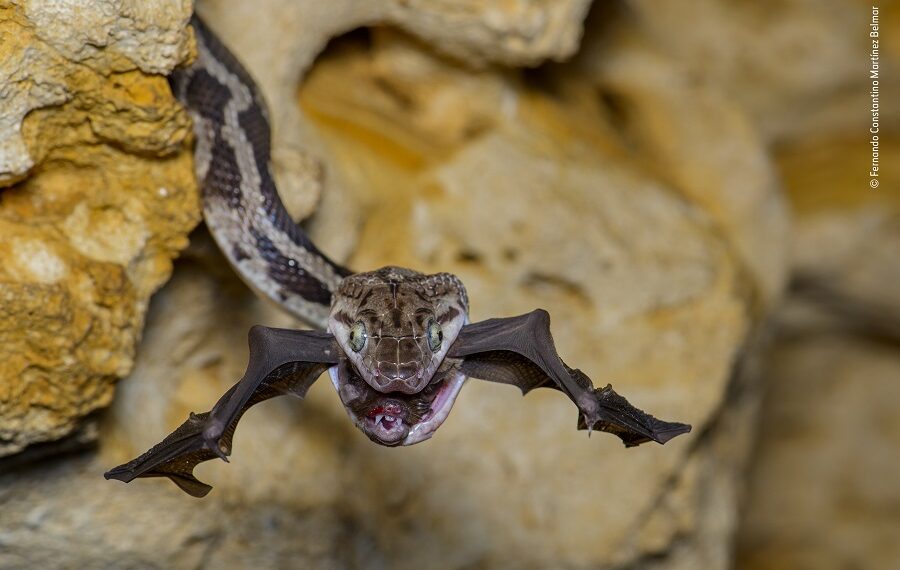
Fernando Constantino Martínez Belmar waits in the darkness for a Yucatán rat snake to snatch a bat. Using a red light that bats and snakes are less sensitive to, Fernando kept an eye on this snake emerging from a crack. He had just seconds to take the photo as the rat snake retreated into its crevice with its prey, a bat. Each evening at sunset in the hanging snake cave, thousands of bats leave to forage for the night. This is also when hungry rat snakes emerge, dangling from the roof to catch their prey in mid-air.
Kantemo, Quintana Roo, Mexico
Natural Art Award – Paradise Pink Flamingos by Junji Takasago, Japan
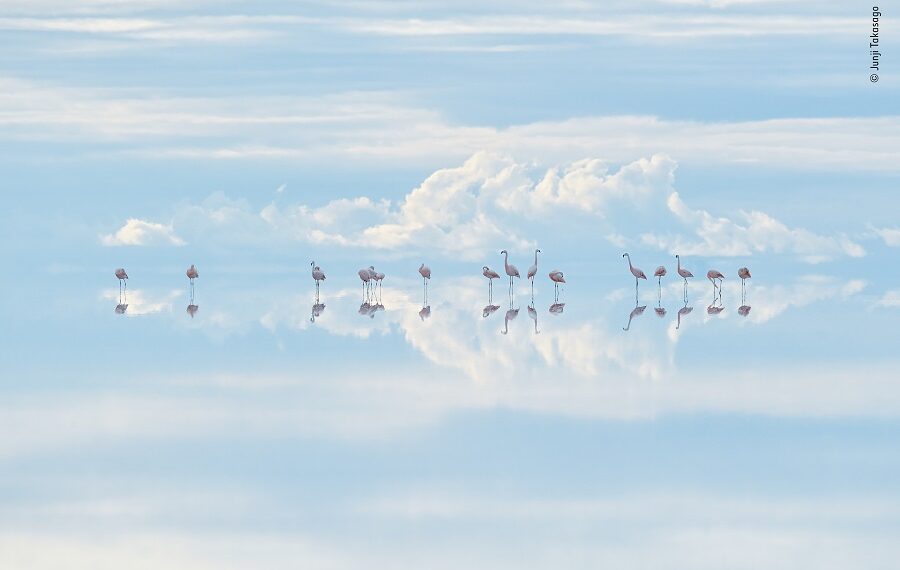
Junji Takasago withstands altitude sickness to produce a dream scene. Junji crawled closer to the group of Chilean flamingos excreting waste. Framing their choreography in the reflection of clouds, he battled altitude sickness to capture this dreamlike scene.
Located in the Andes, the Salar de Uyuni is the world’s largest salt flat. It is also one of Bolivia’s largest lithium mines, threatening the future of these flamingos. Lithium is used in phone and laptop batteries. Together, we can help reduce demand by recycling old electronics.
Salar de Uyuni, Daniel Campos Province, Bolivia
Plants and Fungi Award – Magical Morels by Agorastos Papatsanis, Greece
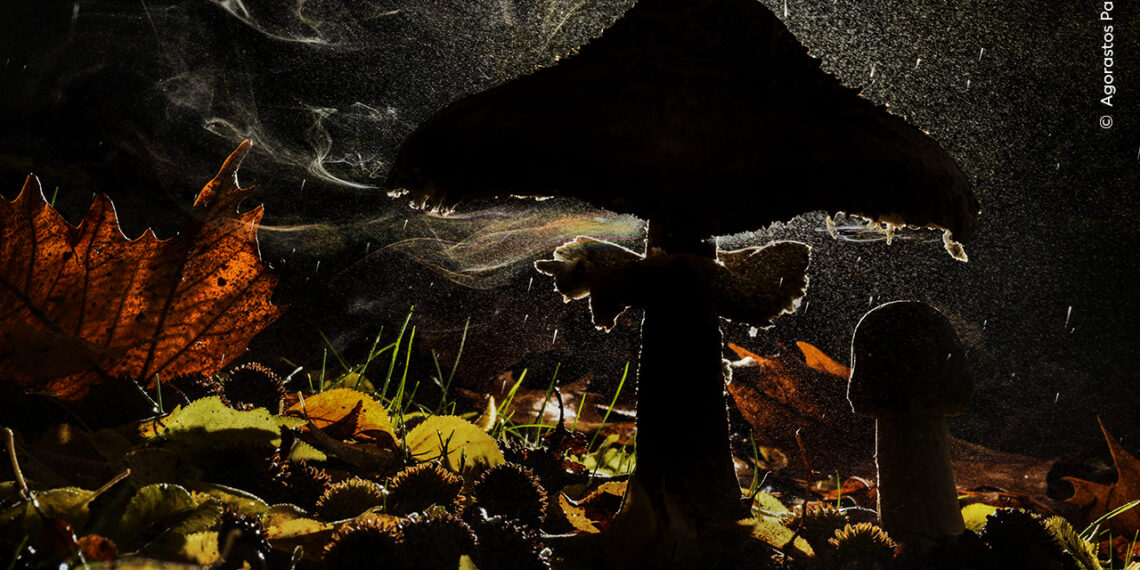
Agorastos Papatsanis crafts a fairy-tale scene in the forests of Mount Olympus. Appreciating the interaction between mushrooms and fairy tales, Agorastos wanted to create a magical scene. He waited for the sun to filter through the trees and highlight the water in the background, then used a wide-angle lens and flashes to highlight the labyrinthine shapes of morels. Morels are considered gastronomic treasures in many parts of the world as they are difficult to cultivate, but in some forests, they thrive naturally.
Mount Olympus, Pieria, Greece
Underwater Award – Shooting Star by Tony Wu, USA/Japan
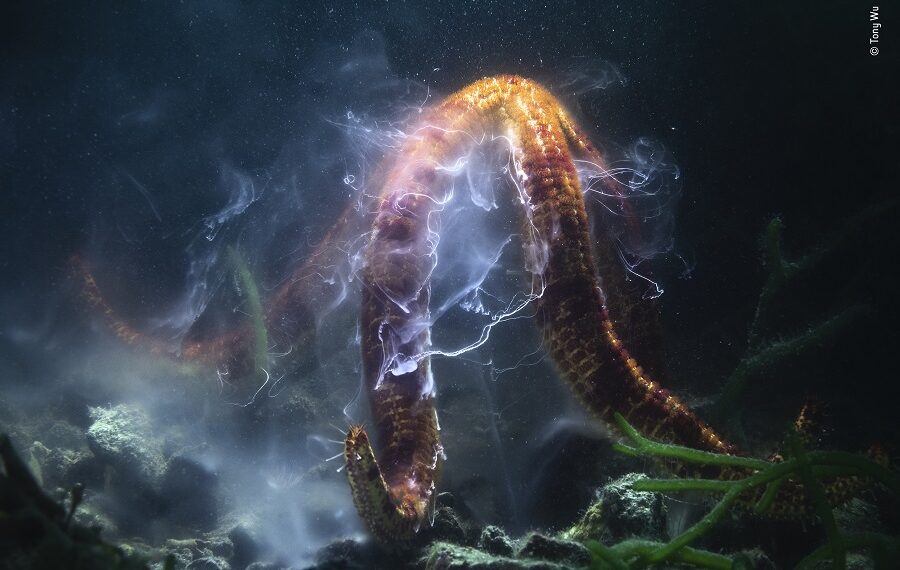
Tony Wu observes the electrifying reproductive dance of a giant starfish. As the surrounding water filled with sperm and eggs of spawning starfish, Tony faced several challenges. Stuck in a small enclosed bay with only a macro lens to photograph the small subjects, he backed away to fit the undulating starfish into his field of view, in this galaxy-like scene.
The « dancing » posture of spawning starfish, which rise and sway, can help release eggs and sperm or carry eggs and sperm into currents, where they fertilize together in the water.
Kinko Bay, Kagoshima Prefecture, Japan
Wetlands Award – An Overview – The Dying Lake by Daniel Núñez, Guatemala
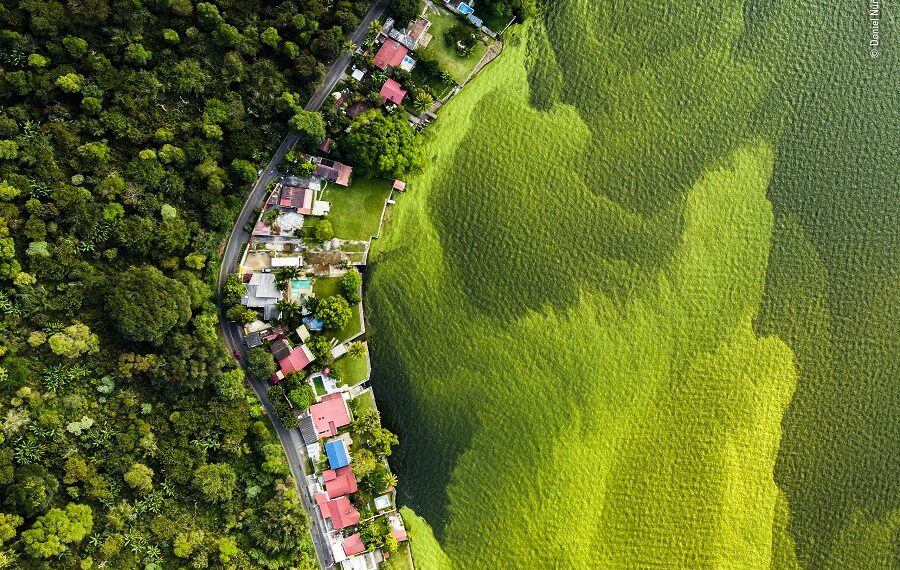
Daniel Núñez uses a drone to capture the contrast between the forest and algae growth on Lake Amatitlán. Daniel took this photo to raise awareness of the impact of Lake Amatitlán’s pollution, which receives about 75,000 tons of waste annually from Guatemala City. It was a sunny day with perfect conditions, he says, but it is a sad and shocking moment.
Cyanobacteria thrive in the presence of pollutants such as sewage and agricultural fertilizers, forming algal blooms. Efforts to restore the Amatitlán wetland are underway but have been hampered by a lack of funding and allegations of political corruption.
Lake Amatitlán, Villa Canales, Guatemala
Portfolio Award – « Under the Antarctic Ice » by Laurent Ballesta, France
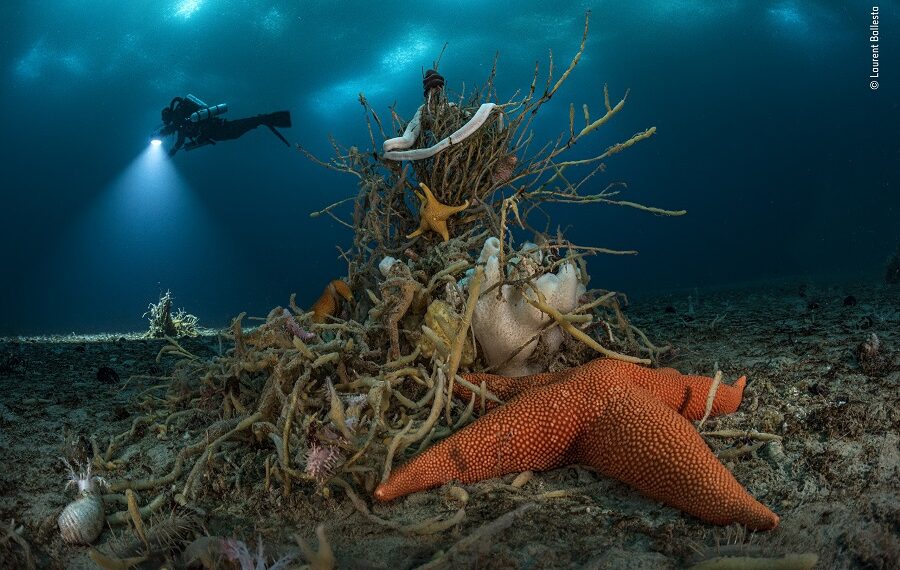
Pyramid of life
Living towers of marine invertebrates punctuate the seabed off Adélie Land, 32 meters under the ice of East Antarctica. Here, center stage, a tree-shaped sponge is draped in life, from giant ribbon worms to starfish.
The story behind the portfolio:
Laurent Ballesta endures icy dives to reveal the diversity of life under the Antarctic ice. A photographer and marine biologist, Laurent has led a series of major expeditions, all involving scientific mysteries and diving challenges, and all resulting in unprecedented images. He has won multiple Wildlife Photographer of the Year awards, including the Grand Title in 2021.
His Antarctic expedition, discovering its vast marine biodiversity, required two years of preparation, an expert diver team, and specially designed equipment. His 32 dives in water that can drop to -1.7˚C include the deepest and longest dive ever made in Antarctica.
Adélie Land, Antarctica