


The common wrasse (Coris julis), a small fish with colorful stripes, is so much part of the scenery during our dives that we often forget to mention its observation. Yet, even with common things, it’s not uncommon to discover unknown peculiarities!
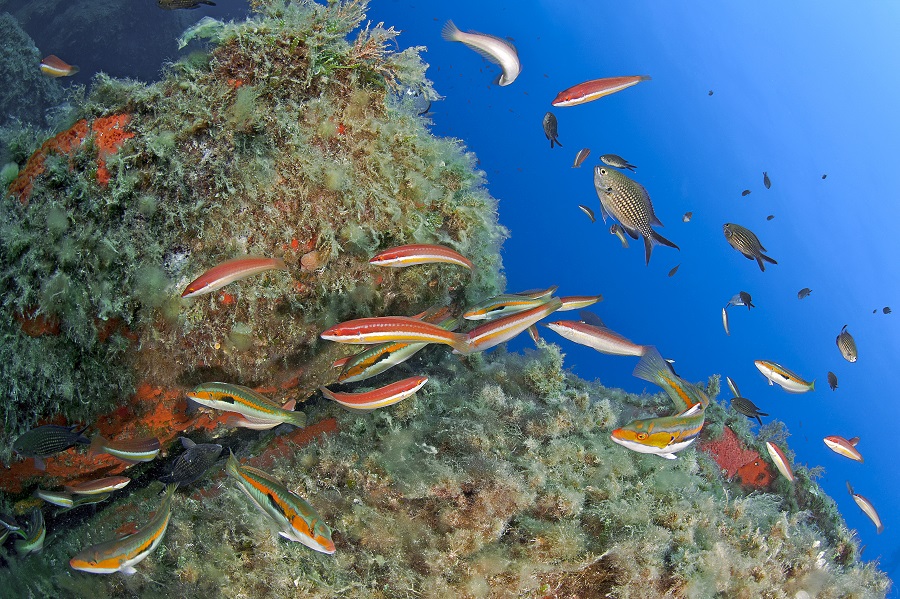
1 – Life in colors: called in English the « rainbow wrasse », it has an elongated, slender body, 15 to 25 cm long. The wrasse is recognizable by the red colored stripes separating the horizontal white stripes on its body. The females are rather « dull » (to avoid attracting attention and being eaten) while the males dress in brighter colors (to attract attention): the « royal wrasses »! Beware, the « peacock wrasse » or « Turkish wrasse », with its bluish spots, shiny yellow and green vertical stripes, often lives among groups of common wrasses.2 – Common, but not so visible: the common wrasse is present in large numbers, but an individual is difficult to observe. Indeed, a wrasse may circle us (out of marked curiosity but mainly to take advantage of what we move) and then appear motionless and flee quickly at the slightest glance. Many wrasses are only quickly glimpsed, so we can only recognize a general shape without distinguishing particular points. That’s why many elongated fish about twenty centimeters long are called « wrasses »…3 – Invisible even: if you have done night dives and/or winter dives, the landscape changes greatly precisely by the absence of wrasses. But where are they? Under the sand! The wrasse digs into the sand with movements of its tail, makes a nice hole and hides in it, without moving. A good way to sleep peacefully at night out of sight and hide when a predator is in view. It’s also quite insulating for the winter!4 – They are everywhere: the wrasse lives on the Mediterranean coasts but can also be seen sometimes in Brittany and even further north up to Scotland, or south along the coasts of the Cape Verde islands, Canary Islands, and Azores. The wrasse is not confined to one type of habitat and lives in rocky, sandy bottoms, and coastal meadows (especially the young, protected in the posidonia meadows), between 0 and 120 meters deep, whether near ports or in protected parks. Dive into the water along the coast, and you’ll surely spot them.5 – At the table! it feeds on pieces of sea urchins, small shrimp and other crustaceans, marine worms, and mollusks like top shells, nassas, moon snails, etc., just like mussels or other bivalves. It turns out to be a large opportunistic predator, with its large teeth. This is one of the peculiarities of its genus (Labridae), as wrasses have fleshy lips (labrum in Latin) clearly visible, often revealing their dentition.6 – Let’s talk about reproduction: from April to September, males become really bright and seek to reproduce at all costs. Females lay their unfertilized eggs when stimulated, and the dominant male (or sometimes opportunists…) covers them with their seed in external reproduction. The eggs are left to float, serving as food for most, but the lucky survivors will mature after a year. Like many species, the wrasse changes sex once in its life. It transitions from female to male (protogyny).7 – Harem: wrasses live in small groups… But rather restrictive. A very dominant male keeps a « harem » of females. There are few other « young opportunist males » around, not because they are repelled, but mainly because the male emits signals blocking the passage of females to the male sex. When the male dies, without inhibitory signals, the oldest female in the group begins her transformation into a male.8 – Tired: it’s not just a change in color, but the internal organs must also change, and it requires energy. For several weeks, the wrasse « in transformation » is so weak that it moves very little, so little that it could be eaten, and therefore hides as much as possible before coming out with new livery.9 – Marie Girelle: in the Hauts-de-France, near Dunkirk, a mermaid-witch child-eater was called as such in popular tales. Getting too close to the marsh waters, one could be devoured… But what’s the link with marine wrasses then? Who knows… Maybe it’s best not to get too close to inquire…10 – Diversity and confusion: many species are called « wrasses » worldwide. The general shape is similar, and their habits are often the same due to their common origins. One must not confuse Coris julis with the « wrasse » of Mauritius Halichoeres hortulanus, nor with the Latin genus Girella of the Pacific (family Kyphosidae). However, royal wrasses and common wrasses represent one and the same species, called in many ways in the south of France: demoiselles, jouriol, julie…
Jérémy Delille
https://vimeo.com/486031279.
