


Diving with gas mixtures other than air involves various techniques, including Nitrox diving (oxygen-enriched air), Heliox (oxygen and helium), Trimix (oxygen, helium, and nitrogen), as well as pure oxygen. These dives can be conducted in open circuit or with rebreathers. They are subject to specific regulations.
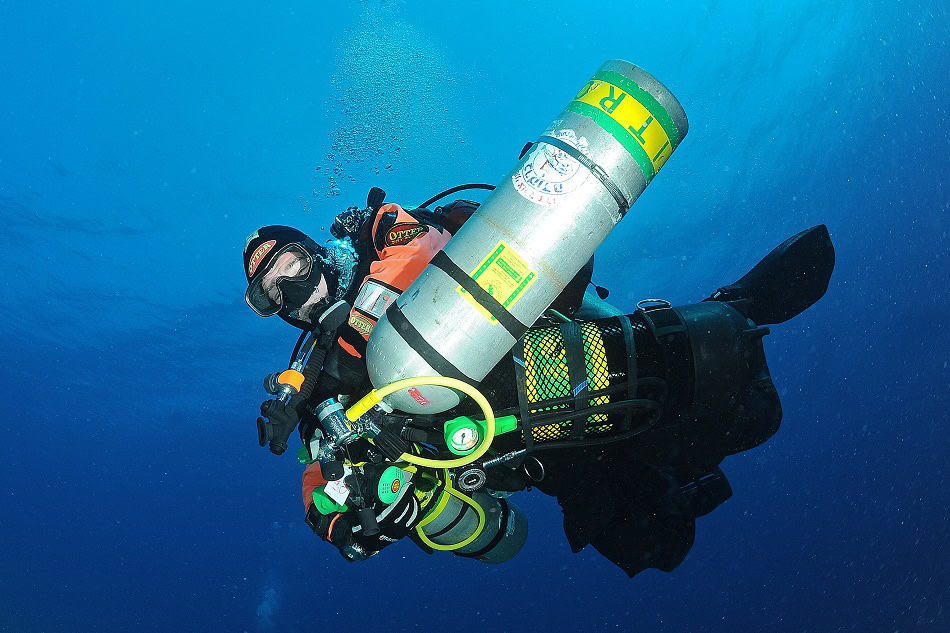
Cylinder labeling
To avoid potentially deadly confusions, each diving cylinder must clearly display the gas it contains. This must be done visibly and indelibly, without any possibility for ambiguity. The regulations do not prescribe a specific labeling method; adhesive tape or a sticker is sufficient. In the case of argon, a neutral gas used in dry suits for thermal comfort, it is recommended to include ‘not breathable’ along with its name.
Register
All facilities (clubs, companies, freelancers) conducting dives with gas mixtures other than air must maintain a register to ensure the traceability of the cylinders used.
Double gas analysis
The manufacturer of the gas and the end user must confirm the composition of the breathing mixture. Each cylinder must display the following information on its identification sheet and in the register:
- Analyzed oxygen fraction and theoretical composition of the mixture.
- Date of the analysis.
- Name of the manufacturer or distributor.
Before diving, the user must fill out the identification sheet with:
- The pressure of the gas mixture in the cylinder.
- The analyzed oxygen fraction and composition of the mixture.
- The maximum operating depth of the mixture.
- The date of the analysis.
- His name or initials.
For Nitrox dives, the maximum operating depth (MOD) depends on the oxygen fraction in the mixture, usually between 1.3 and 1.5 bar, with 1.6 bar being the accepted limit. Dive computers facilitate this calculation. Regarding helium diving, the regulation does not account for some mixtures being hypoxic and thus not breathable before a certain depth. The regulation only requires that the partial pressure of oxygen be at least 160 hectopascals (0.16 bar).
Diving cylinders
Diving cylinders, whether in open or closed circuit, must be suitable to accommodate different types of breathing gases other than air. Therefore, they must bear the label ‘Breathing Gas’ with the classification ‘G1’ or ‘GROUP 1’.
Collective Safety Equipment
It is indispensable to have at least one emergency cylinder with breathing regulators available for dives with gas mixtures other than air, its content adapted to the type of dive. It is not necessary to have an emergency cylinder for every mixture inhaled, but rather one cylinder per mixture that can be used for decompression phases.
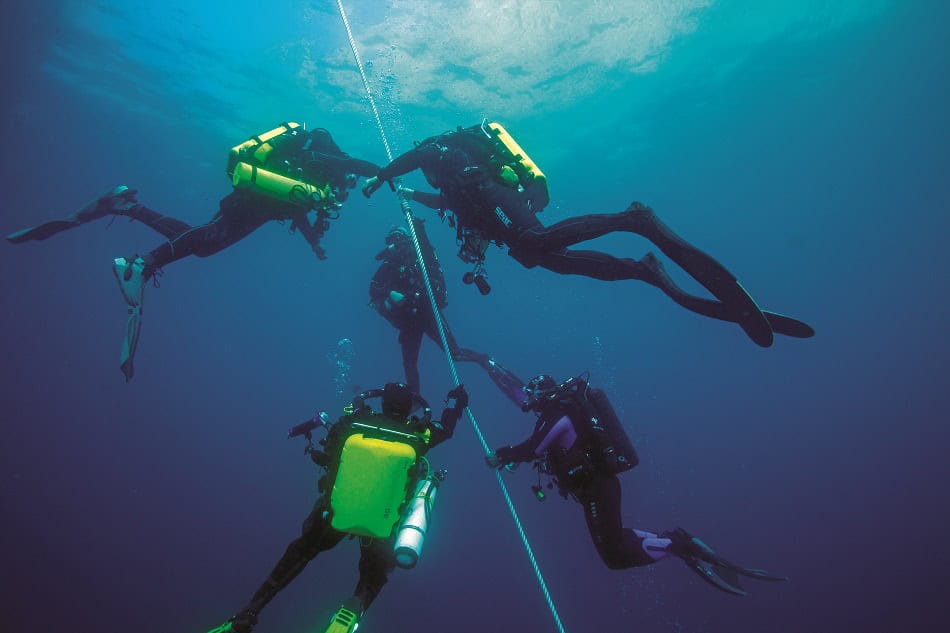
For Trimix and Heliox dives, additional equipment must be available at the deployment site:
- A weighted descent and ascent line, which can be used for decompression.
- A copy of the dive plans.
- Logistical support or a boat with a qualified surface operator.
The levels
The regulation defines two levels for Nitrox divers and three levels for Trimix or Heliox divers:
- Nitrox Diver (PN) : can dive in groups with a Nitrox mixture up to 40%.
- Experienced Nitrox Diver (PN-C) : in addition to the PN authorizations, they can conduct their decompression with highly enriched Nitrox (more than 40% O2) or pure oxygen.
For Trimix and Heliox, the levels are:
- Trimix Heliox Diver (PTH) : authorized to dive to 40 m (PTH-40), 70 m (PTH-70), or 120 m (PTH-120).
Group leader
If the group includes a diver breathing Nitrox, the group leader (guide or instructor) must mandatorily hold the PN-C qualification. For Trimix or Heliox dives, the requirements are stricter:
- In teaching: at least E3 + PTH-70 for depths of 0 to 40 m; E4 + PTH-120 for depths up to 80 m.
- In exploration: at least E3 + PTH-40 for 0 to 40 m; E4 + PTH-70 for 0 to 70 m; E4 + PTH-120 for 0 to 80 m. Dives over 80 m must be conducted autonomously, with a limit of 120 m.
The Diving Director (DP)
The DP for Nitrox dives must mandatorily hold the PN-C qualification. For Trimix or Heliox dives, the DP must be at least E3 + PTH-120 for depths up to 40 m in teaching and 70 m in exploration. Beyond this, he must be E4 + PTH-120.
Rebreather
Four conditions are required to dive with a rebreather:
- The rebreathers used must comply with current regulations and be marked with ‘CE’ for the European Union, including personal and loaned units.
- The diver must have completed valid training recognized by French training organizations (FFESSM, FSGT, ANMP, SNMP, UCPA) or by the manufacturer.
- The diver must demonstrate competence for the dive area and mixtures used.
- For rebreather dives over 6 m, each diver must possess an ‘open breathing system as an emergency device’ to safely return to the surface. In a natural environment, if the guide uses a rebreather, the emergency system must be independent of this device.
This article, originally written by Alain Foret for the print edition of Plongez!, was adapted for the web.
Title image © Nicolas Seksik