


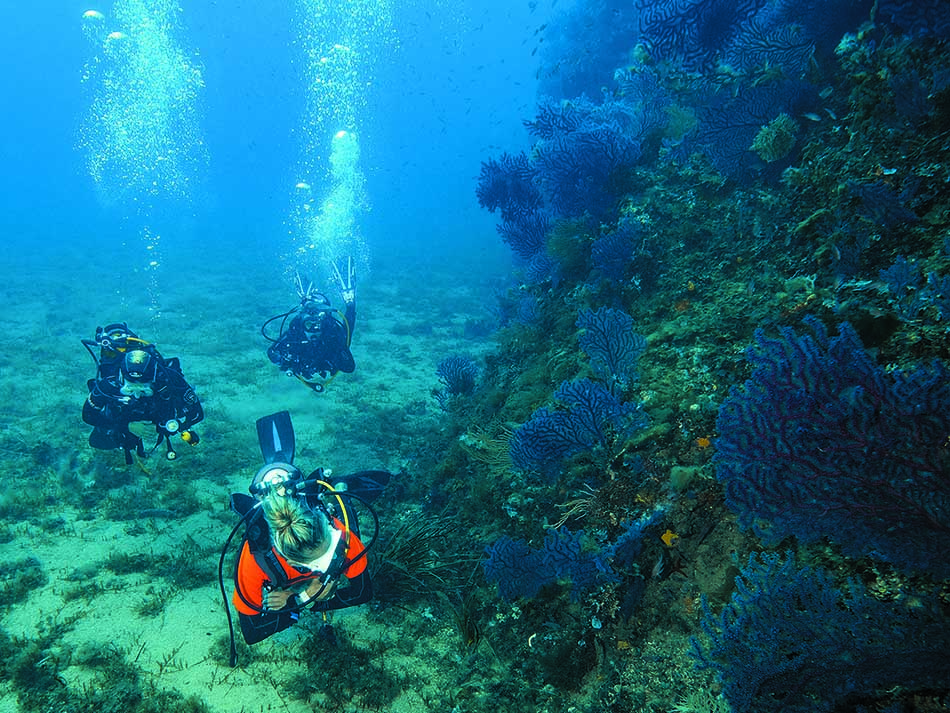
A dive group leader is essential for guiding exploratory dives. His main mission is to ensure that aspects of the dive, such as depth, route, and duration, are suited to the circumstances and abilities of the participants. He leads the dive group during immersion and is responsible for managing the dive. Let’s look in more detail at this crucial role.
Level 4 diver, dive group leader and guide
The term « dive group guide » encompasses teachers, such as instructors and lesson leaders, as well as dive group guides (DG). In France, the DG must be a level 4 diver.
Exploratory dives
The prerogatives of the DG are exclusively limited to exploratory dives. These dives do not include any form of teaching, thus excluding training, assessments, refreshers, and introductory dives. For example, simply clearing a mask at the beginning of a dive is considered a teaching act.
Prerogatives of the dive group guide
Besides his autonomous prerogatives, a DG supervises exploratory dives and can assist teachers without performing teaching acts. In these cases, he must monitor the dive group members when the teacher performs technical actions with one of them.
The level 4 guide in exploration
During exploratory dives, a DG can guide:
- 1 to 4 beginners between 0 and 6 m. These divers are not in introductory mode, but in training, considered fit by their instructor to undertake exploratory dives.
- 1 to 4 PE12 divers between 0 and 12 m.
- 1 to 4 level 1 divers (PE20) between 0 and 20 m.
- 1 to 4 level 2 divers (PE40) between 0 and 40 m.
*Note: it is possible to add an additional dive group guide, for example, to act as a tail-end.
Accompany teachers
Optionally, a dive group guide (P4) can accompany a teacher during outdoor training:
- 1 introductory dive supervised by an E1 between 0 and 6 m;
- 1 to 4 beginners supervised by an E1 between 0 and 6 m;
- 1 to 4 divers in PE12 or PA12 training (level 1) supervised by a minimum of E2 between 0 and 12 m;
- 1 to 4 divers in PE20 training (level 1) or PA20 (level 2) supervised by a minimum of E2 between 0 and 20 m;
- 1 to 4 divers in PE40 training (level 2) or PA40 supervised by a minimum of E3 between 0 and 40 m.
The case of the introductory dive in an artificial environment
An introductory dive is considered a teaching act and, as such, is in principle excluded from the prerogatives of a DG. However, an exception is provided for swimming pool or pit dives up to 6 m, where the dive director (DD) can authorize a DG to conduct introductory dives. Although not specified, it is logical for these guides to have received appropriate training.
Dive group guide and mixtures other than air
When using mixtures other than air, the dive group guide must possess the necessary skills for their use, even if he does not apply them. For nitrox dives, the Sports Code specifies that the guide must be a Confirmed Nitrox Diver (PN-C).
Information for the dive group guide
The DG must be aware of the information provided by the DD on the dive group’s safety sheet. This data (duration, depth) serves as maximum limits. Additionally, the DG should know the rescue plan.
An adaptation to diving circumstances
Even though the DD’s instructions (duration, depth, route) must be respected, a dive group guide is not required to comply entirely. However, he must adjust to circumstances, which may include:
- Reducing the depth and duration of immersion in case of current or cloudy water.
- Modifying the route or reducing the distance traveled.
- Planning for special equipment (lamp, extra weight).
- Requesting a smaller dive group.
- Interrupting the dive if necessary.
An adaptation to the divers’ abilities
The adaptation must also consider the participants’ abilities. The legislator refers to « abilities » rather than « diplomas ». A level 2 diver who has not dived in a long time may be less competent than a level 1 who dives regularly.
Therefore, a dive group guide must carefully observe his group’s members to quickly assess:
- Their physical condition.
- Their psychological state.
- Their technical skills.
- Their equipment, notably weighting.
Some signals can be detected on the surface, such as excessive fatigue or sweating, indicating poor condition. Observing behaviors may also reveal stress or ease levels. The way they equip themselves gives clues about their technical skills. These observations can be supplemented by dialogue with the divers.
Underwater, the DG must remain attentive to the divers’ behavior to adjust the dive if necessary.
Mandatory equipment for the dive group guide in a natural environment
In a natural environment, the DG must have at least the following equipment:
- An inflatable system with compressed gas to surface (usually a vest with a direct system).
- Equipment to monitor characteristics of the dive and manage the ascent. A dive computer is required. If a computer is used to manage the dive group’s desaturation, it must follow each diver’s profile. Vigilance is needed to ensure no diver exceeds the authorized depth.
- Diving equipment with two independent exits.
- Two complete regulators. The guide must have two regulators connected to each outlet of the tank.
- A pressure gauge or equivalent.
- A deco buoy per dive group.
Are « Dive Leaders » or « Divemasters » considered « dive group guides »?
The « Dive Leader » or « Divemaster » has prerogatives and responsibilities different from those of a DG. They cannot be considered equivalent.
Recognition internationally
The level 4 dive group guide is recognized as a 3-star CMAS diver. In the international context, a guide is classified as 3-star. The fact that a French level 3 diver also obtains 3 stars constitutes an exception from CMAS, outside of its standards.
This article, originally written by Alain Foret for the print edition of PLONGEZ!, has been adapted for the web.
Photos © Nicolas Barraqué.