


Discover the Aluterus scriptus, a fascinating fish. This Tetraodontiform, with its unique appearance, captivates divers and underwater photographers. Its common name, ‘scribbled filefish,’ perfectly describes its physical peculiarities.
Habitat and Distribution
The scribbled filefish, also known as the scrabble or writing board, favors the walls of reef areas. It is found in the tropical and subtropical waters of the Atlantic, Indian, and Pacific Oceans. This semi-pelagic fish, often discreet, swims in open water, between 2 and 80 meters deep, near the coasts. Its presence is also noted in the Red Sea, the Antilles, French Polynesia, New Caledonia, and Reunion Island.
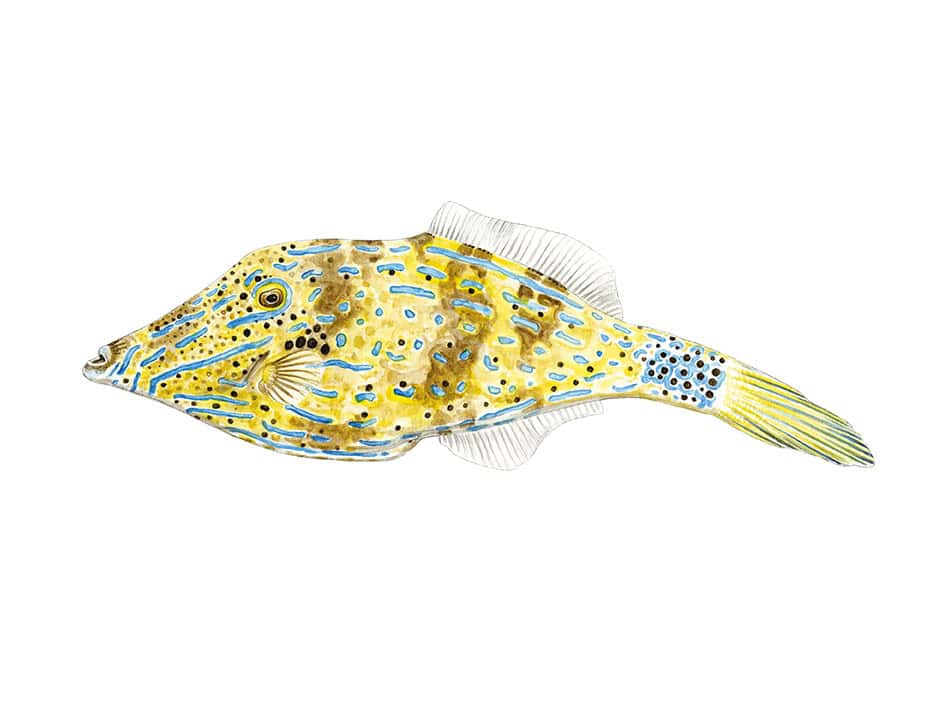
Physical Description
Its average size is 60 cm, but it can exceed a meter. Its oval, elongated body, laterally compressed, displays a changing color, from beige to olive-brown, or even gray, depending on its state and environment. Its nickname ‘scribbled’ comes from its coat adorned with irregular lines, blue dots, and black spots. Its skin, rough like a file, is due to the absence of protective mucus and its scales transformed into small spines. It has a pointed snout with a small mouth equipped with pointed teeth. Two erectable spines rise above the eyes, the first long and thin, the second used to lock the first when it is raised. The large, fan-like caudal fin ensures its movements through undulation.
Behavior and Habits
This solitary fish appreciates the coastal reef. It is rarely seen in groups or pairs and shows no apparent sexual dimorphism. Active during the day, it is a calm swimmer and harmless to divers. Photographing the filefish from the side can be tricky, as it often moves head-down or swims sideways when approached.
Feeding and Reproduction
Omnivorous, it feeds on a variety of elements: plants, invertebrates, small crustaceans, fire coral, gorgonians, anemones, tunicates, and sponges. Its reproduction is particular. In subtropical zones, females can release their eggs in open water. However, the usual strategy is laying eggs in a nest prepared by the male, who then guards it, alone or with the female.
Anecdotes and Particularities
- Filefish: Once dried, its skin was traditionally used as sandpaper.
- Mimicry: It changes color to blend in with the corals and escape its predators.
- Etymology: Aluta (Latin) means leather, purse, and scriptum means written.
- In pajamas: At night, it displays dark and light vertical stripes.
- Demersal: It frequents the seabed without living there permanently, unlike pelagic fish.
- Toxic or edible: Paradoxically, it is considered toxic in French Polynesia (ciguatera) but commercially fished in Australia and Japan.
The Scribbled Filefish and the Monacanthidae Family
The scribbled filefish belongs to the Monacanthidae family, of the Tetraodontiformes order. This order includes about 360 species, mainly marine and reef-dwelling. Among the Tetraodontiformes are well-known species such as triggerfish, porcupinefish, pufferfish, boxfish, and ocean sunfish (Mola mola).
The etymology of Monacanthidae comes from the Greek ‘mono’ (single) and ‘akantha’ (spine). The Monacanthidae, also called filefish or leatherjackets, are bony fish closely related to triggerfish. Their main characteristic is a solid, erectable dorsal spine on the head, used to impress, defend, or cling to rocks. Aluterus scriptus is the largest species (up to 110 cm), while Rudarius minutus is the smallest (5 cm).
This article, initially written by Jean-Christophe Grignard for the print edition of PLONGEZ!, has been adapted for the web.
Image © Jean Christophe Grignard, Illustration © Cyril Girard.