


On the occasion of World Oceans Day, Emmanuelle Périé-Bardout and Ghislain Bardout announce the end of the Under The Pole III expedition, after four years of underwater explorations from the Arctic to French Polynesia. They are now turning towards the new program Under The Pole IV: Deeplife, which will accompany the United Nations Decade of Ocean Science for Sustainable Development. From 2021 to 2030, in partnership with scientific teams from around the world, Deeplife will be dedicated to exploring the mesophotic zone of the oceans up to 200 meters deep, for scientific knowledge and preservation. To achieve its objectives, Under The Pole is launching the construction of a new oceanographic sailboat, specially designed for deep diving and scientific needs.From the Arctic to French Polynesia, 4 years of scientific exploration of the Mesophotic zone. In May 2017, the schooner Why left Concarneau for the third installment of the Under The Pole expeditions. Emmanuelle and Ghislain Bardout, accompanied by a multidisciplinary team, roamed the west coast of Greenland and crossed into the Pacific through the mythical Northwest Passage. After an initial study on natural fluorescence in the Arctic, the team conducted a vast scientific program in French Polynesia in collaboration with researcher Laetitia Hédouin and in partnership with CRIOBE/CNRS. This mission, called « Deephope, » aimed to inventory the diversity of mesophotic corals, understand their ecological characteristics, and their ability to adapt to climate change. The mesophotic zone represents hope for surface reefs largely impacted by global changes. To this end, the expedition members dove over 1000 times in the waters of the five archipelagos, collected over 6000 samples, harvested the deepest photosynthetic coral in the world, and discovered a new coral species. The partnership between CRIOBE/CNRS and Under The Pole enabled both organizations to unite their forces to carry out an ambitious and highly productive program in terms of scientific results.
In continuation of this program, the team completed the « Capsule » mission in Moorea, a true autonomous underwater habitat dedicated to underwater observation and science, allowing divers to live and work under the sea for several days. A promising experiment set to continue with Under The Pole with a second Capsule.
https://www.youtube.com/watch?v=ZDOyZ7-T2moLe Why II, a new oceanographic sailboat dedicated to deep scientific diving. In 2021, the UN proclaimed the United Nations Decade of Ocean Science for Sustainable Development. This opportunity resonates with the objectives of Under The Pole: drawing on its experience of expeditions and deep scientific diving in hard-to-reach areas, Under The Pole is launching the Deeplife research program 2021-2030 starting this year. It will focus on the exploration of the mesophotic zone of the oceans up to 200 meters deep, a largely unknown area although playing a fundamental role in the balance of the oceans.
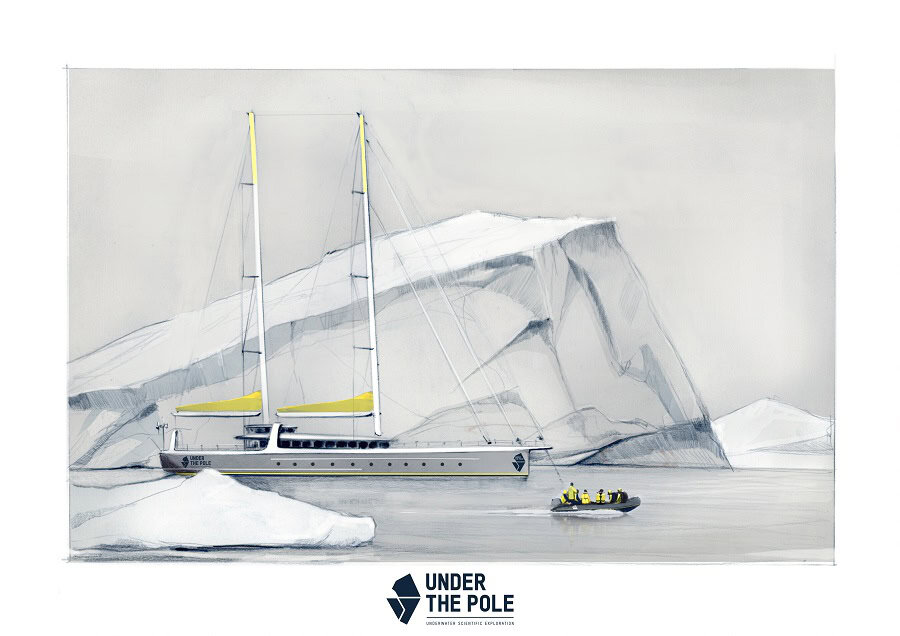
Inspiré du modèle de collaboration fructueux mis en place sur les récentes expéditions, Deeplife s’appuiera sur des partenariats scientifiques solides et internationaux. Afin de répondre au mieux aux besoins des scientifiques, Under The Pole va se doter d’un nouveau navire d’exploration, le Why II. A true operational pivot for upcoming expeditions, this sailboat thus includes means of in situ experimentation with a marine biology laboratory, high operational capability in deep diving, adapted workspaces, and maximum safety level, designed to navigate all oceans in any season. Under The Pole aims to launch the Why II in 2023. In the meantime, the team plans three scientific missions in 2022-2023, in the Svalbard archipelago, Canary Islands, and the Caribbean.
« »Human exploration of the underwater environment, a source of prodigious inspiration and an indispensable tool for a proper understanding of the oceans, is a powerful lever for the emergence of a sustainable world. » Emmanuelle PÉRIÉ-BARDOUT & Ghislain BARDOUT
Key figures of the Under The Pole III expedition
4 years of expedition25000 nautical miles covered
More than 100 crew members12 scientific studies
Sampling record at 172 m depth