


On June 6, 1944, D-Day marked a decisive turning point in modern history, with thousands of ships participating in the assault on the beaches of Normandy. Among the remnants of this operation, the wreck of the minesweeper M-39 now rests on the seabed, bearing witness to the events that took place at that time.
History of the M-39
The M-39 is a German minesweeper of the M35 type, whose name literally means « boat that searches for mines. » Launched on August 8, 1941, and commissioned on May 5, 1942, it initially operated in the Atlantic before moving to the English Channel to escort convoys. Unfortunately, on May 24, 1944, it was torpedoed by a British motorboat off Juno Beach, breaking in two and resulting in the death of seven crew members.
Diving on the Wreck
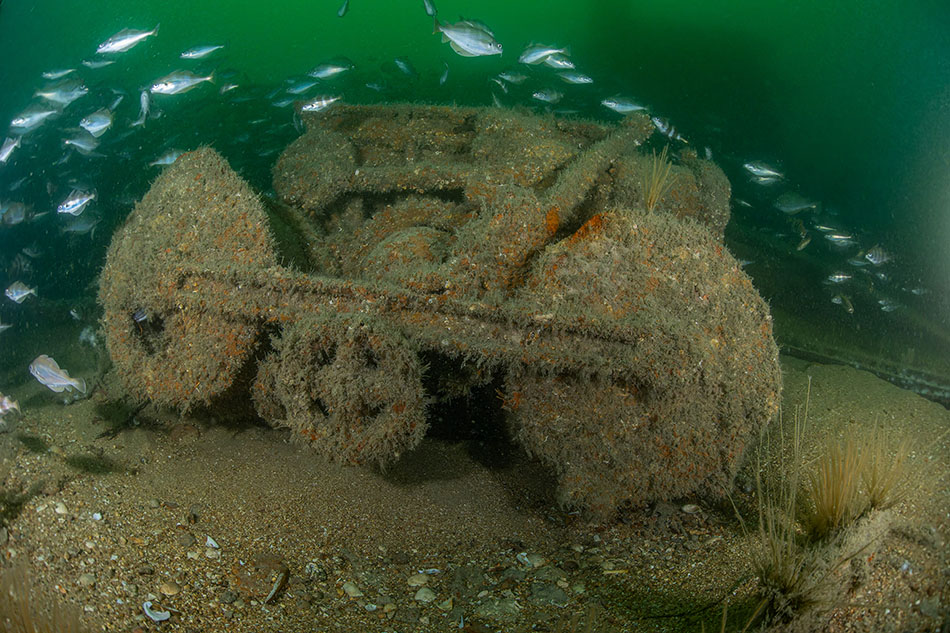
Located 8 miles north of Courseulles-sur-Mer, the wreck of the M-39 lies at a depth of 36 meters during high tides. The ship is broken into two parts forming a tight V: the stern is tilted to port, while the bow is flat.
Dive Details
- Required Level: Diving is reserved for level 2 divers or PE 40.
- Access to the Wreck: The descent is usually made at the level of the two propellers and their rudders. With good visibility, it is possible to observe the entire wreck.
- Exploration: Divers can pass under the lowest propeller and navigate between the two parts of the ship. A major point of interest is the cannon located at the rear, which points towards the sand.
Over the years, the M-39 has become an artificial reef, hosting a rich marine life. Divers can observe schools of fish, crustaceans, and anemones.
Memorial Site
The wrecks from the 1944 landings remind us of the sacrifices made for the liberation of Europe. Their preservation is crucial for passing on the memory of this event to future generations. Divers and historians are interested in these remnants to better understand the unfolding of D-Day.
Conservation and Challenges
Scientific expeditions and underwater mapping missions are regularly organized to document these wrecks. However, corrosion and ocean currents threaten their integrity. Additionally, some ships still contain pollutants, posing challenges for their conservation.
Each year, ceremonies and commemorations are held in Normandy to honor the memory of the soldiers who fell in battle. The seabed, silent yet rich in history, reminds us of the importance of this day that changed the course of the world.
Characteristics of the M-39
- Length: 68.40 meters
- Width: 8.70 meters
- Draft: 2.65 meters
- Speed: 18 knots
- Engines: 2 Lenz SE turbines, 2 Wagner boilers
- Armament:
- 2 105 mm guns
- 2 37 mm AA guns
- 2 20 mm AA guns
- 30 mines
- 2 launchers for 20 depth charges
Practical Information
The best time to explore the wreck of the M-39 and other wrecks in the area is between August and November, when visibility conditions are optimal. The Caen-Ouistreham Diving Club regularly organizes trips to these wrecks departing from Ouistreham. For more information, you can register on their site: Caen-Ouistreham Diving.
To Discover Nearby
To extend your immersion in the history of the conflict, here are some visit ideas:
- Juno Beach Centre in Courseulles-sur-Mer: dedicated to the memory of the 45,000 Canadians who died during World War II, including 5,500 during the Battle of Normandy.
- Caen Memorial: a place that traces not only World War II but also the entire European history of the 20th century.
- Arromanches Jetty: an artificial port created to facilitate the Allied landing.
These sites enrich the experience of divers and visitors while honoring the memory of significant historical events.
This article, originally written by Ludovic Madelaine for our print edition, has been adapted for the web.
Photos: Ludovic Madelaine