


A Caribbean reef shark, or Caribbean reef shark is neither a reef shark (C. amblyrhincos – blacktail reef shark which is more in the Indian and Pacific Oceans), nor a grey shark (C. plumbeus – short and stout). The names sound similar, but Caribbean grey sharks, and those of the Brazilian coasts, have very particular behaviors.
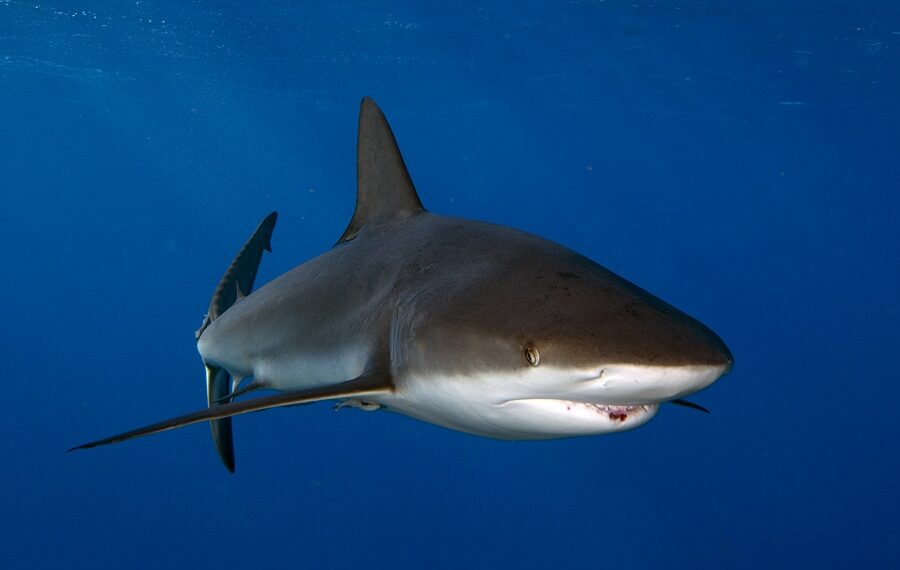
1 – Requiem shark
This term identifies an elongate, streamlined form, for a well-muscled and robust body. It has, like the others in its family, a sickle tail with dark edges, black fin tips, and is 2 to 3 meters long.
2 – Laying down
This Caribbean reef shark can be mistaken for many sharks due to its « common » appearance, like the dusky (C. obscurus) or the silky (C. falciformis) but its ability to lie motionless on the bottom, pumping water to breathe through its gills, is one of its incredible characteristics. Their « dormitories » are impressive!
3 – In contact
perezii is a perpetual teenager (lives up to about 20 years max) who moves in all directions, always looking for something to… theoretically test with its mouth. They (yes, because they usually live in groups) get very close to the diver. Intimidating but never aggressive…
4 – » It passed by perezii, it will pass by again«
These types of sharks are the ones that will be most present during bait gatherings. They will be numerous all around, snapping their jaws, but don’t worry: it has been proven that they do not attack divers at a feeding site, even without food!
5 – Smile!
These sharks attract a lot of tourists, and there are many photos of them. However, they don’t just frequent coral drop-offs: some have been spotted at great depth and even in deep ends, in the mud of river estuaries! Less photogenic…
6 – Recognized but little known
Mating has never been documented…. Yet it seems they reproduce every two years between December and February depending on the location (gestation about 1 year), separating males from females the rest of the time. Like other sharks of this type, females bear marks from reproductive immobilization bites… Hence the separation?
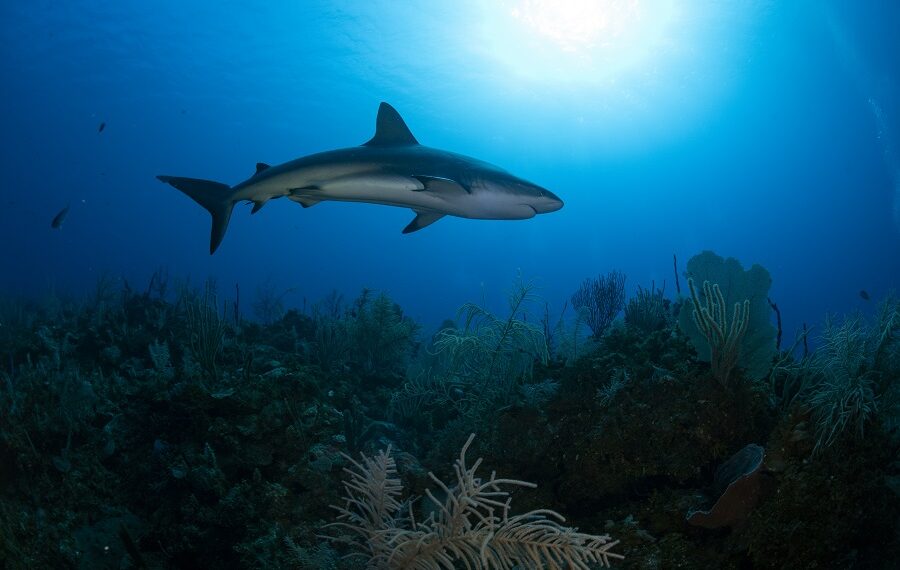
7 – Viviparity
Yes, a C. perezii is viviparous: 4-6 young, 70 cm long, come out directly formed and active from the mother’s belly! A bit like us, even a placenta is present for nutrition during gestation.
8 – Warning!
These sharks are protected in the Bahamas and in reserves, because seemingly numerous populations are « near-threatened »: fishing is still active in Belize, Trinidad and Tobago… for its meat historically, but increasingly for its skin or bones, sold as souvenirs!
9 – Low frequency
Another dance is performed at night, circling small fish or octopuses, charming the rays that pass on the menu with a quick snap. Research has shown a high sensitivity to low sounds emitted by injured prey, but also by boats…
10 – Eating anything…
Residues can accumulate in its stomach, a Caribbean grey shark can then « empty its bag » by turning its stomach inside out, where parasites and leftovers can be eaten by cleaners!
Jérémy Delille