


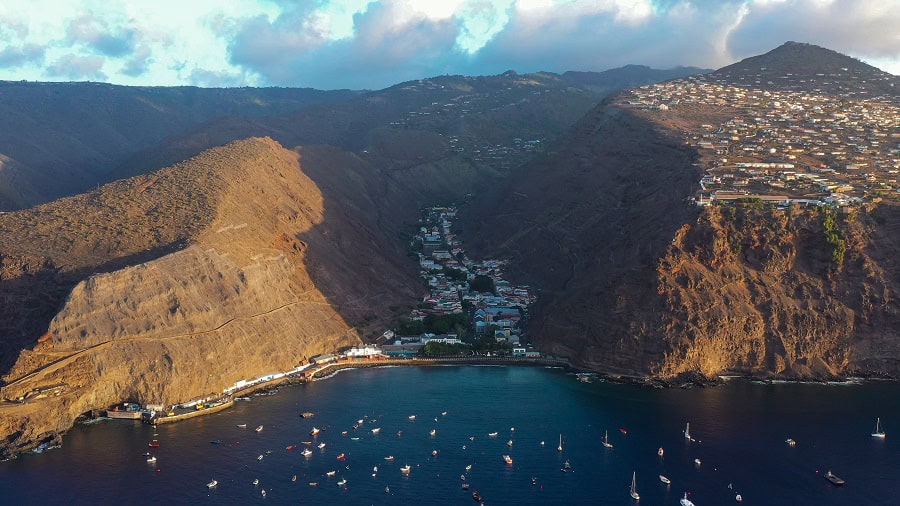
In our collective imagination, Saint-Hélèdoesn’t look à like a wind-swept land, a place of’exile, arid, lost in the middle of nowhere. It’is nothing like that. Certainly, the small îvolcanic island is quite isolatedéin the’South Atlantic, à prèover 2000 kilometersèfrom the nearest land, yet it teems with life! When Alexandra Childs and Rémi Demarthon, back from filming for a few weeks, answer our questions, their wonder remains intact. She is a biologist, he is a wildlife documentary filmmaker and naturalist, and both are freedivers and divers. When the idea of a film dedicated to the basaltic island takes shape, they initially imagine dedicating it to whale sharks. Alexandra, during a long stay in the Maldives, worked for the Maldives Whale Shark Research Programme and was told about this lost island where a large population is concentrated. But, very quickly, during an initial reconnaissance, they realize how limiting Saint Helena to giants would be reductive: its richness is not only underwater but also on land, and in the fight of all its inhabitants to preserve it. After several months of research and writing, they embark on the adventure and arrive on the island to create Saint Helena, bastion of biodiversity, a 52-minute nature documentary. The island, even if it hasn’t yet revealed all its secrets, would host about 500 endemic species, thus surpassing the Galapagos Islands in terms of biodiversity per hectare.
>>> watch the film teaser <<<
Until 2017, the only way to reach the small land was to board the ship that left South Africa every six weeks to supply it. One had to count on six days at sea! But since then, a small airport has been built, and two weekly flights, in high season, depart from Cape Town and Johannesburg. The situation is changing. And, protecting this jewel, if tourism develops in the coming years, becomes even more important. Indeed, for some years now, the approximately 4,500 inhabitants of the small British protectorate, very attached to their natural heritage, have mobilized to protect their island, with the support of their government. In 2016, a MPA (Marine Protected Area) was created, including the 200 nautical mile zone around the island, reinforcing the ban on fishing for foreign vessels established nearly 40 years ago. Only artisanal line fishing, practiced by local professionals, is allowed there. One can easily imagine how essential good tourism management will be..
.
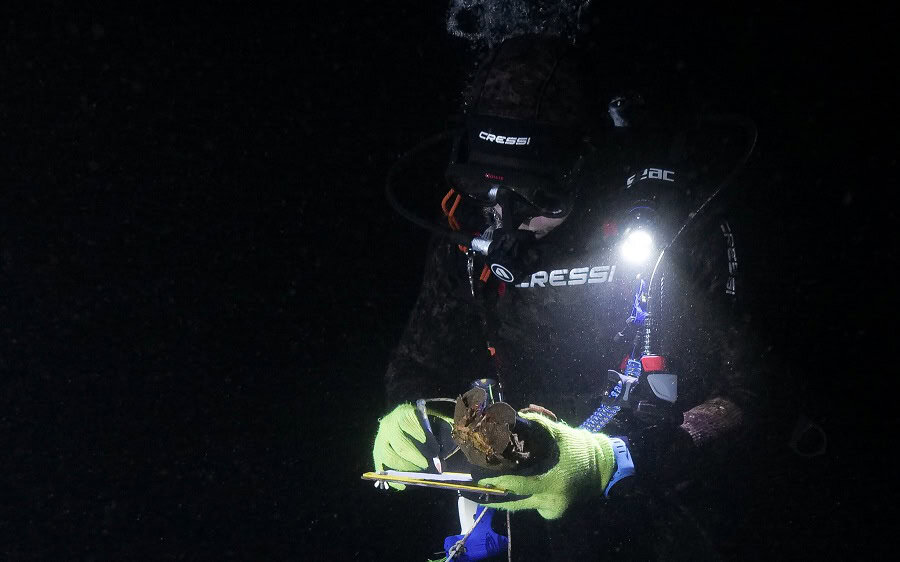
Assessing the marine resources of theileToday, scientific missions are multiplying to better understand the local fauna and flora. And, in the interest of sustainable development, the island’s marine resources are beginning to be analyzed. This is the case, for example, of yellowfin tuna whose movements are particularly studied. « By tagging certain animals with tags, but also by injecting an antibiotic that acts as a biomarker in the otoliths, explains Alexandra, one can géather precious information whenéthey are c’aught, such as their growth rate and theirêché » âge. The first studies thus seem to indicate that the tuna are relatively sedentary, which will allow better management of fish stocks. Other programs concern lobsters,as well as a species of slipper lobster, as well as a species of slipper lobster, , which is endemic to the three English protectorate islands in the Atlantic: Saint Helena, Ascension, and Tristan da Cunha. The goal is both to determine how the populations renew and what their range of movement is. The idea, once again, is to find the right balance between economic resources for local fishermen and biodiversity preservation. « Blue Belt, » a program from the United Kingdom in partnership with Blue Marine Foundation, seeks to give unity to the marine protected areas of the South Atlantic English islands. , which is endemic to the three English protectorate islands in the Atlantic: Saint Helena, Ascension, and Tristan da Cunha. The goal is both to determine how the populations renew and what their range of movement is. The idea, once again, is to find the right balance between economic resources for local fishermen and biodiversity preservation. « Blue Belt, » a program from the United Kingdom in partnership with Blue Marine Foundation, seeks to give unity to the marine protected areas of the South Atlantic English islands.Tagging and monitoring the endemic slipper lobsters of Saint Helena. © Alexandra Childs and Rémi Demarthon / Fathom Pictures[/caption].
« Whale sharks,are massively pr explains Alexandra, esent between October and March, and léittle is known exactly why they gather. But, i’t is in any case the only place in the world where’there are as many mù ales as females. It is therefore assumed tâhey might’ be thereê to reproduce. à » Especially since, although there are no images, two islander testimonies report mating. Here, Whale sharks,says Alexandra, ars punctual depuis plusieurs annér groupings have been reégularèly observedé by the‘marine team of the Saint Helena National Trust with, in Féebruary 2019, a record gathering of 80 individuals». Being genetically different from other populations, a photo-identification catalog is currently being developed. It currently includes just over 277 individuals. A program is also being conducted by Georgia Aquarium in Atlanta and Dr. Alister Dove, an expert on the species, in partnership with the St Helena National Trust (SHNT), to better understand their behavior. Last year, assisted by Cameron Perry, his doctoral student, he notably tagged 5 individuals to track their movements. He also hopes to equip them with cameras attached to the dorsal fin, hoping to have the chance to film a mating, which would be a first!.

.
The birth of butterflyfishAround the island, there are about a hundred dive sites listed by the two local centers: countless wrecks, caves, drop-offs… Inhabited by an omnipresent fauna that, depending on the season, offers some beautiful surprises. The reproduction of butterflyfish, in February, is one of them. « The newly hatchedéjuveniles are then counted in their thousands, ésays Alexandra.I was surprised I even lost sight of Ré’mi, althoughé just a few méeters away, so numerous were they! à » And the large pelagics, when the juveniles are everywhere, rush in turn. Jacks, mahi-mahi, wahoos, and Chilean devil rays (èelectric blue, deep, where é) come to take advantage of the feast. « In water ofelectric blue, deep, wherevisibility is generally between 25 and 30 meters,comments Rémi,’the sight is exceptional! é« ù
é Giant cloud of butterflyfish around the wreck of the Papa Nui, an old steamship resting in James Bay between 6 and 12 meters deep. A perfect spot for freediving. © Alexandra Childs and Rémi Demarthon / Fathom Pictures
In January and February, it is not uncommon to observe green turtles during their breeding season underwater or on the surface from the boat. A population of pantropical spotted dolphins, respected by fishermen, has also settled off the coast of Jamestown, the capital. Extremely playful, they sometimes reward dive boats with spectacular jumps. From June to December, even though they are rarely encountered while diving, humpback whales cruise offshore. Solitary hammerhead sharks also frequent the island’s waters, and their fins are often seen from the boat cutting the surface. Life is teeming, everywhere.énéSome wrecks have rather intimidating guards, such as this tiger moray eel (Enchelycore anatina) that watches over the Bedgellet deck at night. © Alexandra Childs and Rémi Demarthon / Fathom PicturesèSpecies end emic to the sea and le coup d’oeil est exceptionnel ! »

En janvier et en février, il n’est pas rare d’observer les tortues vertes en période de reproduction sous l’eau ou en surface depuis le bateau. Une population de dauphins tachetés pantropicaux, respectée des pêcheurs, a également élu domicile au large de Jamestown, la capitale. Extrêmement joueurs, ils gratifient parfois les bateaux de plongée de sauts spectaculaires. De juin à décembre, même si on les croise rarement en plongée, les baleines à bosse croisent au large. Des requins marteaux solitaires, eux aussi, fréquentent les eaux de l’île et l’on voit fréquemment, depuis le bateau, leurs ailerons affleurer en surface. La vie est foisonnante, omniprésente.
.

.
Des espèces endéland à Every year, new fish species are discovered on the reefs surrounding the island, more than twenty of which are endemic, such as the Saint Helena flounder (), the Saint Helena pointy-nosed puffer (), the Saint Helena pointy-nosed puffer (and the famous Saint Helena butterflyfish (and the famous Saint Helena butterflyfish ( ), true emblems of the island’s marine life. But there are probably still many more to identify and catalog.), true emblems of the island’s marine life. But there are probably still many more to identify and catalog.The pointy-nosed boxfish of Saint Helena is one of the island’s endemic species. © Alexandra Childs and Rémi Demarthon / Fathom Pictures[/caption].

à Alexandra and Rémi spent six weeks on site, and the footage they brought back testifies to a still preserved biodiversity. « ’What we want to show today with our documentary, they conclude,.
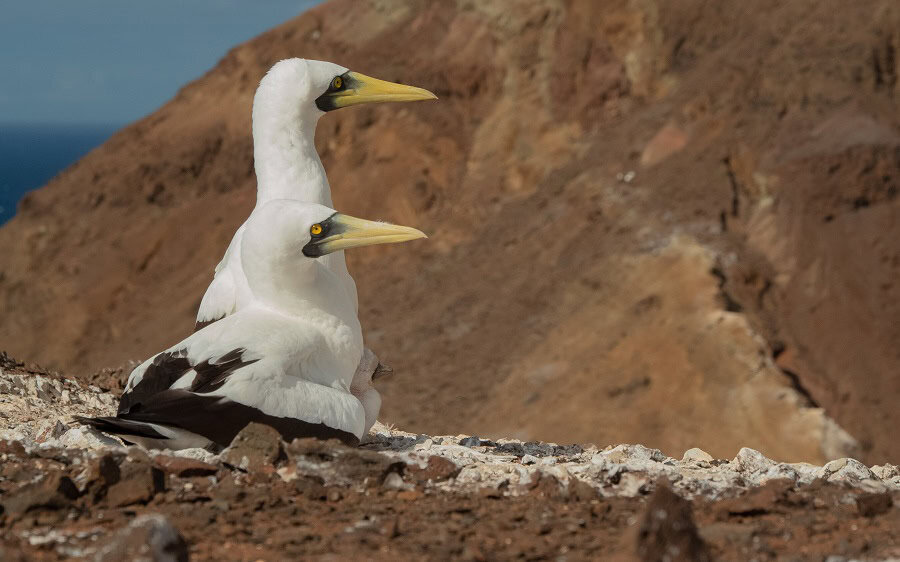
ète. »
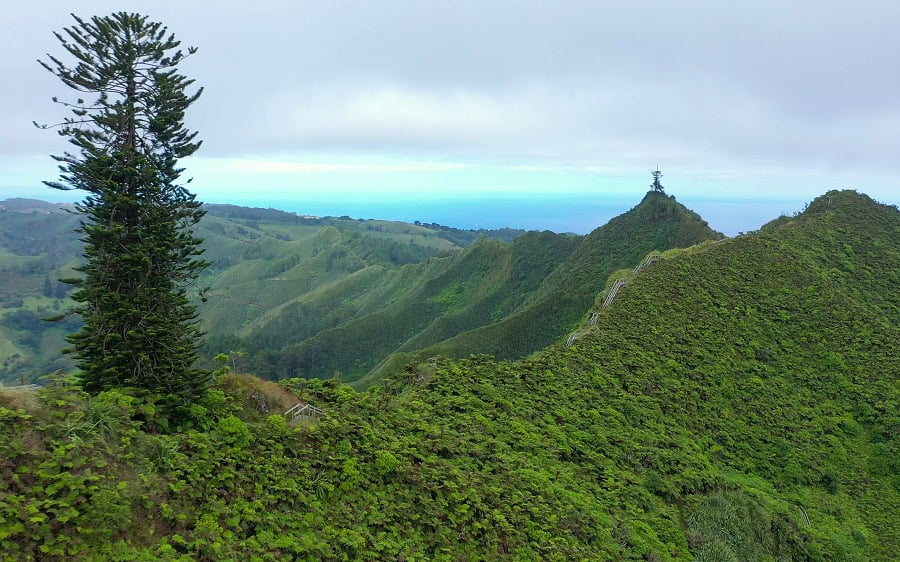
Une îA tropical rainforestée d’Most of the 122 km² of the island is covered with windy and rather desert-like plains, bordered by high cliffs where seabirds nest. But, in the heart of Saint Helena, the 81 hectares of Diana’s Peak Park shelter a tropical rainforest that once covered almost its entire area. Often soaked in clouds, it rises to 823 meters in altitude, and hosts a multitude of plant species, including threatened endemic ferns. It is also where one can discover what is said to be the world’s rarest isopod, the yellow-spined woodlouse.The Saint Helena Plover Calypso, lors de l’expédition narrée dans Compagnons de plongée.
.
.
Among the six terrestrial endemic bird species that once populated the island, only one has survived: the Saint Helena Plover, of which only a few dozen individuals remained in the late 1990s. But the efforts of the inhabitants and authorities have paid off, as the population is now 545 adults! Every year, in January, the protected areas are monitored, and counts are conducted by members of the NGO Saint Helena National Trust and by volunteers, attesting to the unwavering commitment of the island community to the conservation of its natural heritage.êThe Saint Helena Plovers favor open habitats like this field which they prefer to run through rather than fly over. © Alexandra Childs and Rémi Demarthon / Fathom Pictures[/caption]Practical informationLe pluvier de Sainte-Hélène
Parmi les six espèces terrestres d’oiseaux endémiques qui peuplaient l’île, une seule a survécu : le pluvier de Sainte-Hélène, dont il ne restait, à la fin des années 90, que quelques dizaines d’individus. Mais les efforts des habitants et des autorités ont payé puisque la population est aujourd’hui de 545 adultes ! Chaque année, en janvier, les zones protégées sont surveillées et des comptages effectués par des membres de l’ONG Saint Helena National Trust et par des bénévoles, témoignage de l’engagement sans faille de la communauté insulaire pour la sauvegarde de son patrimoine naturel.
.

Pratique
Dive Saint Helena,Dives for all levels. Snorkeling is also offered. et Dives for all levels. Snorkeling is also offered.Saint Helena Tourist Office.Two diving centers are currently established on the island:Water temperature: from 19 °C to 25 °C.
Best visibility: around 40 meters, between December and May.
The island is served, from South Africa, by the airline Airlink.
Isabelle Croizeau