


The 57th edition of the Wildlife Photographer of the Year has awarded its grand prize, for the first time, to a Frenchman. Laurent Ballesta was crowned nature photographer of the year with his photo titled « Creation. »
The Wildlife Photographer of the Year is a photographic competition organized by the Natural History Museum in London each year. Through 19 categories, it celebrates the captivating beauty of nature! This year, 50,000 images from 50 different countries were submitted to the jury, who ultimately selected that of biologist and underwater photographer Laurent Ballesta.
Starting Monday, October 18, submissions for the 58th edition of the contest will be open. If you wish to participate, you have until December 9 to submit your photos. Up to 25 images per photographer (£30 entry fee, £35 for images submitted in the last week), and 10 images for those under 17 (free).
Find all the information and all this year’s winners on the contest’s website.
Discover our selection of images, whether magnificent or impactful, among those awarded this year:
Nature Photographer of the Year – « Underwater » prize – Laurent Ballesta (France)
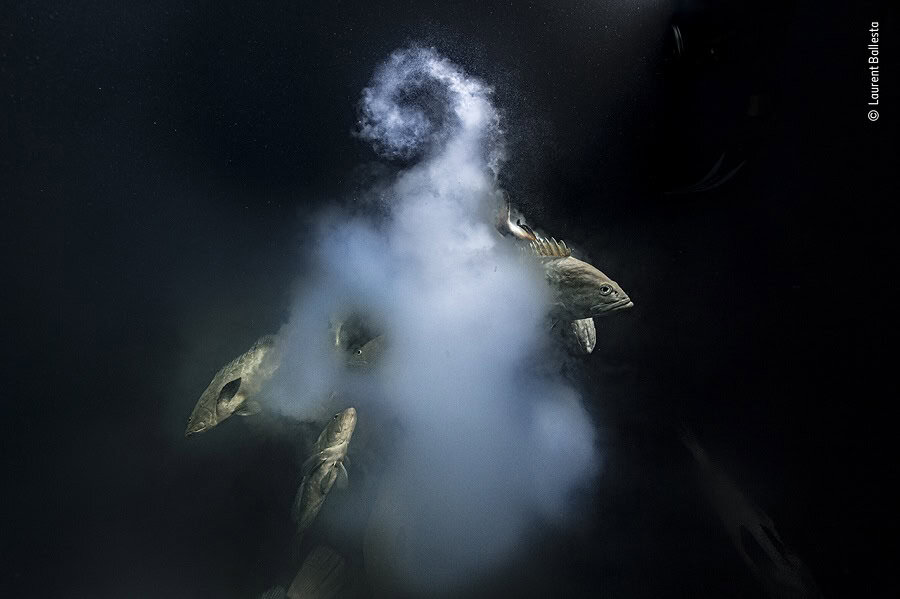
Laurent Ballesta dives into the depths as a trio of camouflaged groupers emerges from their milky cloud of eggs and sperm. For five years, Laurent and his team returned to this lagoon, diving day and night to witness the annual grouper spawning. They were joined after dark by reef sharks hunting the fish. This event occurs around the full moon in July, when up to 20,000 groupers gather in Fakarava in the narrow southern channel connecting the lagoon to the ocean. Overfishing threatens this species, but here the fish are protected within a biosphere reserve.
Young Nature Photographer of the Year – « Under 10 » Prize – Vidyun R Hebbar (India)
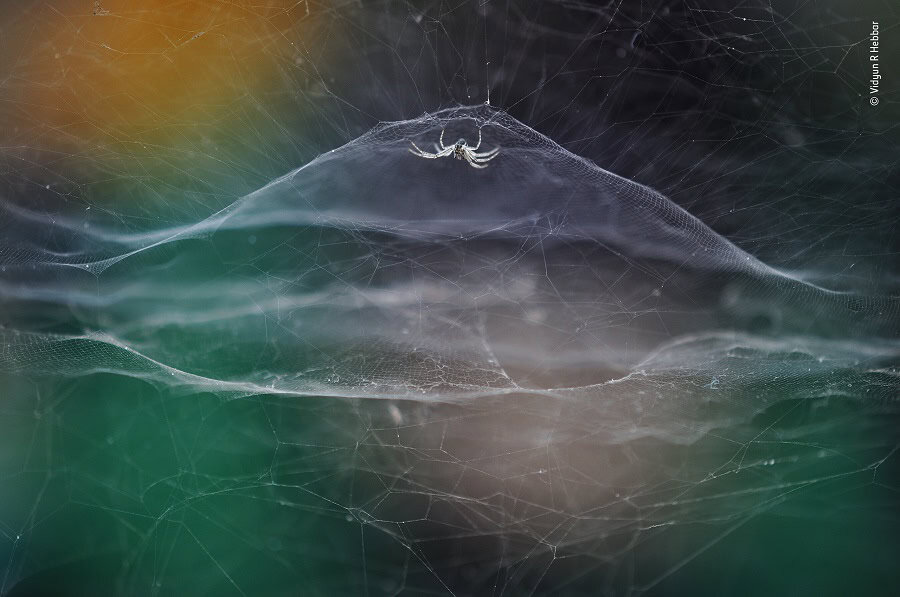
Vidyun R Hebbar observes a spider web as a tuk-tuk passes behind. Exploring his local theme park, Vidyun found an occupied spider web. A passing tuk-tuk (motorized rickshaw) provided a rainbow-colored backdrop to highlight the spider’s silk creation. These orb-weaving spiders are tiny – this one had legs measuring less than 15 millimeters. They weave non-sticky, square-mesh domes surrounded by tangled webs that make it difficult for prey to escape. Instead of weaving new webs each day, these spiders repair existing ones.
« Animals in their Environment » Prize – Zack Clothier (United States)
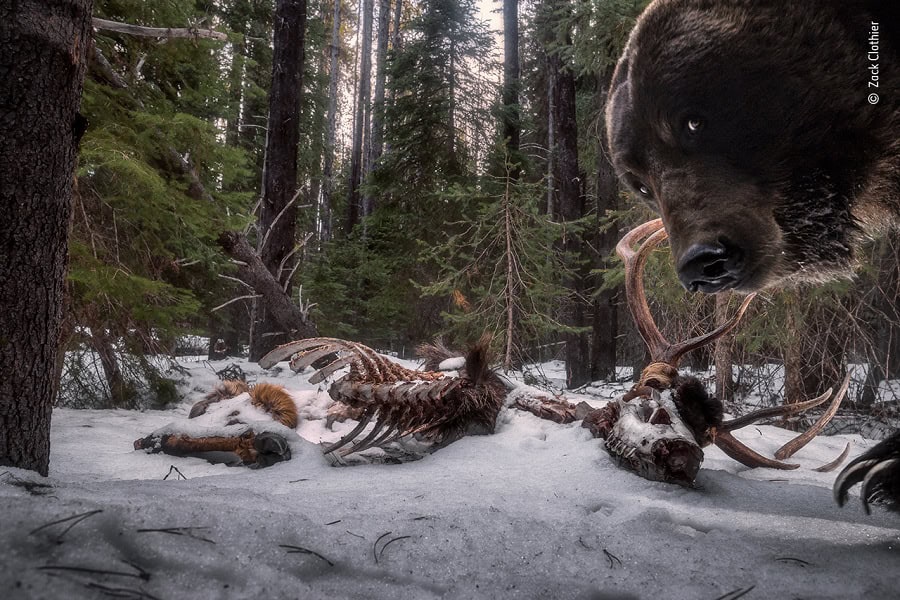
Zack Clothier discovered that a grizzly bear took an interest in his hidden camera. He had decided this bull elk carcass was an ideal spot to set up his camera. Returning was challenging. Zack found his setup ravaged. This photo was the last image captured by the camera. Grizzly bears, a subspecies of brown bears, spend up to seven months in a light form of hibernation. Emerging in the spring, they are hungry and consume a wide variety of food, including mammals.
« Animal Portraits » Prize – Majed Ali (Kuwait)
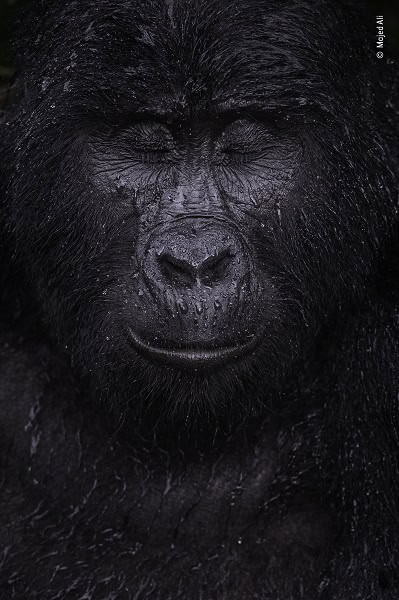
© Majed Ali, Wildlife Photographer of the Year
Majed Ali captures the moment a mountain gorilla closes his eyes in the rain. Majed walked for four hours to meet Kibande, an almost 40-year-old mountain gorilla. » The higher we climbed, the hotter and more humid it got « , he recalls. As a refreshing rain began to fall, Kibande remained in the open, seemingly enjoying the shower. Mountain gorillas are a subspecies of the eastern gorilla and live at altitudes above 1,400 meters in two isolated locations: the Virunga volcanoes and Bwindi. These gorillas are endangered due to disease, poaching, and habitat disruption caused by human activity.
« Behavior: Invertebrates » Prize – Gil Wizen (Israel/Canada)
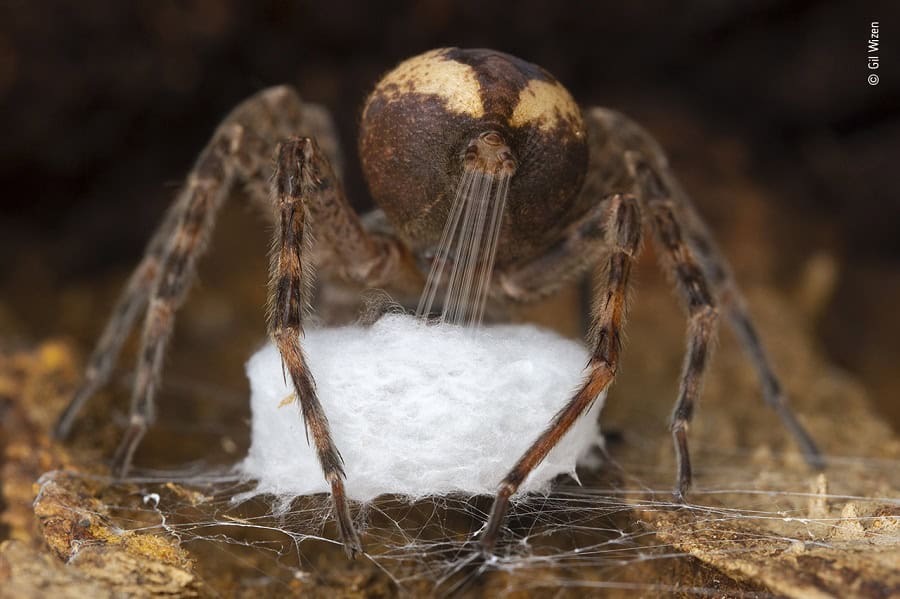
Gil Wizen discovered a fishing spider weaving silk from her spinnerets to create her egg sac. Gil found this spider under the bark of a tree. Any disturbance could have made her abandon her task, so he took great care. « The action of the spinnerets reminded me of human fingers weaving « , explains Gil. These spiders are common in wetland areas and temperate forests of eastern North America. Over 750 eggs have been recorded in a single sac. These spiders carry the sac with them until the eggs hatch and the young disperse.
« Behavior: Birds » Prize – Shane Kalyn (Canada)
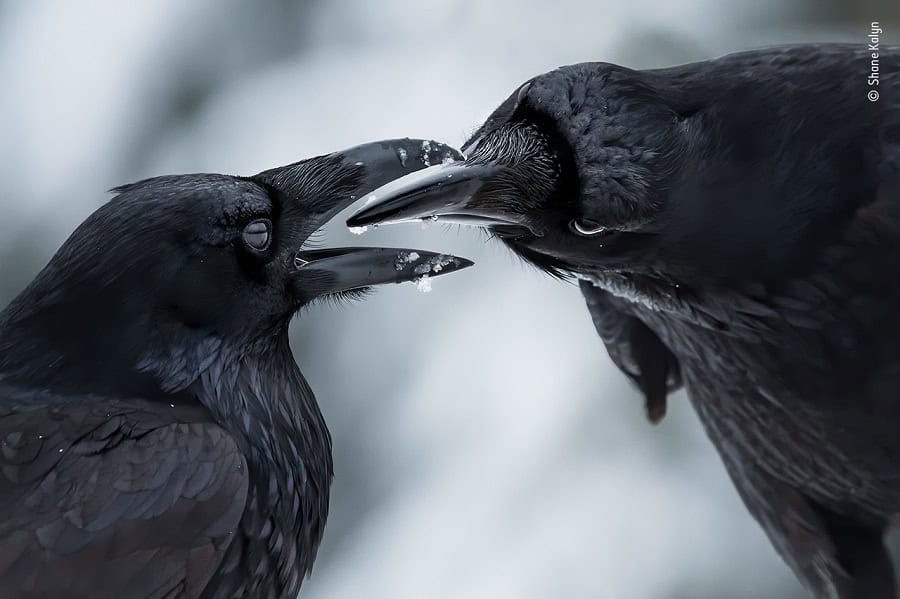
Shane Kalyn witnesses a raven courtship display in mid-winter: the start of raven breeding season. Shane lay on the frozen ground, using the muted light to capture the detail of the raven’s iridescent plumage against the snow to reveal this intimate moment where their thick black beaks met. Ravens pair with a partner, likely for life. This couple exchanged gifts – moss, twigs, and small stones – and preened each other before beginning a serenade of soft croaking sounds to reinforce their bond or « pair bond. »
« Behavior: Mammals » Prize – Stefano Unterthiner (Italy)
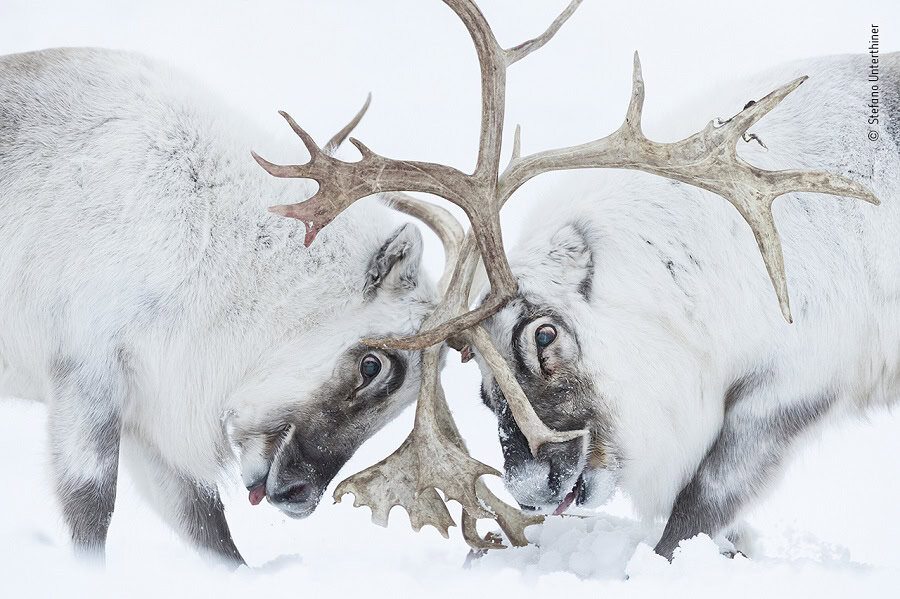
Stefano Unterthiner observes two reindeer from the Svalbard archipelago (Norway) fighting for control of a harem. Stefano followed these reindeer during the rutting season. Watching the fight, he felt immersed in « the smell, the noise, the fatigue, and the pain« . The antlers clashed until the dominant male (on the left) chased his rival away, securing his chance to reproduce. Reindeer are widespread in the Arctic, but this subspecies is only found in Svalbard. Populations are affected by climate change, where increased precipitation can freeze on the ground, preventing access to plants that are usually accessible under soft snow.
« Behavior: Reptiles and Amphibians » Prize – João Rodrigues (Portugal)
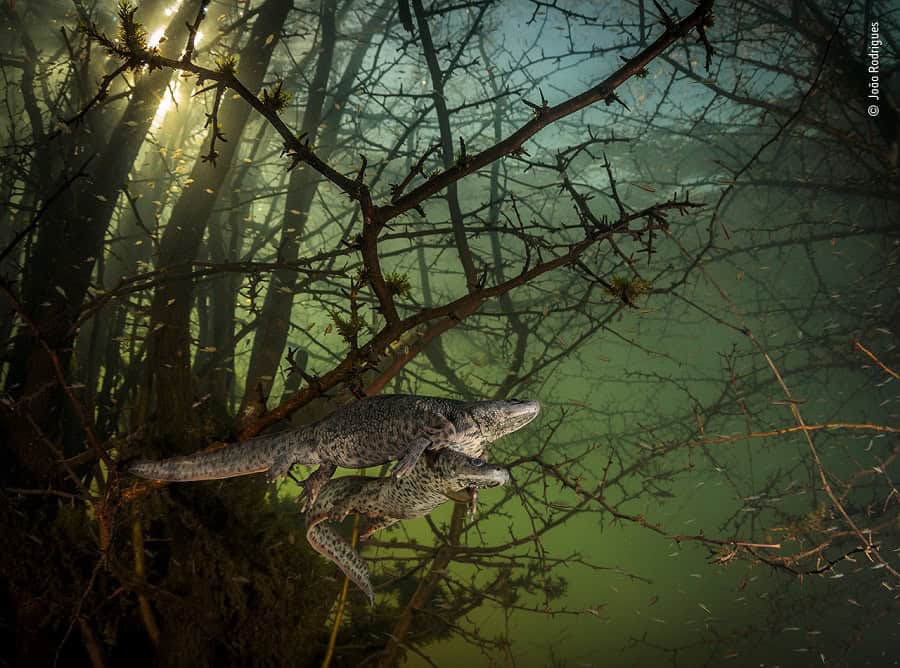
João Rodrigues is surprised by this pair of salamanders (Waltl’s newt) courting in the flooded forest. This was the first time João had the chance to dive in this lake in five years as it only forms during exceptionally wet winters when underground rivers overflow. He had only a fraction of a second to adjust his camera settings before the salamanders swam away. Found in the Iberian Peninsula and northern Morocco, they are known for using their sharp ribs as weapons, piercing their own skin, collecting toxic secretions, and then stabbing them into an attacker.
« Natural Art » Prize – Alex Mustard (United Kingdom)
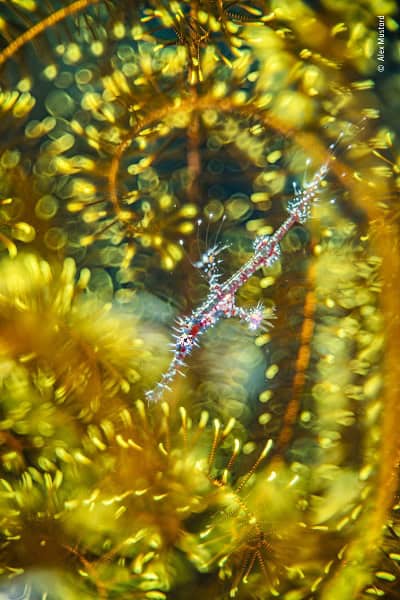
Alex Mustard discovers a harlequin ghost pipefish hidden among the arms of a crinoid. Alex had always wanted to capture this image of a juvenile but usually only found the darker adults on these crinoids. His image expresses the confusion a predator would face when encountering this kaleidoscope of colors and patterns. The juvenile’s bright colors indicate it was born on the coral reef within the last 24 hours. In a day or two, its colors will change, allowing it to blend in with the crinoid.
« Oceans: The Bigger Picture » Prize – Jennifer Hayes (United States)
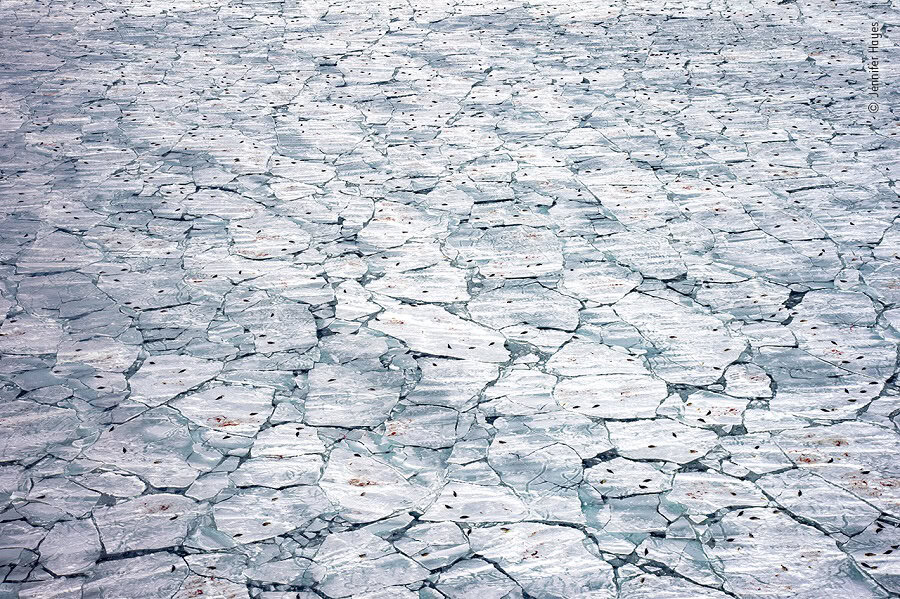
Jennifer Hayes photographs Greenland seals, their pups, and the blood from their birth on the melting sea ice. Following a storm, it took hours of helicopter search to find this fractured ice used as a birthing platform by the Greenland seals. Each fall, they migrate south from the Arctic to their breeding grounds, delaying births until the ice forms. The seals depend on the ice, meaning future populations will likely be affected by climate change.
« Plants and Fungi » Prize – Justin Gilligan (Australia)
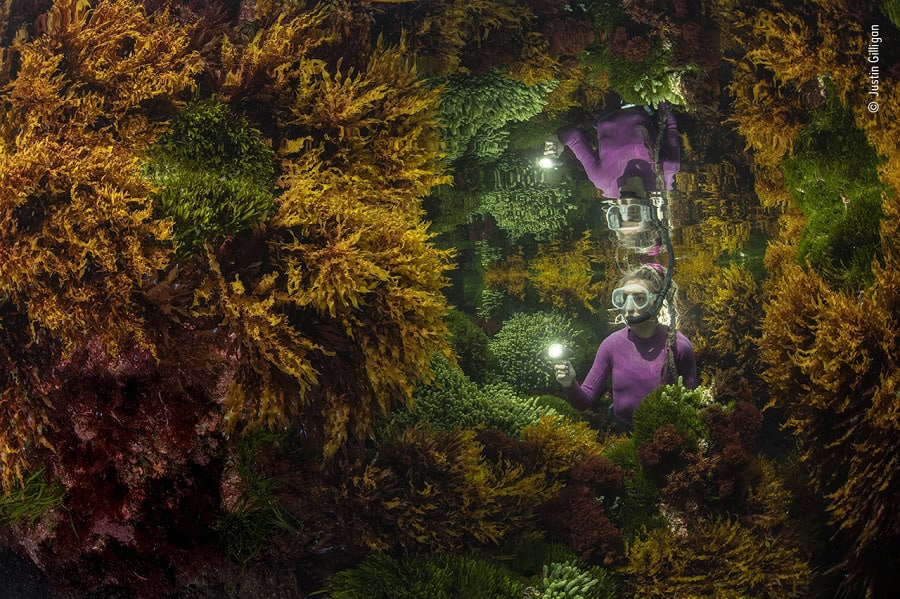
Justin Gilligan highlights the reflection of this diver amidst kelp. On the world’s southernmost reef, Justin wanted to show how prudent human management helps preserve this vibrant kelp jungle. With only a 40-minute window when tide conditions were right, it took three days of trial and error before Justin got his shot. The impacts of climate change, such as rising water temperatures, affect the reefs at an ever-increasing pace. Kelp forests are home to hundreds of species, sequester carbon, produce oxygen, and help protect shorelines.
« Photojournalist » Prize – Adam Oswell (Australia)
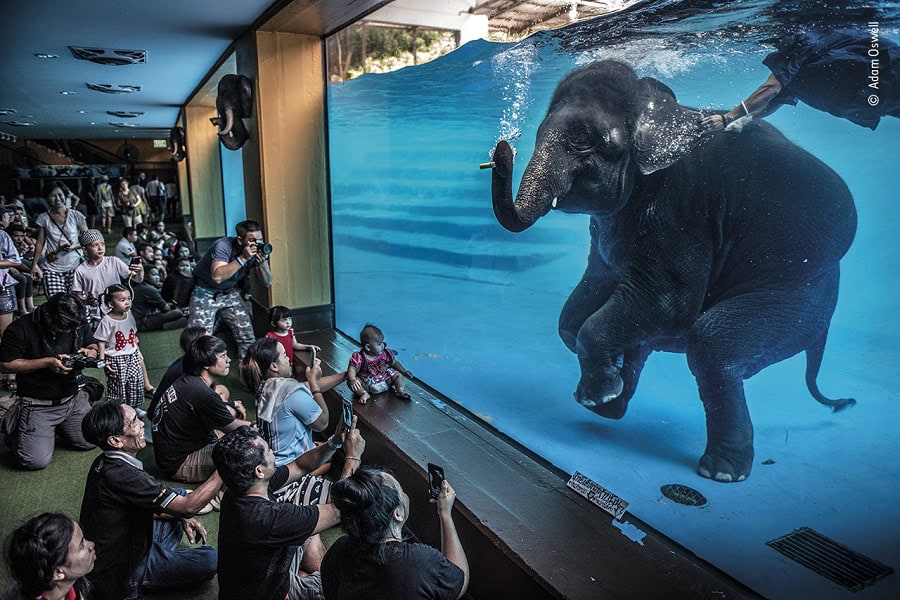
Adam Oswell draws attention to zoo visitors watching a young elephant play underwater. Although this performance was promoted as educational and exercise for the elephants, Adam was disturbed by the scene. Organizations concerned for the welfare of captive elephants regard these demonstrations as exploitation because they encourage unnatural behavior. Elephant tourism has increased across Asia in recent years. In Thailand, there are now more elephants in captivity than in the wild. The Covid-19 pandemic caused the collapse of international tourism, leaving elephant sanctuaries overwhelmed with animals that their owners can no longer afford to care for.
« Photojournalist Portfolio » Prize – Brent Stirton (South Africa)
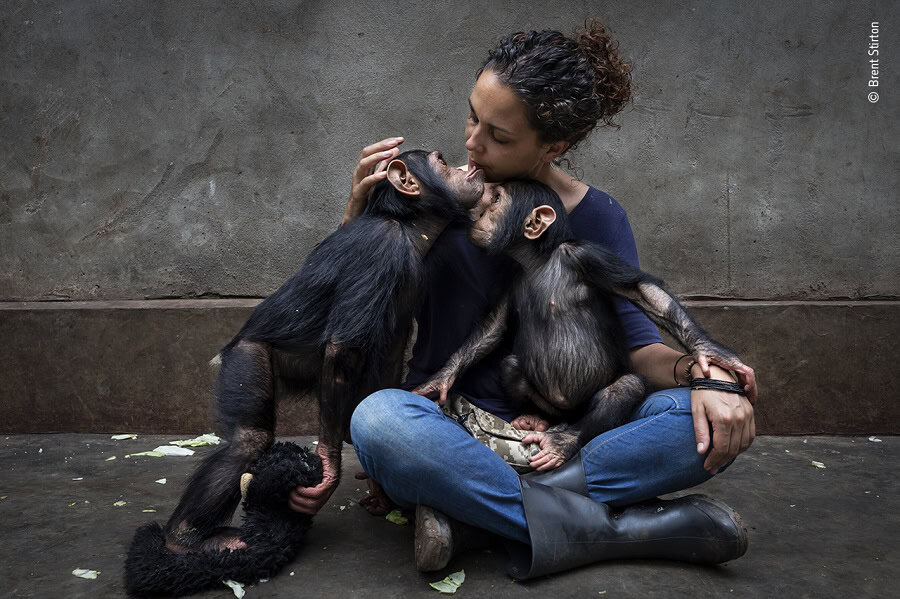
Brent Stirton portrays a rehabilitation center caring for chimpanzees orphaned by the bushmeat trade. The center’s director sits with a newly rescued chimpanzee as she slowly introduces him to the others. Young chimpanzees receive individual care to overcome their psychological and physical trauma. These animals are lucky. Fewer than one in ten are rescued, having witnessed the adults of their group killed for meat. Most have experienced hunger and suffering.
His portfolio:
Many people worldwide rely on wild animal meat for protein and as a source of income. Hunting threatened species such as chimpanzees is illegal but occurs too frequently. Brent’s photographs document the work of the Lwiro Primate Rehabilitation Center, which rescues and rehabilitates primates orphaned by poaching. Many staff members here are survivors of the military conflict in the Democratic Republic of the Congo. Working at the center aids in their recovery.
« Rising Star Portfolio » Prize – Martin Gregus (Canada/Slovakia)
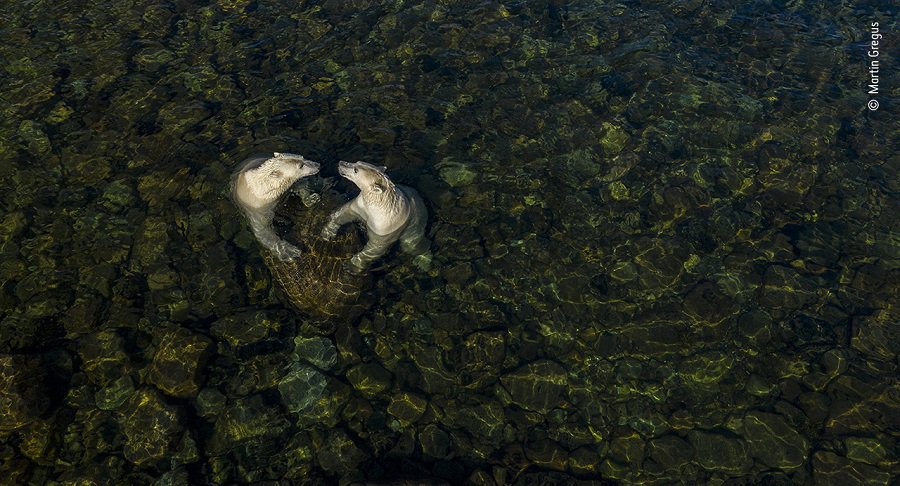
Martin Gregus shows polar bears in a new light as they come ashore in summer. On a warm summer day, two polar bears ventured into the shallow waters to cool off and play. Martin used a drone to capture this moment. They form a heart, symbolizing for the photographer the apparent sibling affection between them and « the love we owe to the natural world. »
His portfolio:
Martin spent three weeks on his boat using various techniques to photograph polar bears around Hudson Bay. Bears are mostly solitary, and while living on the ice, they can be scattered over vast areas. As they move closer to the shore in summer, they live mainly off their fat reserves and, with less pressure to find food, become much more sociable. Without wanting to downplay their plight with climate change, Martin wanted to show polar bears in a new light.
« Portfolio » Prize – Angel Fitor (Spain)
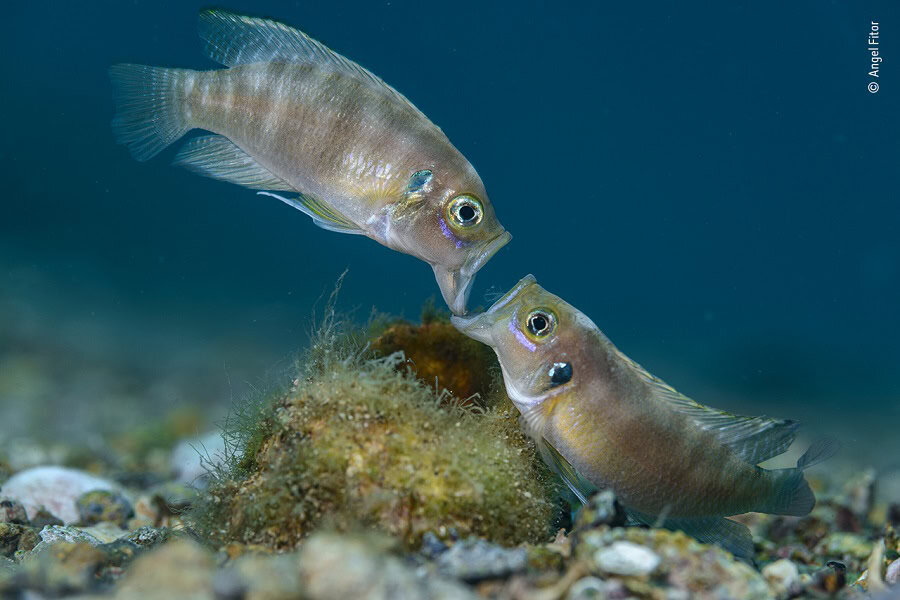
Angel Fitor offers an intimate look at the life of cichlids in Lake Tanganyika. Two male cichlids fight jaw to jaw over a snail shell. Inside the half-buried shell is a female ready to spawn. For three weeks, Angel monitored the lake bed for such disputes. The bites and pushes last until the weaker fish gives way. This struggle ended in just a few seconds, but lasted long enough for Angel to get his winning shot.
His portfolio :
Lake Tanganyika, the oldest of the Great Lakes in East Africa, is home to over 240 species of cichlids, each with unique shape, size, and behavior. Despite its bustling life, this incredible ecosystem is threatened. Angel has been working on cichlids for two decades, braving difficult diving conditions to photograph their behavior. Recently, chemical runoff from agriculture, wastewater, and overexploitation by the unregulated fish trade have pushed some cichlid populations toward extinction.
Opening image – Rising Star Portfolio Prize. © Martin Gregus, Wildlife Photographer of the Year