


The Mediterranean is home to thousands of life forms, including a number that are threatened. Here is a selection of 10 species, among the most emblematic of the great blue, that require protective measures for their preservation. It is impossible to mention them all, which is why cetaceans, also under numerous threats, are not included.
1- The brown grouper
Another symbolic species to place alongside the posidonia: the grouper. More precisely, the brown grouper, the largest sedentary fish in our Mediterranean. Up to 1.40 m long, for a very modest size of 2 cm at birth! With its massive head, bulging eyes, and large lips, it’s easy to recognize. But outside reserves (including Port-Cros), admiring it up close is much less easy because the animal, though curious, keeps its distance. This is an atavism resulting from strong pressure exerted by spearfishing. Indeed, before its prohibition, spearfishing caused significant harm to the extent that the grouper became an endangered species. Fortunately, in France, successive moratoriums regarding its fishing (renewed every five years) have benefited it. Regular counting campaigns demonstrate this: a healthy adult population is present. Small individuals are also regularly observed. A positive point since this perciform is a protogynous hermaphrodite. That is, a female fish at the beginning of its life becoming male with age.Protected since: 1988 in Corsica and 1993 on the mainland coast, by moratorium (prefectural decree).Conservation status: present in areas protected from human predation. Outside, young groupers have been observed again since the 1990s, but the species, threatened by poaching, remains discreet.

2- The spiny lobster
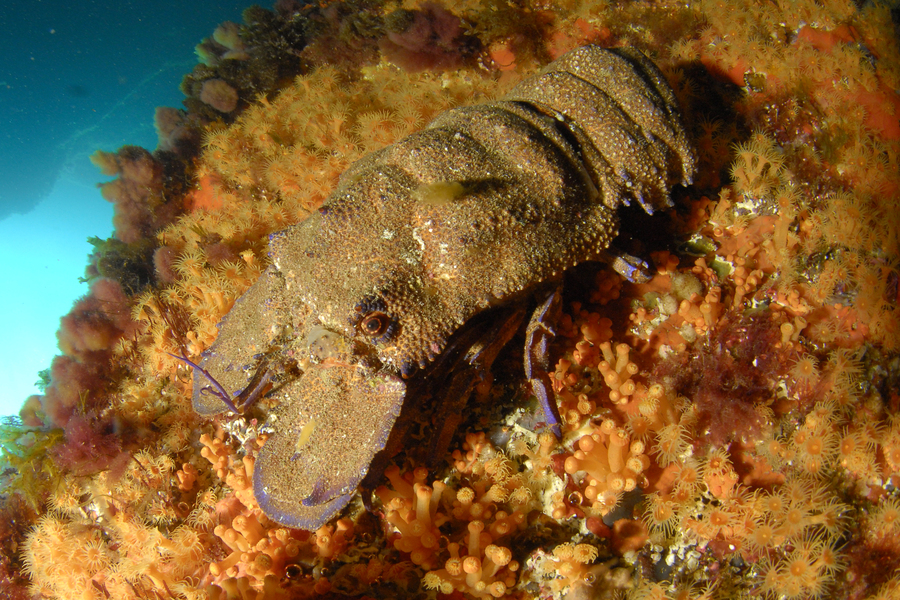
The habits of the spiny lobster, a cousin of the rock lobster, remain little known. An animal with a sturdy body and a rough shell tinged with reddish, it favors rocky habitats. Provided they are rich in crevices to hide in. From its lair, it sets out in search of its preferred prey, which takes the form of small invertebrates. A mostly nocturnal hunt. During the day, the creature hangs preferably head down, meaning attached under an overhang or the ceiling of a cavity. Targeted for its delicate flesh, this defenseless crustacean, apart from its discretion, was subject to intensive fishing that almost led to its disappearance in our continental waters (the Corsican area being an exception). After a quarter-century of protection, a (slight) comeback of its population is observed.Protected since: late 1992 by ministerial decree.Conservation status: a species still threatened (poaching) and rarely observed.
3- The brown meagre
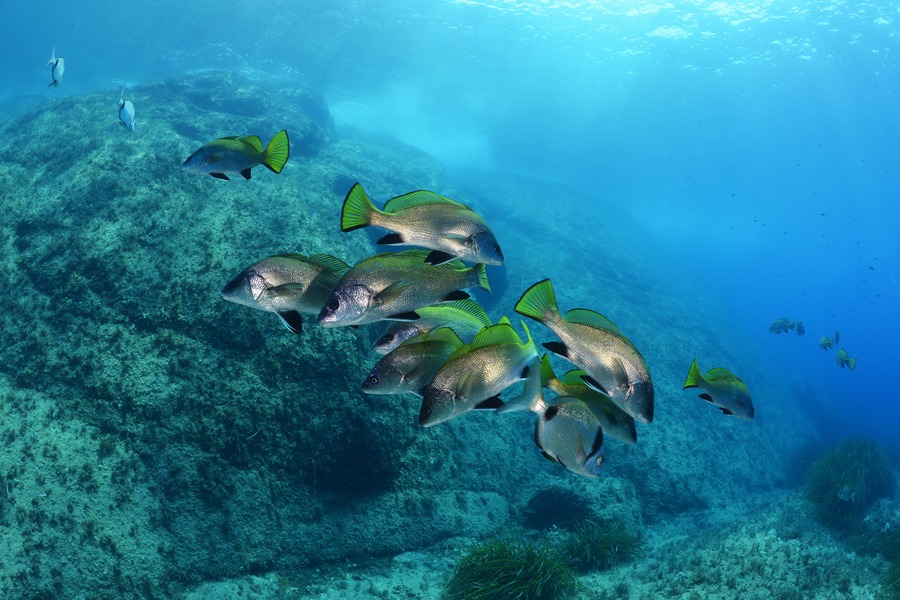
It’s the newest addition to the group since its protection was enacted just in 2014. Like its cousins, the meagre and the umbra, the brown meagre adopts a compact oval shape. This fish belongs to the Sciaenidae family, from the Greek ‘scia’ or shadow. But it’s unknown if our ancestors named it so due to its preference for dark places or the dark hue of its body. It seems that, like the brown grouper, spearfishing is the original cause of its decline. In any case, it’s evident that much like Epinephelus marginatus, this beautiful fish is easily observed in protected marine areas. Whereas outside reserves, it also becomes much more elusive and discreet.Protected since: January 2014 thanks to a moratorium applying to recreational fishing and spearfishing.Conservation status: vulnerable species (poaching), rarity of observation outside protection zones.
4- The red coral
The use, especially in jewelry, of “Neptune’s blood” dates back to ancient Greece. Like the Posidonia, the growth of the “stone tree,” another of its nicknames, is extremely slow. Indeed, the polyps (white in color) only grow their skeleton or trunk (red in color) by a few millimeters per year. As for branch diameter, its annual increase does not exceed a millimeter. Thus, observing through the glass of your mask some red coral displaying a size of a few cm is equivalent to observing a colony several decades old. Faced with commercial exploitation of its stocks, this heritage resource needs to be protected in order to regenerate.Protected since: a species whose harvesting is regulated (fishing reserved for professionals). In some areas, the depth of this harvesting is also regulated (collection prohibited between 0 and -50 m).Conservation status : overexploited due to its commercial value, well-sized red coral (skeleton 10 cm or more) is now rarely found at less than 50 m.(main photo – © Nicolas Barraqué)
5- The noble pen shell
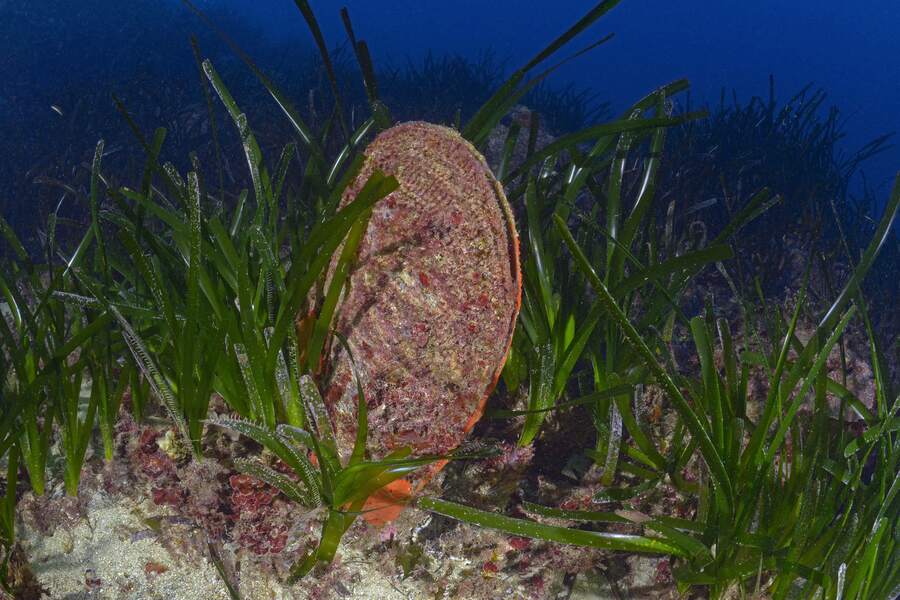
This is the largest mollusk of the Mediterranean, endemic to the great blue. This sort of giant mussel is an organism filtering seawater to retrieve its food (living planktonic particles or organic matter). The noble pen shell’s population has regressed due to two factors, admittedly distinct, but resulting both from human responsibility: the first rests on the fact that this bivalve implants itself on Posidonia meadows, the marked recession of which mechanically led to the weakening and disappearance of a significant percentage of its population.
The second cause is due to intense human collection, which in its time contributed to the decimation of this shellfish.Protected since: 1992 by decree prohibiting its destruction or uprooting.Conservation status: although its population has considerably regressed, protection efforts allow for the observation of a (slow) beginning of recolonization of its biotopes.
6- The monk seal
The younger generations may be surprised to learn that not so long ago (in the 1940s to 1960s), seals lived in the French Mediterranean, notably in the Marseille creeks and on the Corsican coasts. Exterminated by humans (especially fishermen, with whom the seal competed, as the animal did not hesitate to help itself from their nets), this amphibian carnivore is now among the ten most endangered species in the world. Some optimism seems to emerge, despite a possible inbreeding issue. Indeed, protection efforts have slightly increased its population. Their observation takes place in the eastern Mediterranean where the last representatives of the species have taken refuge.Protected since: 1975, classified as critically endangered in 1996.Conservation status : endangered, listed on the red list of endangered species.
7- The diadem sea urchin
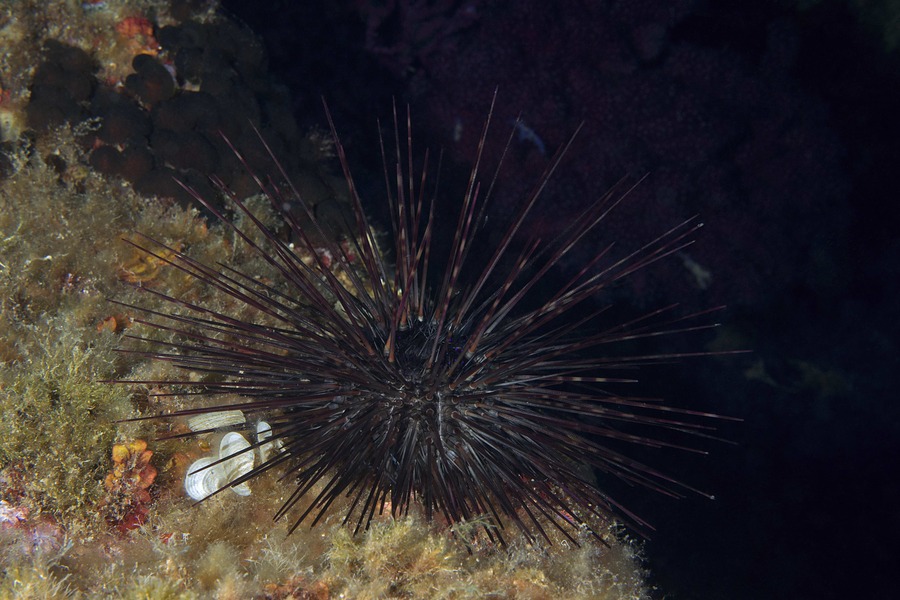
The origin of its scientific name – Centro-stephanus meaning crown of thorns, longispinus for long spines – perfectly describes this sea urchin. Thus, its skeleton seems small in circumference compared to the length of its spines. Due to their size and fineness, its spikes are extremely mobile (and their prick painful). The diadem sea urchin is said to be “of the Mediterranean” as it has close cousins living in tropical conditions (Caribbean, Red Sea, etc.). This echinoderm is sciaphilic, meaning it avoids strong light intensity. The protection of this species is not a result of intensive fishing but is due to its low representation in Mediterranean waters.Protected since: November 1992, by decree valid throughout the national territory.Conservation status: rare and protected species due to its low reproduction rate.
8- The mobula ray
A dark back, a white belly, two cephalic horns on each side of the head, and a long tail… To an untrained eye, confusing the Mediterranean devil ray (nickname for the mobula ray) with the famous manta ray is understandable. Especially since the Mediterranean species, the largest of its kind, can reach a wingspan of 5 meters. But this confusion is not possible since the graceful manta does not patrol (for now?) in the great blue, probably finding the water too cold for its taste. If the Mediterranean mobula ray is threatened, it is due to its rarity. Indeed, this pelagic species has a low reproduction rate, with newborn litters being limited.Protected since: 2011 (date of entry into force of the amended annex of the Barcelona Convention in 2009).Conservation status : endangered (listed on the red list of threatened species).
9- The Posidonia
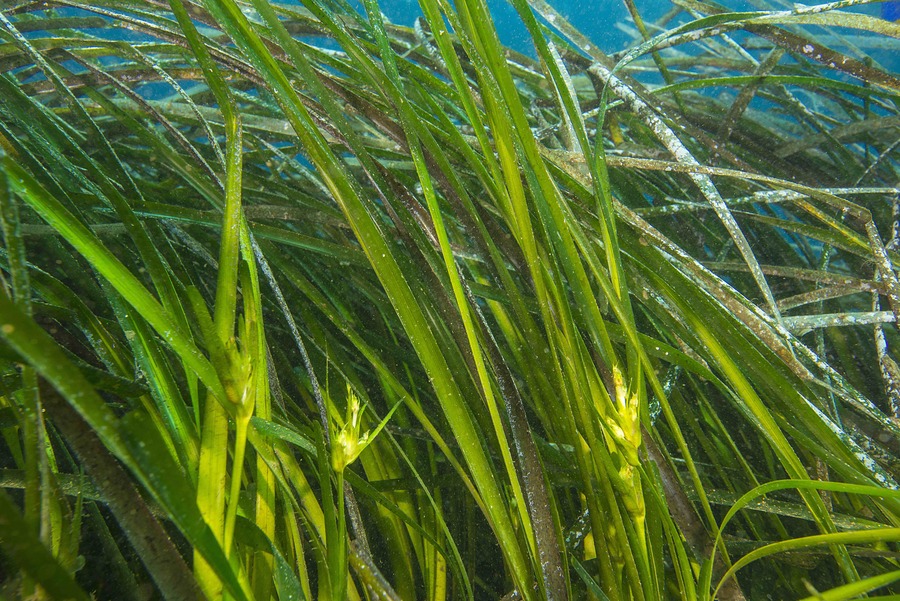
And no! Despite appearances, posidonia is not an alga. Posidonia oceanica is actually a flowering plant… akin to the iris. Its role is vital in the Mediterranean because posidonia fulfills several functions. A nursery first, by hiding eggs and larvae at the heart of its foliage. For protection and feeding next, as a large number of juvenile fish and invertebrates shelter and grow under its long green leaves. Finally, it occupies different ecological functions: anchoring the seabed, oxygen production, water filtering, and coastline protection (a barrier against swell and erosion). Thus, Posidonia meadows serve as true oases of life. While their expanse is in decline, the responsibility lies with humans. The urbanization of the coastline, the discharge of turbid wastewater (depriving posidonia of the light it needs), and, to a lesser extent, ship anchoring, are the main culprits of its destruction. Due to its very slow regrowth (one meter per century), the only remedy for reconstruction is transplantation.Protected since: 1988 by ministerial decree.Conservation status: in decline, the total area of the meadows decreasing due to pollution and/or urbanization.
10- The turtles
Among members of the Chelonidae family (to which green and loggerhead turtles belong), the shell derives its strength from ossification (horn plates). In the case of the leathery turtle, the shell’s resistance comes not from the presence of scales but from the skin’s thickness (leather). Regardless of its nature, their shell in no way protects these three species evolving in the Mediterranean, as they are all threatened. The causes are now well known (and are not specific to the great blue). Firstly, their nesting sites are threatened by coastal urbanization, particularly for the green turtle, known to land on Italian, Corsican, Greek, and Turkish beaches to lay eggs. Secondly, their migratory lifestyle makes them susceptible to capture by any fishing gear (nets, longlines). Finally, ingesting plastic easily confused with jellyfish – one of its prey – leads to the animal’s death by intestinal obstruction…Protected since: 1979 (green turtle), 1991 (loggerhead turtle), and 2008 (leathery turtle).Conservation status : listed on the red list of reptiles of mainland France.
This article is extracted from the special Mediterranean edition published in 2018.