


“Barracudas!” Oh? Are you sure? Because this Sphyraena group includes many species, often living in the same places (although they do not reproduce together due to different habits) and look very similar. To the point that many publications do not distinguish these two species of barracuda encountered around mainland France… You will need to pay attention to details to tell them apart! Sphyraenae feature many species often living in the same places (though not reproducing together due to different habits), and they look very similar. To the point that many publications do not distinguish between these two species of barracudas found around mainland France… You’ll need to pay attention to the details to distinguish them!
1- The large form
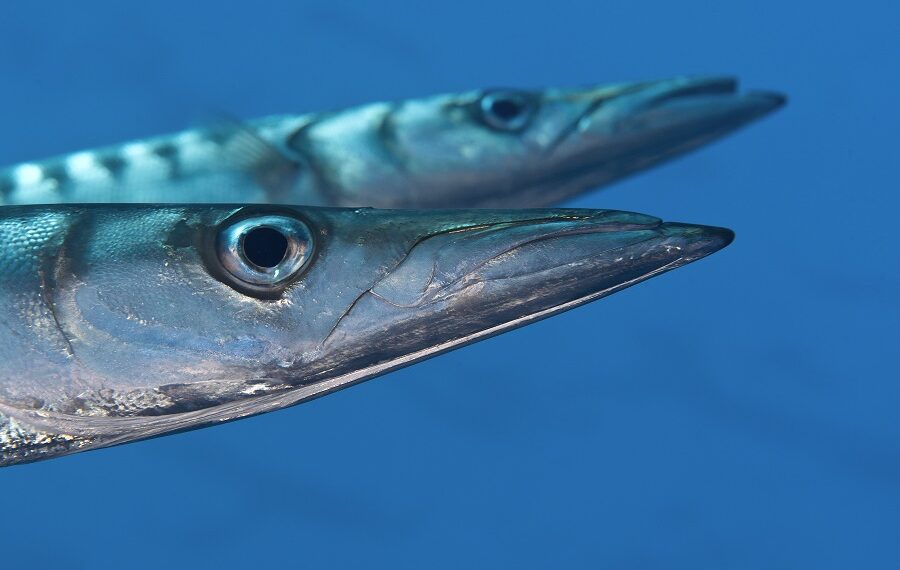
The elongated and silver barracuda (or spet) measures 160 cm max (at 15 years old), has a pointed, sharp, and prognathous head (lower jaw forward). Its fins are short, even the 2 dorsals, and the tail is well V-shaped in adults (not in the juvenile), making barracudas resemble northern pikes (Sphyraena in Latin) of the sea. These barracudas are found between 0 and 100 m depth.
2- Barracudas or barracudas?
Sphyraena viridensis or “yellowmouth barracuda” has about twenty dark vertical stripes down its body and no scales on the gill covers. S. sphyraena looks very similar, with scales sometimes barely visible on the cheeks and no stripes, or else they are very pale. For some authors, these are close species and the “pales” might be hybrids (normally infertile if the species are separated, think of the mule or the hinny). Yet they reproduce: these dark bands might be a variable trait in a single species, like eye color in humans?
3- Group strategy or group of strategists?
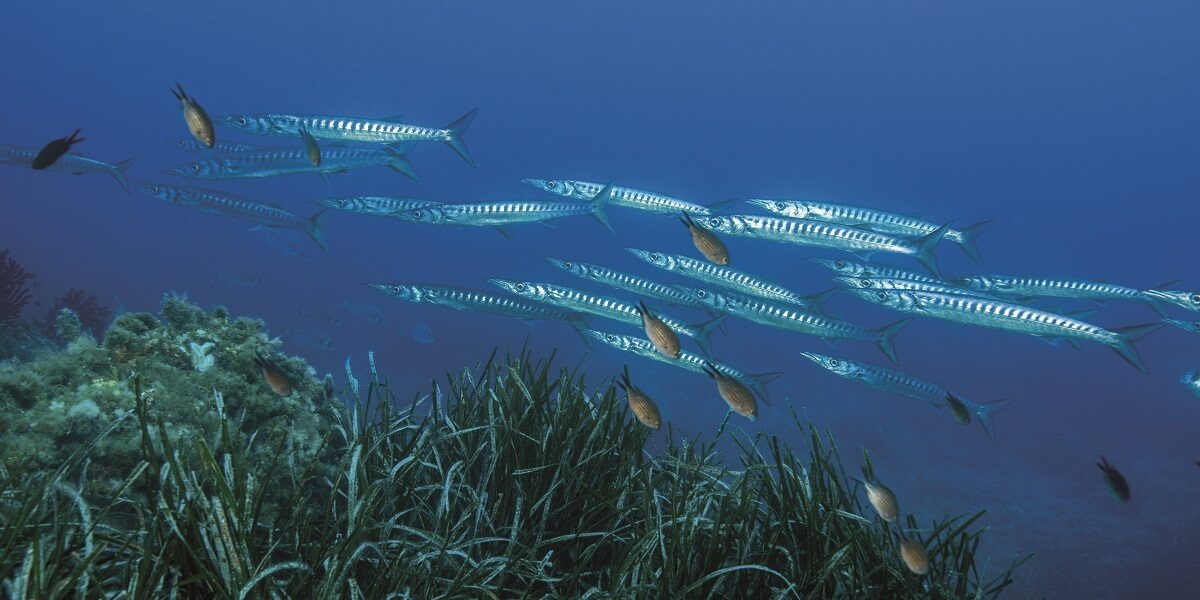
Juvenile, the barracuda floats in shallow waters, hiding in posidonia seagrass beds to escape cannibalism, especially by adults. They live in shoals of various sizes (from 10 to 40 individuals) and of different sizes (average 40-60 cm). Group strategy to avoid predators? They are at the top of the food chain. To organize the hunt? No defined role yet… They are simply loners who regularly gather.
4- Devours everything (that’s smaller)
You may have noticed, barracudas are solitary in winter, while the shoals can be huge in summer: it depends on the prey sought, especially coastal ones. These are mostly small fish, like small mackerels Trachurus picturatus which make up their menus, shoals against shoals. Octopuses, cuttlefish, and even worms or crustaceans crossed complete the menu.
5- “Ba-rra-cu-da!”
What would you say if, approaching a pack of wild cats, someone said “Oh, cheetahs!”? So, why are groups of barracudas called “barracudas” when there is a 2 m long, silver, solitary fish in the Red Sea that bears this name Sphyraena barracuda ? This species is actually found in almost all seas and oceans. Even in the western Mediterranean going through the Suez Canal… And the young of this large barracuda live in groups, so the confusion is easy.
6- Dentition
By the way, how to distinguish them? The teeth, elongated, thin like canines, are very visible when the barracuda yawns (to deter potential large predators such as divers?). But when the mouth is closed, its teeth are invisible. Conversely, the big great barracuda has such imposing teeth that they stick out on the sides of its closed mouth.
7- Speed and curiosity
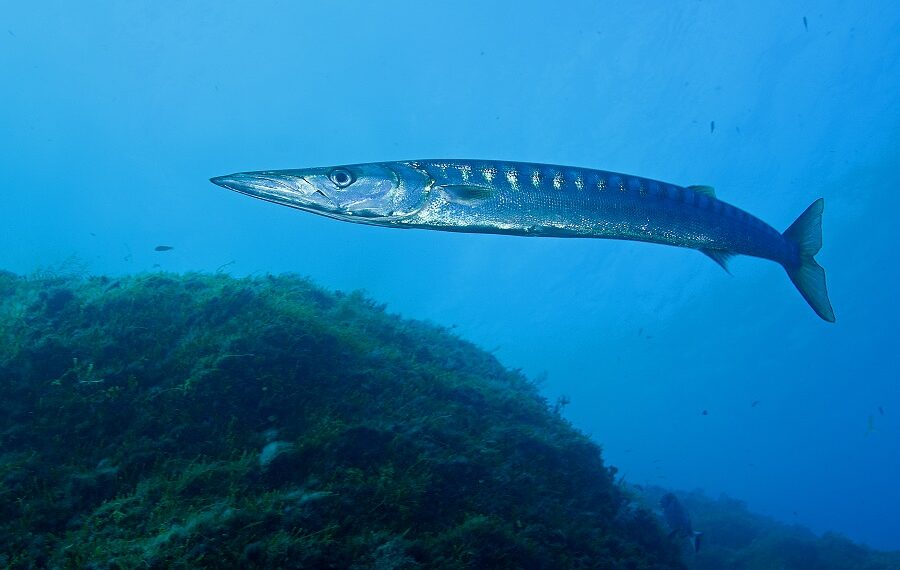
A barracuda, high up on the food chain, has little reason to be afraid. It may even be in its interest to check if everything it encounters is edible. That’s why barracudas can sometimes come closer to divers. With speeds reaching 40 km/h, they can flee and return in a very short time. Stay on the lookout for your photos! Most of the time lazy, they wait facing the current.
8- Danger to be moderated
It is impressive to find yourself in a shoal of barracudas! Only attacking the smaller ones for food, there is little danger for you, as long as your fingers are gloved or not easily accessible. They would be more afraid: if you are too intrusive, a barracuda might bite preemptively. And break its teeth, as they are thin and fragile.
9- More and more?
Divers have the impression of seeing more and more shoals of barracudas. However, it has been shown that the yellowmouth barracuda has a low renewal rate (few adults compared to the number of eggs). On the other hand, the S. chrysotaenia or yellow-line barracudas, smaller and with yellow tails, observed in the eastern basin of the Mediterranean are great competitors. Are they therefore increasingly replacing them or are they being gradually replaced?
10 Currently
There are many species of Sphyraenae and with the global warming of the waters, Mediterranean species find themselves competing with those coming from the Suez Canal and the Gibraltar Canal. But they also leave, heading towards the Canaries and other Atlantic islands, while remaining southern.
Jérémy Delille