


A crustacean member of the order Stomatopoda, the colorful mantis shrimp, also known as peacock mantis shrimp or mantis shrimp, made a name for itself in 2018 by appearing in the documentary “Blue” by Keith Scholey and Alastair Fothergill (Disneynature production). Displaying multiple colors that delight diver-photographers, it exhibits fascinating abilities…
-
- An immense strength: a formidable predator, the colorful mantis shrimp (Odontodactylus scyllarus) boasts the ocean’s most powerful punch with an impact force reaching 1,500 newtons, generating a cavitation phenomenon, the production of a vapor bubble that implodes in turn. Its two club-shaped raptorial appendages stun prey and break their shells at speeds up to 80 km/h, making it one of the fastest invertebrates in the world. Divers must beware as it can inflict significant injuries and is capable of breaking a camera housing.
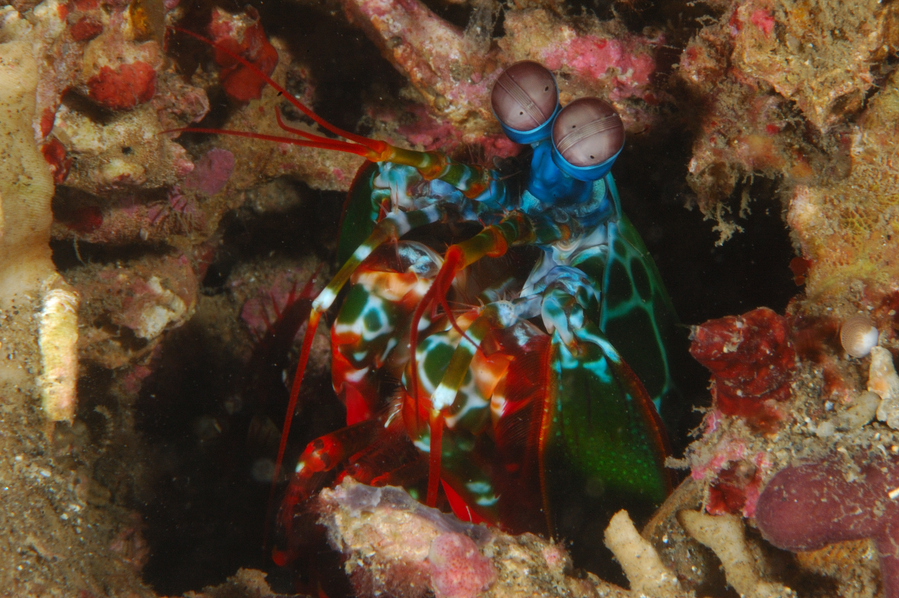
- Multicolored: the mantis shrimp doesn’t hold this name for nothing; it’s one of the most colorful crustaceans in the world. Its coloration is bright green in males, olive to brown for females, and yellowish in juveniles for most of the body. Bright red bristles run along the appendages on its body. As for the peduncle at the base of the eyes and antennae, it is an intense blue. To grow, the mantis shrimp must molt and change its shell every 6 weeks.
- A complex vision: the colorful mantis shrimp has the most advanced and detailed vision in the animal kingdom. Its globular and stalked eyes are independently mobile, offering it a 360° view. They are also composed of thousands of facets, each displaying an image. Divided into two hemispheres with a central band, they provide it with a very precise three-dimensional vision, even with just one eye.
- A spectrum of colors: the mantis shrimp is capable of distinguishing colors through its central band. It indeed possesses around ten photopigments per eye, compared to 3 for humans. It can thus detect ultraviolet and perceive polarized light in its two forms, linear and undulating.
- A cancer detector: according to a study conducted in Queensland (Australia), the colorful mantis shrimp could detect cancerous lesions and neuron activity thanks to its ability to perceive polarized light. This biomimetic approach might, in the future, develop camera sensors identifying tumors.
- Unique means of communication: the only invertebrates capable of individual recognition, peacock mantis shrimps are equipped with uropods (posterior appendages) and antennal scales that allow them to communicate with other mantis shrimps when they reflect light.
- A characteristic posture: the mantis shrimp displays a very particular position, raising its head and cephalothorax at a 45° angle to watch its surroundings. In case of danger, it adopts a defensive posture by lying on its back and raising its tail towards the danger, its uropods spread like a fan.
- Its burrow, an obsession: adopting territorial behavior, the mantis shrimp regularly maintains its burrow throughout the day. Beware of overly curious fish that disturb it! This doesn’t prevent it from regularly changing homes, not hesitating to fight to take over a better-located burrow and settle there.
- A male that listens: during mating, the male charms the female with a dance indicating his intentions. He possesses two penises, one at the base of each leg of the third pair of locomotor limbs. Once up to 50,000 eggs are laid, the female keeps them in a ball in front of her mouth. During this gestation period, which lasts 2 to 3 months, she is vulnerable because she can no longer feed or defend herself. But she can rely on the male who ensures her protection!
- A colorful mantis shrimp in France: an individual was reported in Saint-Malo in 2009. The animal is said to have escaped from an aquarium.
https://vimeo.com/417932153Where to find it? The colorful mantis shrimp is mainly found in the Indo-Pacific Ocean, south of Japan, in New Caledonia, and Hawaii. Divers can find it up to 70 meters deep.
Lisa Ferré