


Diving, whether recreational, military, or professional (« commercial diving »), requires certification (license, diploma, qualification). While military and commercial diving have their own systems, recreational diving is more flexible, except in countries like France, where regulation exists. A French diver might think this situation is universal, but that’s far from the case.
Freedom of Certification Internationally
Globally, diving certification is largely self-determined. Much like starting a tennis or golf school, anyone can establish their own diver certification system, defining their own rules and standards. This is how many international private organizations emerged after the CMAS (1959): NAUI (1960), NASDS (1961), PSAI (1962), PADI (1966), ACUC (1969), PDIC (1969), SSI (1970), IDEA (1979), IDSA (1982), NASE (1982), MDEA (1984), IANTD (1985), PSS (1990), TDI (1993), PDA (1995), IDA (1996), ANDI (1988), GUE (1998), ISC, ITDA (1998), SDI (1998), WOSD (2005)…
The Three Types of Recreational Diving
Recreational diving, practiced for pleasure, is divided into three complementary approaches.
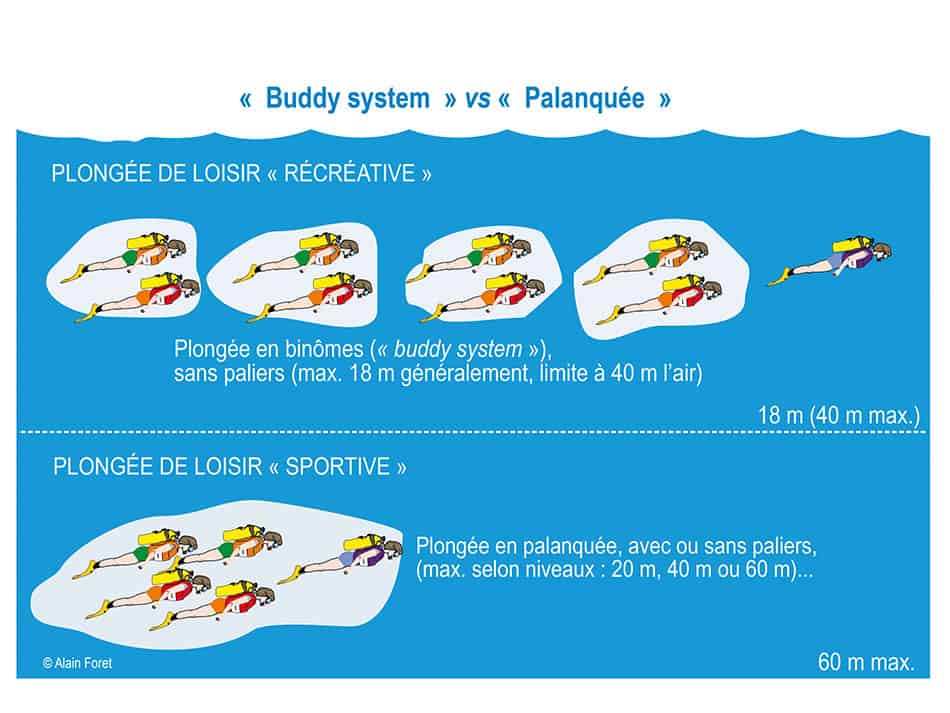
Recreational « Fun » Diving
Originating from North America and centered on air diving, it prioritizes:
- The absence of mandatory stops: the possibility to ascend to the surface at any moment.
- Depth limitation: generally 18 m, with a maximum of 40 m on air.
- The « buddy-system »: pairs supervised by a « dive leader » (who is not legally responsible for the pairs, unlike the French diving guide).
Examples of certifications: Open Water, Advanced Open Water, Rescue Diver or Stress & Rescue, Divemaster, Instructor…
Recreational « Sport » Diving
This European approach considers diving:
- With or without stops, including decompression with nitrox or pure oxygen.
- In areas that can exceed 40 m (e.g., 60 m in France, recommended limit in Belgium).
- In supervised or autonomous teams (total autonomy, unlike the buddy-system).
Examples of certifications: Level 1, Diver 1, Level 2, Diver 2*, Level 3, Diver 3* diving guide, Instructor…*
Recreational « Technical » Diving
Emerging in the 1990s, « tech » diving allows going deeper with helium-based mixes (heliox, trimix), in open circuit or rebreather (CCR – Closed Circuit Rebreather). Its definition varies: it starts at 40 m for « recreational » divers and beyond 50 or 60 m for « sport » divers. The depth limit ranges between 100 and 120 m.
Examples of certifications: Trimix and heliox diver (PTH), Normoxic trimix diver, Hypoxic trimix diver…
How Are Depth Limits Defined?
Certifying agencies freely set depth limits. However, national or regional regulations (France, Catalonia, Egypt) prevail and ISO standards are applied voluntarily, without replacing local laws.
Role of a Certifying Agency
A certifying agency:
- Defines the types of recreational diving certified (recreational, sport, technical).
- Establishes the detailed curriculum for each training program.
- Specifies the training content (theory and practice).
- Sets the conditions for issuing certifications (age, experience, courses…).
- Determines the associated prerogatives (depth, stops, supervision).
- Issues certifications (physical card or e-card).
- Ensures traceability of certifications.
- Issues duplicates.
- Acts as a trusted third party to verify the validity of a certification.
For a school or instructor to issue a certification, they must:
- Be recognized as « active » by the agency (approved structure, up-to-date member…).
- Comply with training curricula (practical and theoretical).
Recognition of Training: Which System?
There is no mandatory international system for training recognition. The certifying agency must provide key information about the certification (validity, content, skills). The host structure is free to accept or reject the certification. Competition between agencies can lead to the disqualification of competitors. Private organizations promote mutual recognition:
- World Confederation of Underwater Activities (CMAS).
- World Recreational Scuba Training Council (WRSTC) – https://en.wikipedia.org/wiki/World_Recreational_Scuba_Training_Council (read on 03/10/2023).
- European Underwater Federation (EUF).
France has specific regulations, which is an exception internationally. An agency can seek ISO certification to strengthen the credibility of its training.
This article, initially written by Alain Foret for the print edition of DIVE!, has been adapted for the web.
Illustration © Alain Foret, Image © Nicolas Barraqué.