


With the rise in popularity of digital photography, it is now almost impossible not to encounter an underwater photographer during your boat outings. If the idea of capturing beautiful memories of your dives excites you, don’t hesitate to explore this passion!
The technique
You don’t need to be an expert, but it is essential to acquire some basic skills. Since one hand will be occupied by the camera, you must know how to handle your diving vest easily, in all positions and without looking. It is crucial to master your buoyancy and lung ballast, as issues at this level will result in blurred photos. Your movements, stabilization, and way of moving should become automatic and fluid. This will improve the quality of your photos, while respecting the environment and avoiding damage. If you spend too much time moving in the water to stabilize, you’re not ready yet. Learning to photograph underwater at depths of 5 to 10 meters is recommended. This reduces your air consumption and extends your practice sessions. Lights and colors are richer, facilitating your learning.
The experience
Acquiring a minimum of practice is recommended. Conditions like currents, poor visibility, or waves can make taking photos more complex. One of the first steps will be to automate your settings. For comfortable divers, around twenty varied dives will suffice. For others, it will take between 50 and 100 dives to master the basics. Some will say it’s enough to go underwater to take pictures. I invite them to check their results once they’ve surfaced…
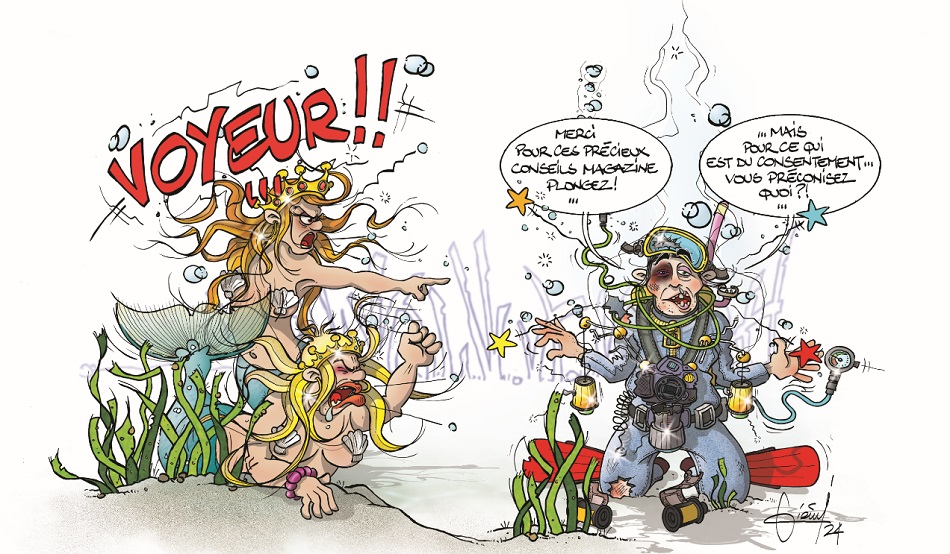
No need to already be a photographer
Obviously, those who already practice terrestrial photography will have an advantage in terms of knowing their camera and photographic principles (aperture, speed, sensitivity). However, underwater, they’ll have to relearn almost everything! Whether you use a smartphone or a more sophisticated camera, it’s essential to familiarize yourself with the fundamentals before moving on to techniques specific to underwater images. Furthermore, there are levels in underwater photography, and many courses and trainings are available in France and abroad, often conducted by renowned photographers. A good knowledge of marine biology will help you identify and observe species more easily, and anticipate their behavior for stunning shots.
What images?
To start, focus on “macro,” that is, close-up photos. You will quickly get satisfying results. Concentrate on stationary subjects such as nudibranchs, corals, anemones, or gorgonians. This will allow you to take the time to correctly set up your camera, adjust focus, framing, and brightness. Familiarize yourself with your equipment and flash settings. Subsequently, you can approach moving subjects such as crustaceans and fish, then explore using wide-angle to capture larger creatures like cetaceans and capture underwater atmospheres.
What equipment?
If you master the technique and have a lot of experience, do not hesitate to invest in a full-frame hybrid camera with two flashes. You will quickly get used to managing their bulkiness and making the necessary settings. For beginners, why not start with a smartphone housing, especially if it already takes beautiful photos on the surface? These housings are practical, affordable, compact, and easy to handle underwater. They allow for macro and wide-angle shots in the same dive. Adding an orange filter will help bring out colors in videos at depths less than 10 meters. Compact cameras also represent an interesting alternative for beginners, with many brands offering excellent models at competitive prices, similar to those of a good smartphone. Plan on between 500 and 1000 € for the device, at least 500 € for a synthetic material housing (1000 € for aluminum, more robust), not to mention a flash, about 500 € on average, to complete your setup. From the high-end, count 2500 € for a bare camera and 3000 € for the housing alone. Remember that underwater photography can be costly, so thoroughly research the prices of housings, flashes, and domes before investing. Buying second-hand can also be an economical solution to acquire quality equipment.
This article, originally written by Antoine Mettra for the print edition of PLONGEZ!, has been adapted for the web.