


During a very limited period in the Mediterranean, the black bream reproduce and the males, who take care of their eggs, display a magnificent blue color! Divers have witnessed this phenomenon.
When a diver, Bernard for instance, mentions a specific period during which the black bream* gather to reproduce on the deck of a wreck – the Togo in the bay of Cavalaire, in the Mediterranean – ears perk up… Biology and wrecks, two words that resonate directly in every diver’s mind.
We inquire, ask local clubs (or training centers) for details on these specific little creatures, and get notified of their arrival, as the period is short. In late March/early April, over about 2-3 weeks, one must contend with uncertain weather… Then the information arrives: they’re here! A week later, conditions are met, and we head for the famous wreck. The dive promises the best: clear water at 55 meters depth on the submerged forward part.
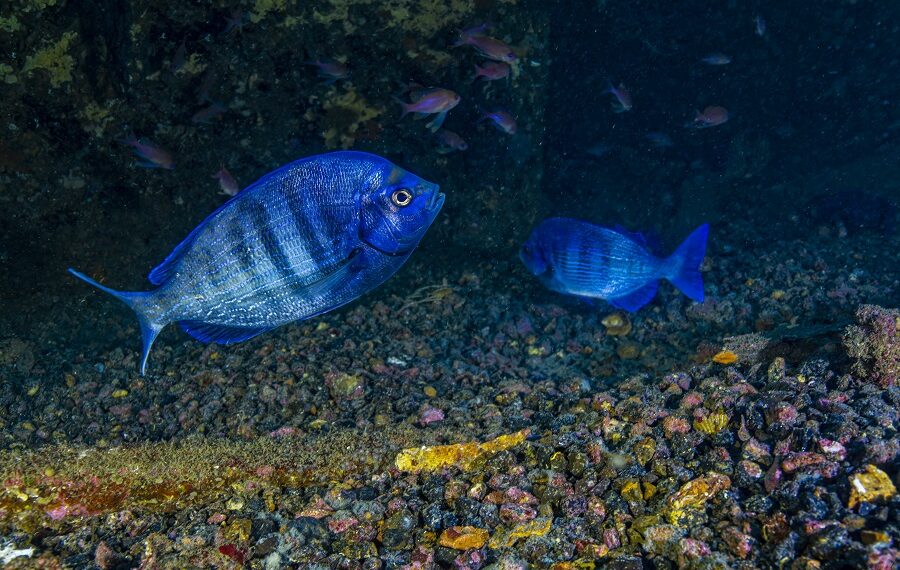
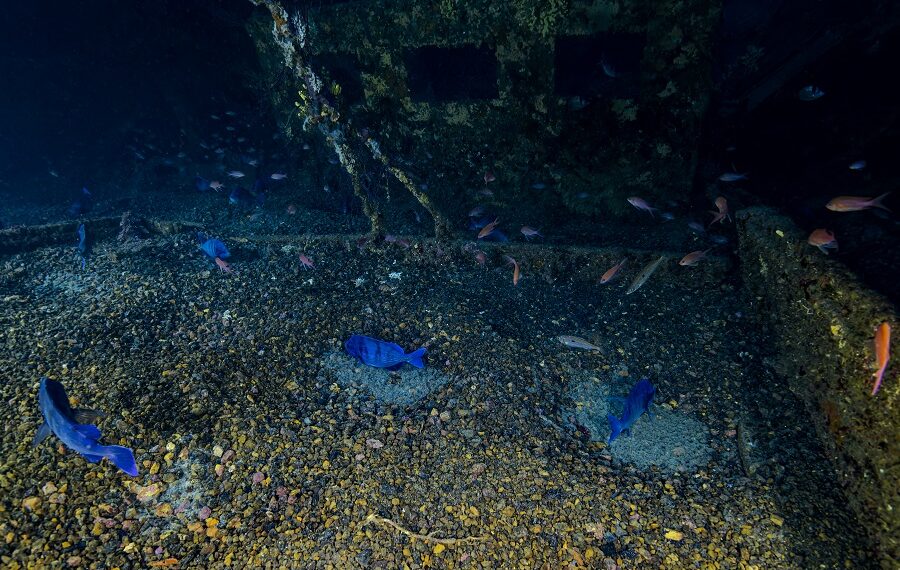
Minutes pass, deco stops increase, and we find them towards the end of the allotted time. What first seems to us like sargo drums with their wide vertical stripes, dark blue as they are shrouded in shadow, remain unyielding at this depth, too great for them… Upon closer inspection, the identifying features define black sea bream. These bream are not gray: they see life in blue, magnificent! There, wonderfully, clustered, dozens of holes about thirty centimeters in diameter dug in the sand covering the metal are individually guarded by these males with their unusual coloring.
Upon returning onboard and debriefing, we schedule a second dive, knowing more precisely where to look. This demonstrates that a wreck is not only an oasis of life or a refuge, it also becomes a nursery, a place for reproduction…
A Mediterranean Specificity
This pronounced blue coloration on a black breamSpondyliosoma cantharus (or black bream, brèmes, grisets) raises questions. According to Linné or Valenciennes’s descriptions based on fishing and various books with sparse photos, the body is silvery-gray, as traditionally observed during summer… BiObs and DORIS indicate that this bluish appearance occurs only 1/ during the breeding season, 2/ in the Mediterranean (remaining dark gray in the Atlantic) and 3/ in the male!
Indeed, the black bream is female upon reaching sexual maturity, at 20 cm (2 years), but becomes male at 35 cm (8 years), being a protogynous hermaphrodite. Finally « he » in this case.
The male prepares this 30 cm to 1 m diameter hole for the arrival of spring conditions to attract females during the spawning period, fiercely defending and ventilating the fertilized eggs for about ten days until they hatch. Then it gradually returns to its inconspicuous coloring, essential to avoid detection despite its size.
The few 5 cm wide black vertical bands suggest the coloring of the sargo drum (Diplodus cervinus) due to the lack of light at this depth**, whereas the black bream has fine horizontal, longitudinal bands during the day. Yes, during the day, because as some note « at night the body is dark and marked with 5 black vertical stripes » (additional sources fishipedia and INPN).
This is therefore a photograph taken during a deep morning dive, with lighting reminiscent of night to this species, in the Mediterranean, breeding season, of the male gray sea bream over 8 years old!
It would only remain to add the presence of the second new moon of this April 2022 to explain that the conjunction of particular conditions can lead to observations worthy of a rare privilege.
Jeremy Delille