


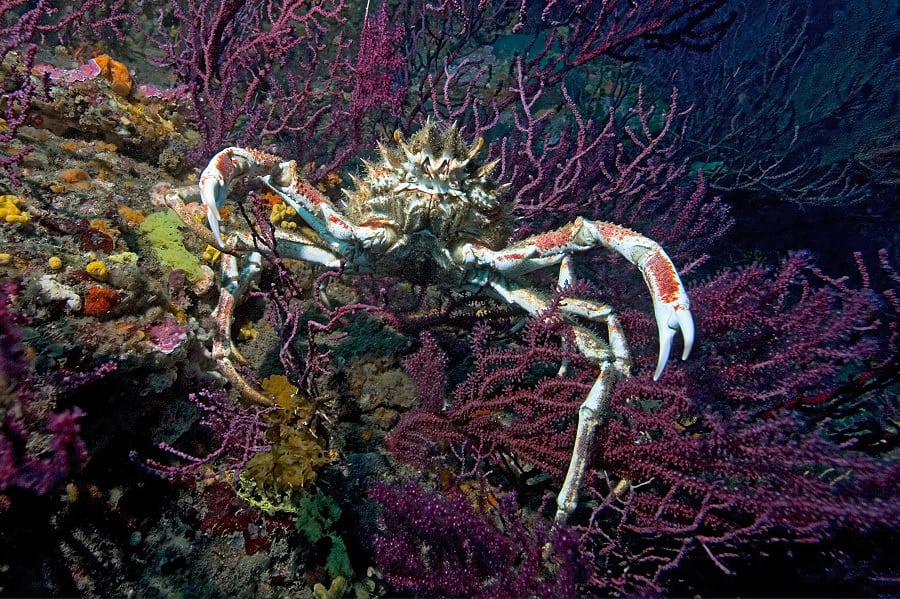
A quick flyover above a seagrass meadow and a slight movement catches our diver’s eye and makes us stop finning to scan the surroundings. It’s hard to see anything in the middle of this meadow and suddenly slow movements become apparent and a long leg clings to the rocky rubble near the meadow. Then a stocky, spiked body emerges from the plants in slow motion and comes to a standstill. A magnificent spider crab has just appeared. A lovely gift offered by Mother Nature!
https://vimeo.com/5116838701- Warning to arachnophobes: Do not be afraid, although its common name designates it as a spider and its impressive size makes it worthy of some nightmares, this creature is actually a crustacean! Arachnids have only 4 pairs of legs and no antennas, which is not the case for our spider crab which has a total of 10 legs and 4 antennas. It belongs to the order of decapods (from the Latin deca = ten and podia = feet).2- An adaptable armor: like all animals with an exoskeleton, the growth of the spider crab takes place through successive molts. To grow, the animal will shed its old shell, which has become too small, and will create a new one better suited to its new size. Growth is rapid during the first 2 years of life then slows down and stops completely. The spider crab undergoes what is called a terminal molt beyond which it will no longer grow, which is not the case for all crustaceans.3- A reparative growth: The molts have a significant advantage: if the spider crab has lost one or more legs eaten or torn off by predators, they can regenerate, allowing the animal to regain its full body. Depending on when this leg was lost, it will regrow either at the next molt or the one after. For the spider crab, this reparative aspect will unfortunately disappear with the terminal molt.4 – Queen of camouflage: despite a rather imposing size, it is not easy to observe spider crabs. They move slowly so as not to attract attention, and the orange-brown color of their shell blends perfectly into the underwater scenery. Young individuals take the time to cover their shell with small algae and other organisms that greatly improve their ability to hide. It has been observed that these elements are generally evenly distributed over the entire shell.5 – Only Mediterranean: Maja squinado is a crustacean endemic to the Mediterranean. This large spider crab was long compared to its Atlantic cousin, but recent studies from the beginning of the millennium have clearly identified the uniqueness of this species.6 – A remarkable size: The large Mediterranean spider crab is among the most impressive crustaceans that can be seen in the deep blue. The massive head, which can measure about twenty centimeters, is surrounded by thick spikes. The front part ends with 2 solid and imposing V-shaped rostrums. Its ten long, slender legs are folded under its body, but its wingspan, once deployed, can reach 80 to 90 centimeters!7 – We love it: The 2 front legs end in thin pincers. These do not have the power of a lobster’s or some crabs’ pincers but are very effective for picking apart available food scraps on a dead animal or catching algae and other small crustaceans, worms, and mollusks which will serve as meals. The spider crab does not shy away from consuming a few algae to further enrich its varied diet. Ultimately, anything that is immobile or does not move too quickly is potentially edible.
8 – A large-scale reproduction: the breeding season seems to start in January and lasts 3 to 4 months. Scientific studies report 2 to 3 spawning periods with egg quantities ranging from 40,000 to 400,000 depending on the individuals and their size. The female jealously guards her offspring between the folded segments of her abdomen. 6 to 7 weeks of incubation will allow the larvae to hatch and spend about fifteen days in a pelagic form before joining the seabed.9 – A vertical migration spider crabs leave areas of great depths (beyond 150 m) to join coastal areas at the end of winter during an upward migration. Then, after a few months, around autumn, they descend back to their wintering areas.10- A name that is not new: The scientific name Maja squinado comes from the contraction of the terms:Maja (or Maia) is a type of crab described in the works of Aristotle and Pliny the Elder, but may also be the name of an ancient goddess whose festival was celebrated in May; Squinado comes from the Provençal « esquinado » meaning a bent or hunchbacked person – which perfectly matches this beautiful crab hunched over its legs.
Fabien Valladier