


Tryon’s nudibranch: the battered beauty of the seabed
Underwater, the spectacle of Tryon’s nudibranch (Hypselodoris tryoni) immediately catches the eye. With its elegant mantle speckled with purple spots resembling acne pustules, this nudibranch bears a name as poetic as it is mysterious. Yet, behind its refined appearance lies a much harsher reality: Tryon’s nudibranch faces various forms of harassment daily in the ruthless world of marine life.
An extraordinary being in the heart of the underwater world
Tryon’s nudibranch presents a fascinating particularity: it is both male and female, like all nudibranchs. This hermaphroditism places it in a unique category, where each individual can fertilize and be fertilized. It could almost be considered an icon of sexual diversity in the animal kingdom.
Does this explain the sometimes strange behavior of its peers? Not really, as all nudibranchs share this characteristic. Yet, it is not uncommon to observe intriguing processions where several nudibranchs follow each other closely, almost stuck to one another.
Mysterious processions: social behavior or mating display?
- Tryon’s nudibranchs sometimes move in a line, giving rise to strange parades on the sand.
- Several theories exist, the most likely being that it is a reproduction-related behavior, although scientists still hesitate to decide.
Invasion of stowaways
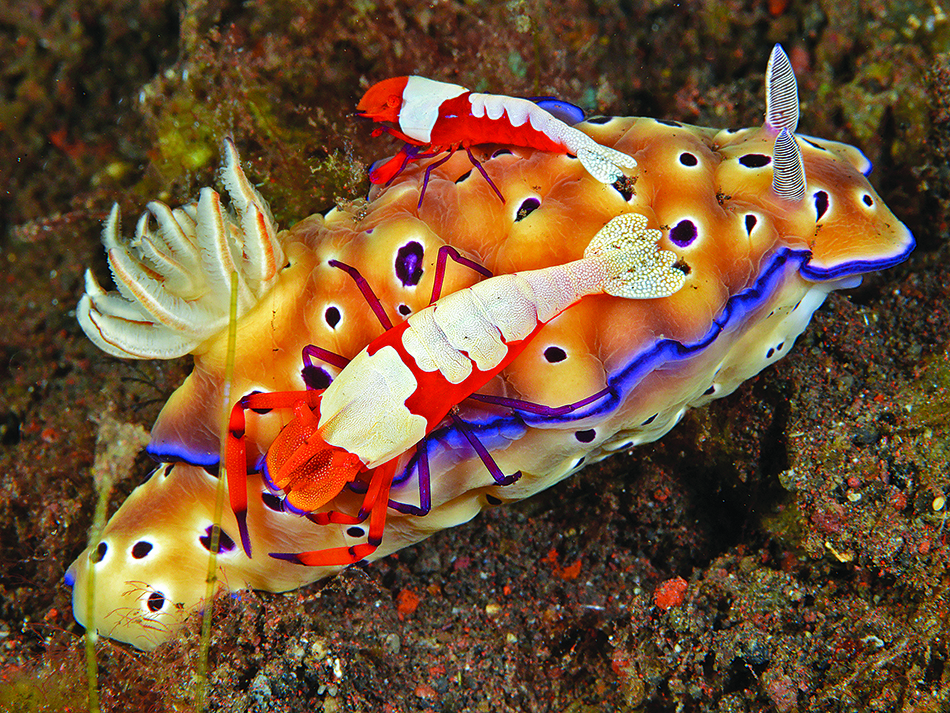
The harassment of Tryon’s nudibranch doesn’t stop with its peers. Other creatures take advantage of its relative slowness to travel for free. Imperial shrimp (Periclimenes imperator), recognizable by their orange and white livery, eagerly climb onto its back for free transportation, while taking every opportunity to feed.
- Imperial shrimp use the nudibranch as an underwater taxi, collecting organic debris along the way.
- This relationship, classified as symbiosis, hardly benefits the nudibranch, which derives no advantage from this cohabitation.
The invisible threat of parasites
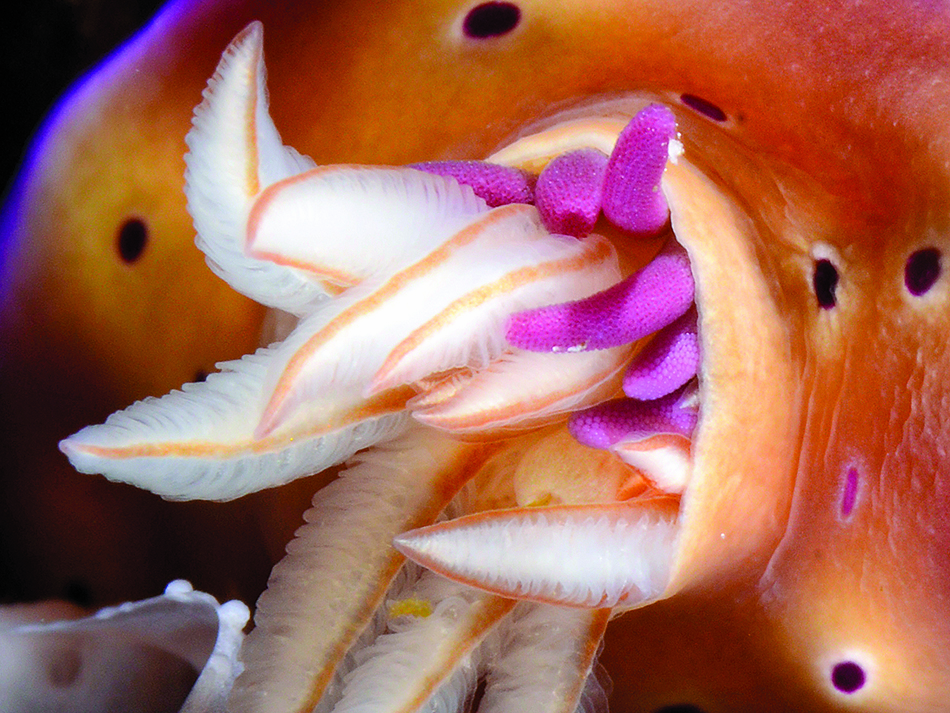
Even more concerning, some parasites discreetly join Tryon’s nudibranch. Copepods from the Splanchnotrophidae family infiltrate its gills to feed at its expense. Invisible from the outside, only their purple egg sacs betray their presence and weaken the host animal.
- Parasitic copepods steal food from the nudibranch while remaining hidden in its gills.
- Their egg sacs protruding from the gills signal an often devastating parasitosis for the victim.
Underwater harassment: a natural balance
Underwater, these multiple forms of ‘harassment’ primarily demonstrate adaptation and survival, without malice or real harmful intent. They illustrate Darwin’s golden rule of nature: only the best-adapted thrive, and Tryon’s nudibranch is a perfect example, blending beauty, fragility, and resilience.
To learn more about nudibranchs and underwater survival strategies, consult this NOAA article.
Photo Legends
- Processions of Tryon’s nudibranch: the mystery of these corteges remains, mere parade or prelude to mating?
- Two imperial shrimp (Periclimenes imperator) practice ‘nudibranch-hopping,’ eagerly enjoying transport and lodging.
- The purple egg sacs protruding from Tryon’s nudibranch’s gills belong to parasitic copepods, to the host’s detriment.
This article, initially written by Steven Weinberg, has been adapted for the web.
Photographer: Steven Weinberg