


Photos © Steven Weinberg and François Libert
There are over 130 species of butterflyfish! Whether swimming alone, in pairs, or in schools, these colorful fish are often found in the shallow waters near coral reefs, delighting photographers.
Butterflyfish: Gems of the Reefs
In the tropics, divers frequently encounter butterflyfish belonging to the family Chaetodontidae. More than half of them feed on coral (polyps or mucus), which limits them to shallow depths. These fish are distinguished by:
- A disc-shaped body, very tall and strongly laterally compressed.
- A symmetrical anal fin with a soft dorsal fin.
- A terminal mouth equipped with fine comb teeth (the name Chaetodon means « comb teeth »).
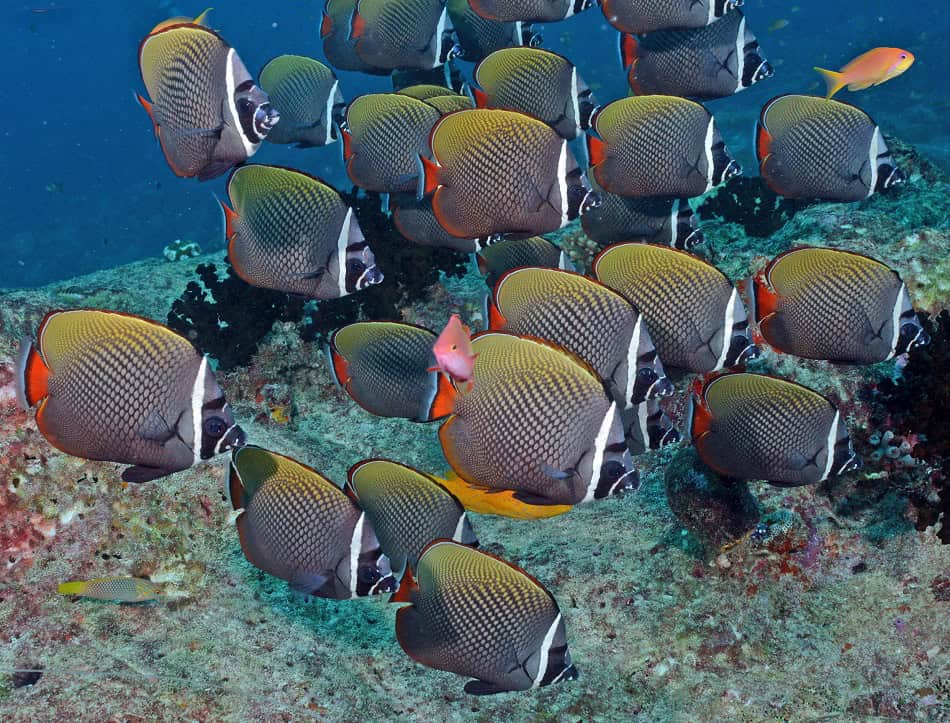
Depending on the species, butterflyfish can be seen alone, in pairs, in small groups, or in large schools. This diversity of colors and behavior excites underwater photographers. However, with over 130 species, this article cannot present them all. For a more exhaustive exploration, consult our Indo-Pacific guide, which inspired this article.
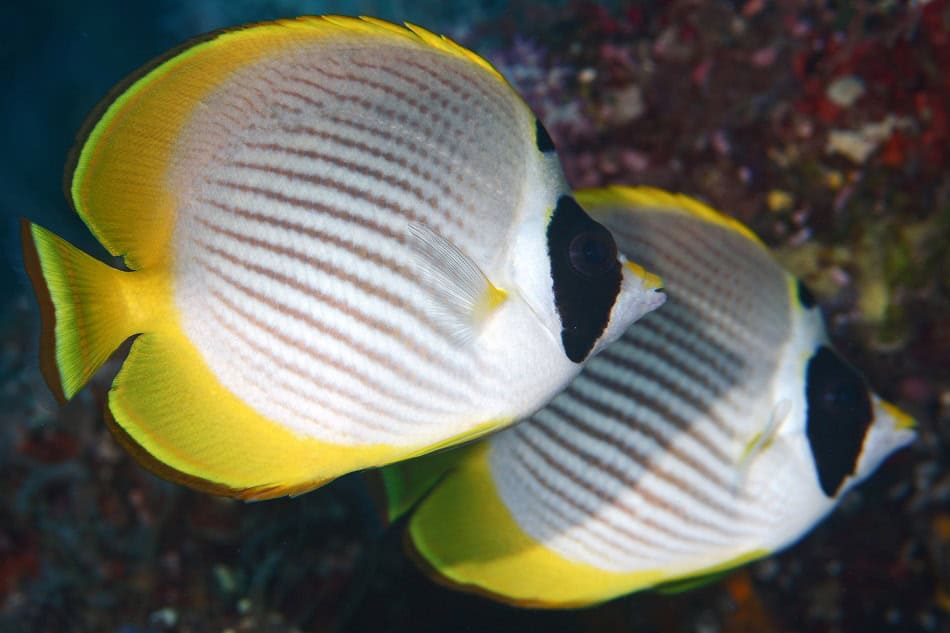
The Richness of Colors
Like other fish (angelfish, parrotfish, wrasses), butterflyfish display bright colors. But what explains these varied palettes? Evolution plays a crucial role. Mutations cause variations (size, shape, color), followed by natural selection. If a mutation is advantageous, the carrier has a better chance of survival (the « survival of the fittest » according to Charles Darwin) and passes these genes on to its offspring. Conversely, disadvantageous traits are quickly eliminated.
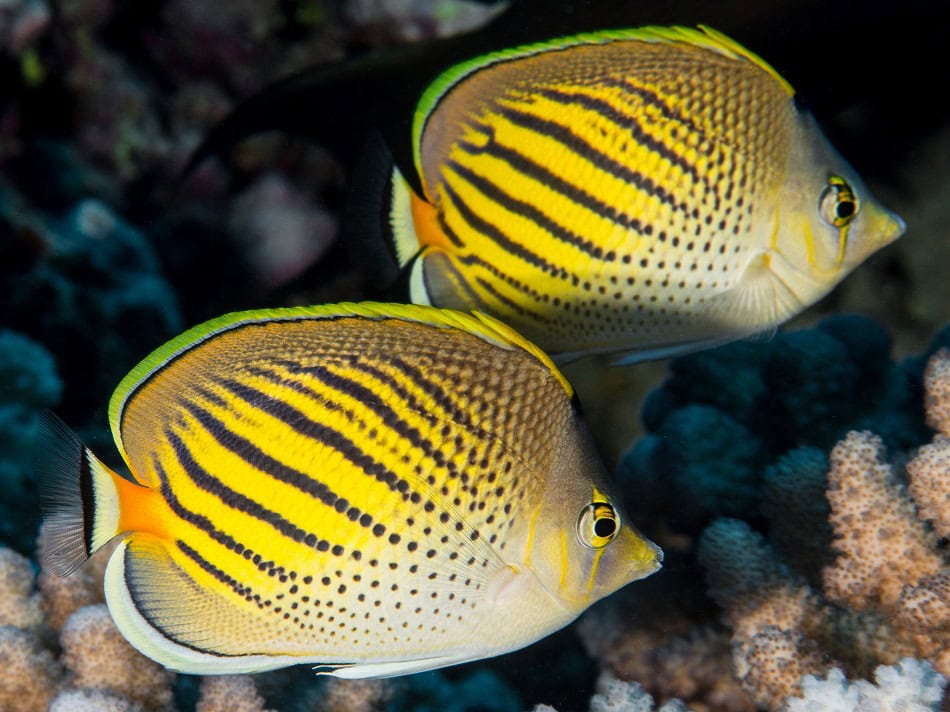
In an environment where hunters and prey seek to camouflage, how do we explain the bright colors of butterflyfish? There are two main reasons:
Many fish do not perceive colors acutely.
Warm colors (red, orange, yellow) quickly become invisible underwater, turning grey-green.
Thus, these bright colors, although acquired by mutations, do not hinder their survival. What matters is staying discreet. Among the strategies to achieve this is hiding their eyes or suggesting larger false eyes – a phenomenon called ocelli. Butterflyfish excel in these tactics!
Did you enjoy this excerpt?
Read the full article.
READING TIME ≈ 9 min
Dive into the heart of PLONGEZ! Magazine
To enjoy this article and its exclusive content, a modest participation is required.