


On February 24, 2019, the winners of the Underwater Photographer of the Year (underwater photographer of the year) were announced! This prestigious annual contest, based in the UK, celebrates photography below the surface of oceans, lakes, and even swimming pools. The Briton Phil Smith was the first to receive the supreme award in 1965. The competition now has 13 categories. It offers photographers themes such as macro photography, wide angle, behavior, and wreck, as well as four categories dedicated to photos taken specifically in British waters. The jury was composed of Peter Rowlands, Martin Edge, and Alex Mustard, renowned underwater photographers.
1st place behavior category and prize Underwater Photographer of the Year 2019 (photographer of the year 2019): Richard Barnden (United Kingdom)
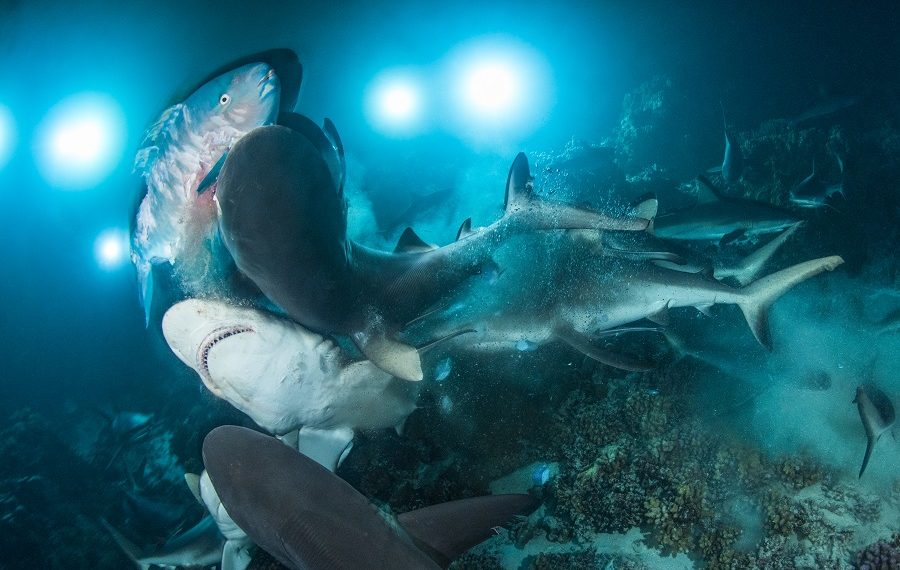
British photographer Richard Barnden, named underwater photographer of the year 2019, captures the exact moment when a group of grey reef sharks catch and devour a parrotfish. “The Gauntlet” was taken underwater, late at night, on Fakarava reef in French Polynesia. Richard Barnden explains: « When I descended, hundreds of sharks covered the seabed. This unlucky parrotfish flinched, and this little movement alerted the sharks. Chaos unfolded around me and I instinctively pressed the shutter button of my camera. Moments later, only a rain of scales remained in the darkness, and this photo on my camera’s memory card. » Barnden, 40, hails from Brighton, England, but now lives in Palau (Micronesia).
Alex Mustard, the head of the jury, comments: » Photography is about preserving moments and creating an unforgettable image. Using a wide-angle lens, the photographer immerses us in the drama of the hunt, as a melee of grey reef sharks rises like a surging wave to tear apart their prey, thus revealing the ocean’s wilder side. »
1st place “up and coming” category (beginner) and prize Up and Coming Underwater Photographer of the Year 2019 (beginner photographer of the year 2019): Taeyup Kim (South Korea)
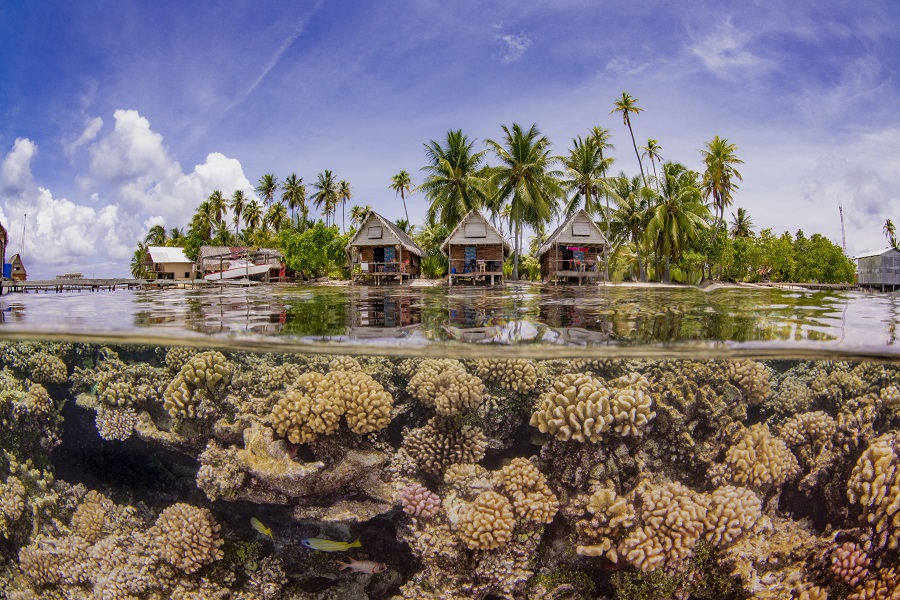
The underwater photographer of the year contest also aims to promote emerging photographic talents. South Korean Taeyup Kim was named beginner underwater photographer of the year 2019 for a technically challenging image, half-air and half-water. “Paradise” showcases healthy corals growing on the edge of the southern pass of Fakarava in French Polynesia. Kim explains « this photo was physically challenging to take, I had to hold the camera exactly in the right position while floating in the water« .
Jury comment, Martin Edge: » A perfect split between air and water. One of the best examples of this type of image I have seen for a while. »
4nd place “wide angle in British waters” category and prize Most Promising British Underwater Photographer of the Year 2019 (most promising British photographer of the year 2019): Malcolm Nimmo (United Kingdom)
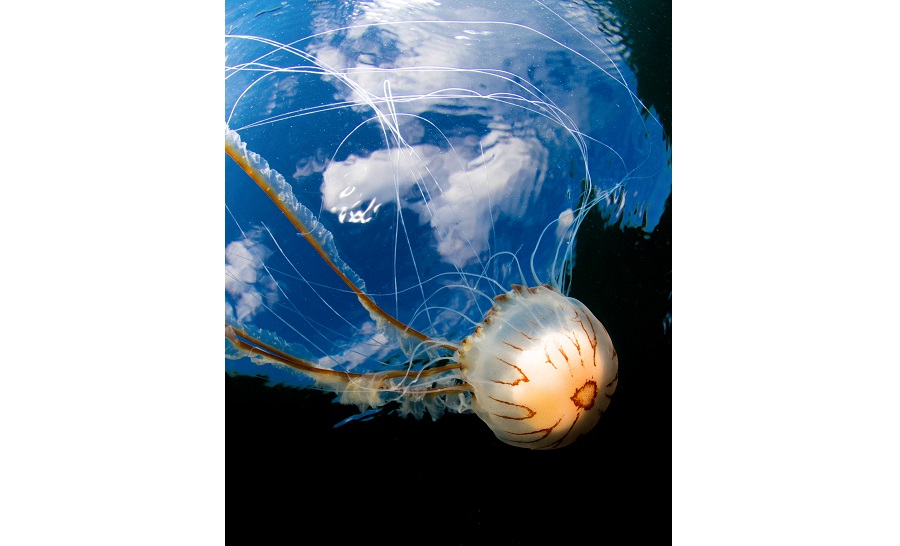
The title of most promising British underwater photographer goes to Malcolm Nimmo from Plymouth, England. His image “Marine Compass” was taken during a snorkel dive in the Scilly Isles, UK. Nimmo explains that » maintaining both the surface features and subject lighting requires significant adjustments and meticulous positioning. Hopefully, this image highlights the beautiful underwater landscapes we are fortunate to have in the UK. »
Jury comment, Peter Rowlands: « Composition, color dynamics, and contrast combined with an unusual angle, it moved up in the ranking with each viewing. »
1st place “Marine Conservation” category and prize Marine Conservation Photographer of the Year 2019 (marine conservation photographer of the year 2019): Eduardo Acevedo (Spain)
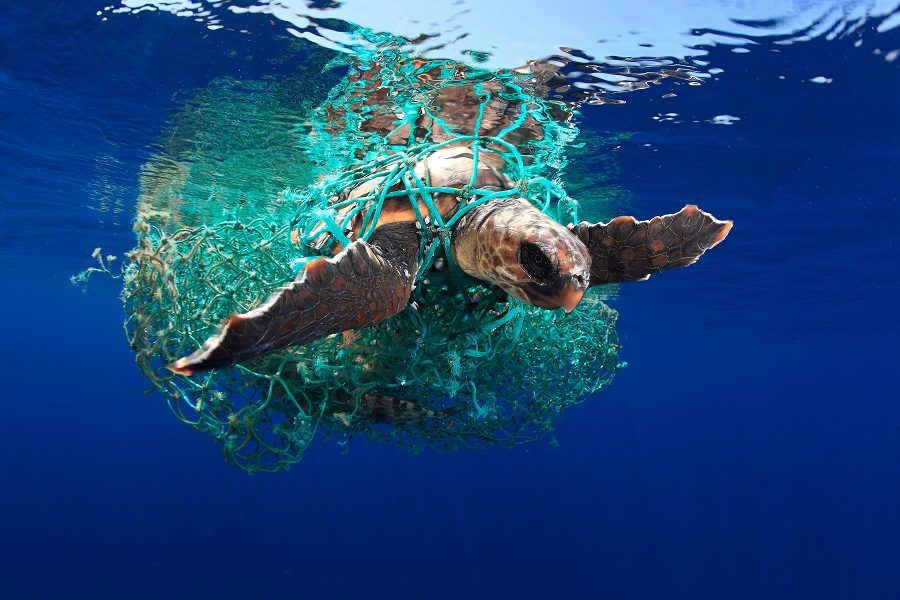
Spanish photographer Eduardo Acevedo was named 2019 photographer of the year for marine protection with his photo showing a loggerhead turtle trapped in a plastic fishing net. Acevedo states, » turtles arrive from the Caribbean to the Canary Islands crossing the Atlantic Ocean and must avoid many human-origin hazards, such as plastics, ropes, and fishing nets. This turtle was lucky as we managed to release it and retrieve the net. »
Jury comment, Alex Mustard: » plastic pollution and ghost nets are severe issues threatening the ocean, this poignant image highlights it ».
1st place “Wide Angle” category: François Baelen (France, Réunion)
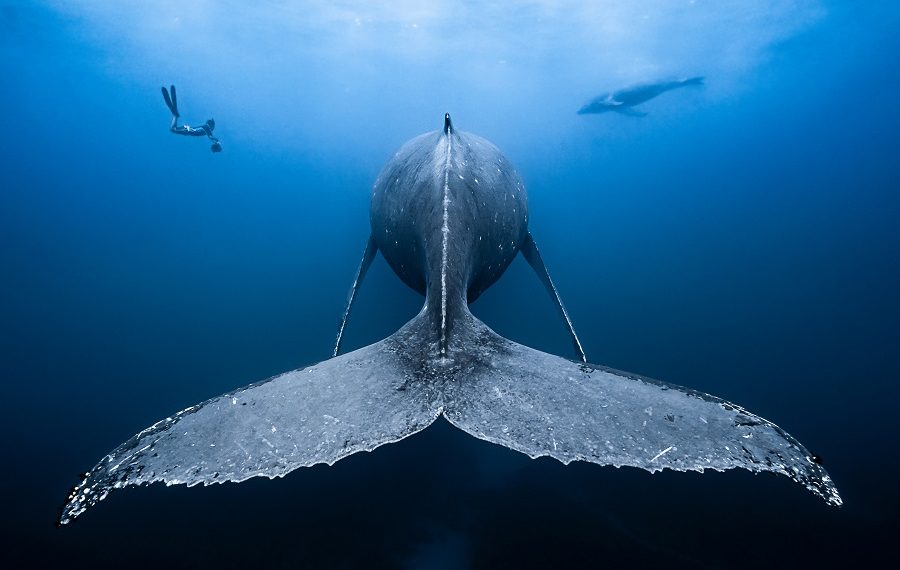
« At the end of the day, this humpback whale was resting 15 meters deep and allowed me to dive just a few centimeters from its tail. I told my buddy I wanted him to be part of the picture, but I didn’t need to ask the calf: it was very curious. From there, the scene seemed unreal and I am glad this photo captured that moment. Humpback whales are amazing and peaceful animals, and I still can’t believe they are still hunted by some people today. »
Jury comments, Martin Edge: « From the moment I saw this image, I knew it would be a strong contender. For me, it’s all about the symmetry and balance between the whale, the divers, and the calf. Everything is perfectly aligned: the shape of the tail in relation to the four corners of the frame, not to mention the position of the freediver and the calf. Superb image!».
1st place “Macro” category: Fabio Iardino (Italy)
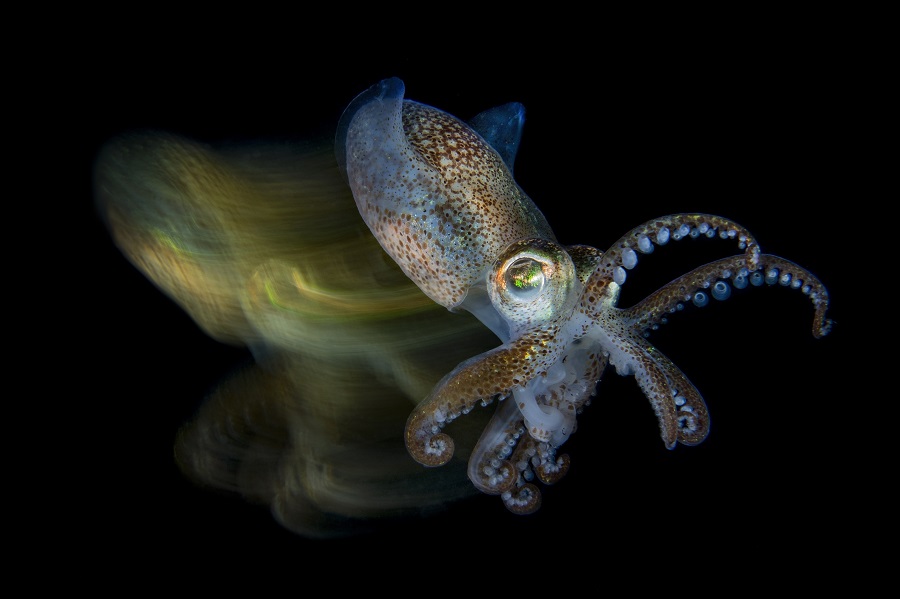
« During the first three months of the year, I often go to the Gulf of Trieste, in northeastern Italy, where I do night dives to photograph small cuttlefish, specifically the « Sepiola sp. » species. The hope, given the period, is to find the cuttlefish during the mating phase. During my search, I found this Sepiola. Seeing its way of moving, I attempted a panoramic shot to photograph the effect of the movement to give dynamism to the image. Using slow-sync technique, after some unsuccessful attempts and modifying my camera settings, I managed to capture an image that represents both movement and visual impact. »
Jury comments, Alex Mustard: « the use of long exposures and pans made us forget the classic portrait of a Sepiola. The image, both sharp and ghostly, with the cuttlefish blends pleasingly into the frame, and, combined with the extended tentacles, gives the sensation that the cephalopod is pouncing on prey. A deserving and innovative category winner.
1st place “Wreck” category: René B. Andersen (Denmark)
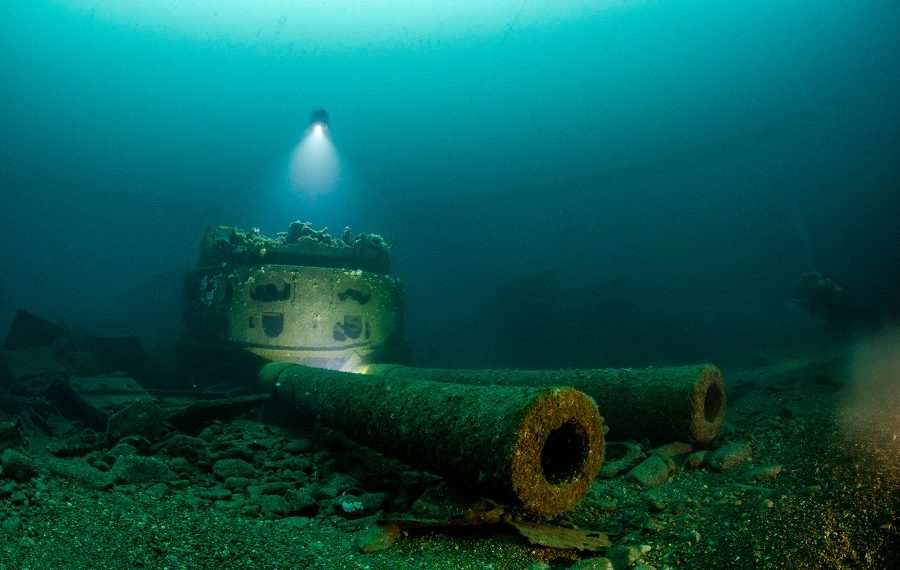
« The inspiration for this photo is the black and white image by Leigh Bishop of the HMS Audacious turret stretching 64 meters at Malin Head, Ireland: a battleship that struck a mine in 1914. I used a tripod and 3 Big Blue video lights to illuminate the turret with its majestic guns and myself as a model. There was a slight current, so it wasn’t easy to stay still during this long exposure. It took some time before taking this photo and at 64 meters, the clock ticks fast. That’s the challenge of deep wreck photography. Using the tripod with myself as the model, there was always a risk of something going wrong as I was far from the camera and had to keep my fingers crossed for each shot. »
Jury comments, Peter Rowlands: « So simple yet so powerful: the extra lighting on the turret and the principal diver perfectly positioned. This was a very strong category this year with a worthy winner, and it’s refreshing to read the recognition of Leigh Bishop’s pioneering work.«
1st place “Portrait” category: Nicholas Samaras (Greece)
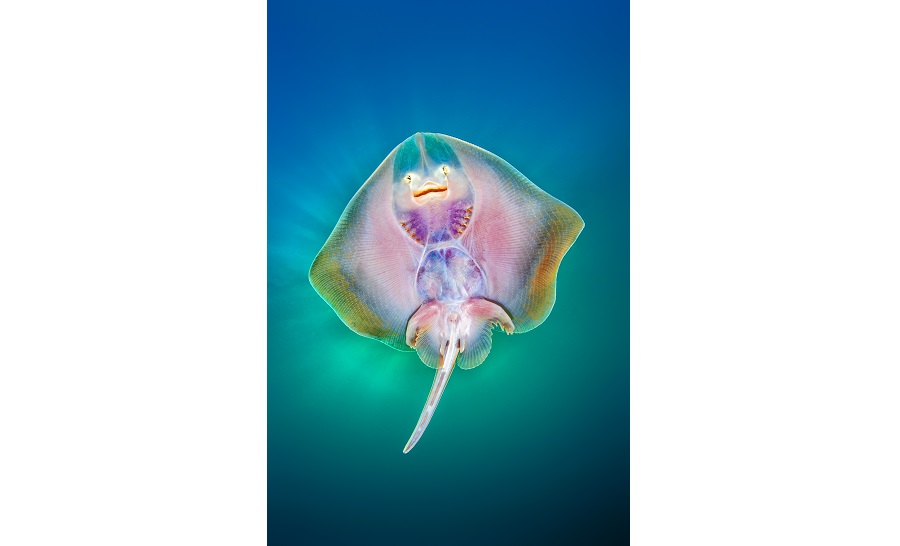 « Abandoned by swimmers and divers for many years due to the gold mine located just nearby the gulf, Stratoni is a well-kept secret for divers and macro photographers. I visited Stratoni three times in August 2018 for a photo project dedicated to the seahorse colony that has managed to survive there. On my third and last visit, I intended to create a group photo of seahorses, just before sunset, using natural light. Just in time for the grand finale, a small ray entered the scene! Hidden in the sand a few centimeters from my camera, it swam away into the shallows. I managed to swim alongside it and place my camera below to capture a portrait of its belly. Its mouth and nose resembled the smiling and joyful face of an angel. »
Jury comments, Martin Edge: « Superb impact from the first moment this photo was presented. Perfect composition in the image frame and muted colors. To top it all off, the author’s comments above say it all… a smiling face of a joyous angel. One of my favorite photos of the competition.«
1st place “Black and White” category: Henley Spiers (Philippines)
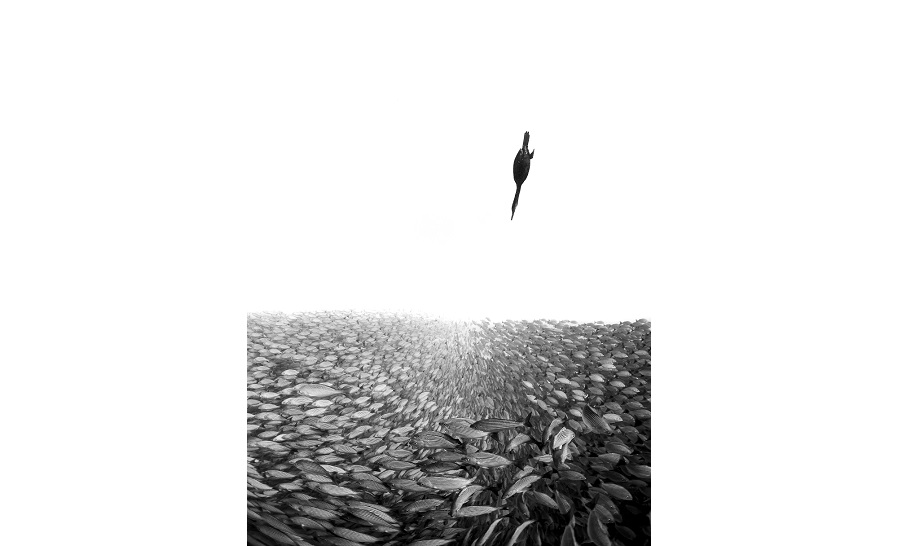 « 10 meters below, I found myself hovering between two worlds. Below, a massive shoal of fish covered the seabed as far as the eye could see. Above, a solitary cormorant patrolled the surface, catching its breath and eyeing a potential underwater feast. The cormorant, better designed for swimming than for flying, dives at high speed, aggressively pursuing the fish. The shoal moved in unison to escape the bird’s pointed beak, making it difficult to isolate a single target. The bird returned to the surface “empty-handed” and peace was momentarily restored. I looked up towards the sunny surface, trying to follow the predator and anticipate its next underwater raid. This image represents the black and hostile silhouette of the cormorant diving on its prey, which, for a brief moment, remains unaware of the impending danger. »Jury comments, Peter Rowlands: « »
You’d have to give this groundbreaking image 11 out of 10. Design, interpretation, and perseverance, coupled with the black and white ability to focus on the key elements.
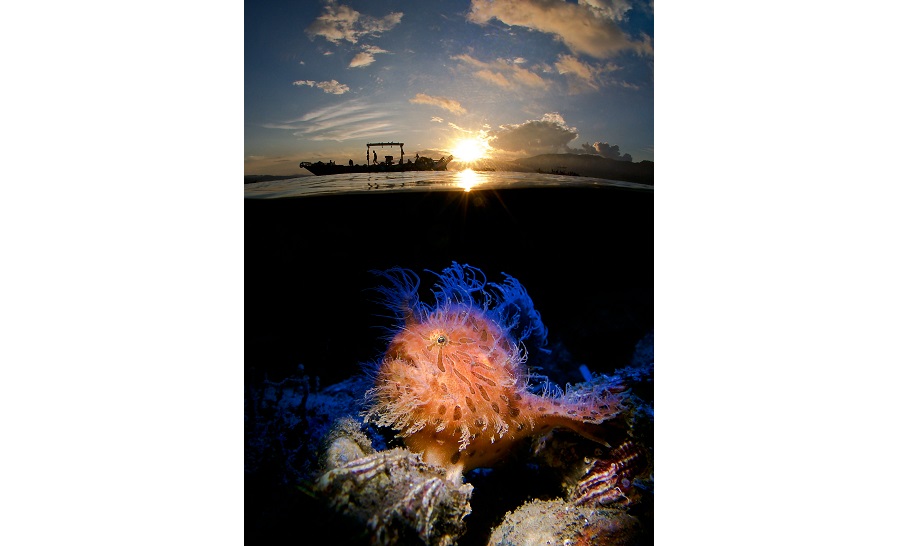 « I got up early in the morning to do a half-air, half-water photo session with a fishing boat and the sunrise. This is the first photo. The second is of a hairy frogfish. I used an Inon S2000 for the hairy one. For the blue backlighting, I used a colored Snoot Fiberoptic on an Inon Z240. To get both images together, I used the double exposure setting in the camera. »
Jury comments, Martin Edge: « This image was a very popular choice among us. What makes it a winner for me, despite the double exposure, is the perfect balance between the light and the colors connected between the upper and lower parts of the image frame.«
1st place “Wide angle in British waters” category: Robert Bailey (United Kingdom)
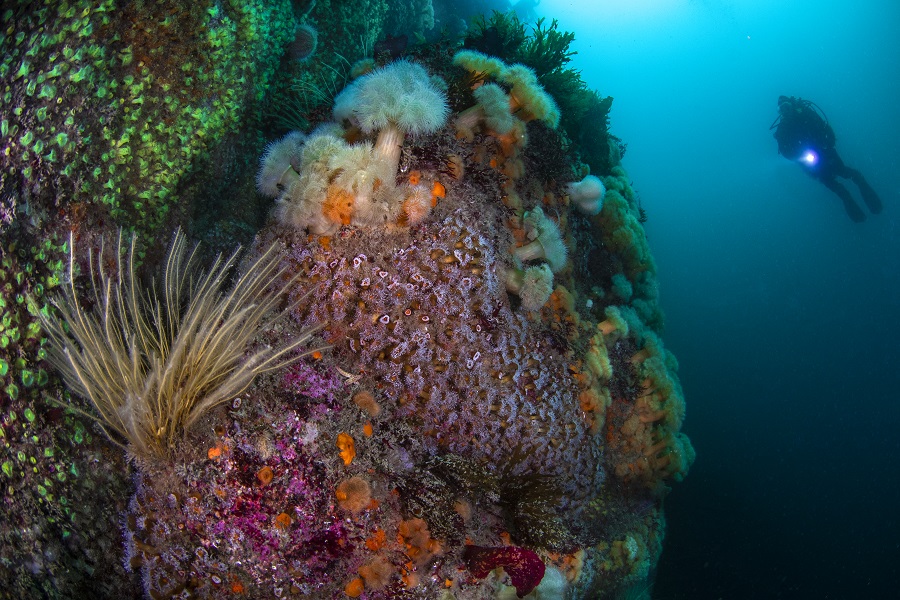 « Our group was with Dive Scilly at the end of last summer. The skipper allowed us to dive on this lovely wall full of invertebrate life. I wanted to capture a good wide-angle landscape with anemones and a diver. Diving in the UK, I found that visibility rarely suffices to achieve high-contrast wide-angle images, let alone with a model. On this occasion, the site, being far offshore, allowed us to have clear water. I took advantage of this to encourage my wife and model Paula to make her way into the frame. I took 20 shots in series on this part of the wall before finding this image. »
Jury comments, Alex Mustard: » Photographers often think that competition photos need to be filled with new tricks to win. At UPY, we always appreciate classic technique when it raises the bar compared to what has been done before. Rob’s comprehensive wide-angle panorama reveals the riches of British seas with an elegant simplicity that is incredibly hard to harness in British diving conditions. »
1st place “Macro in British waters” category: Arthur Kingdon (United Kingdom)
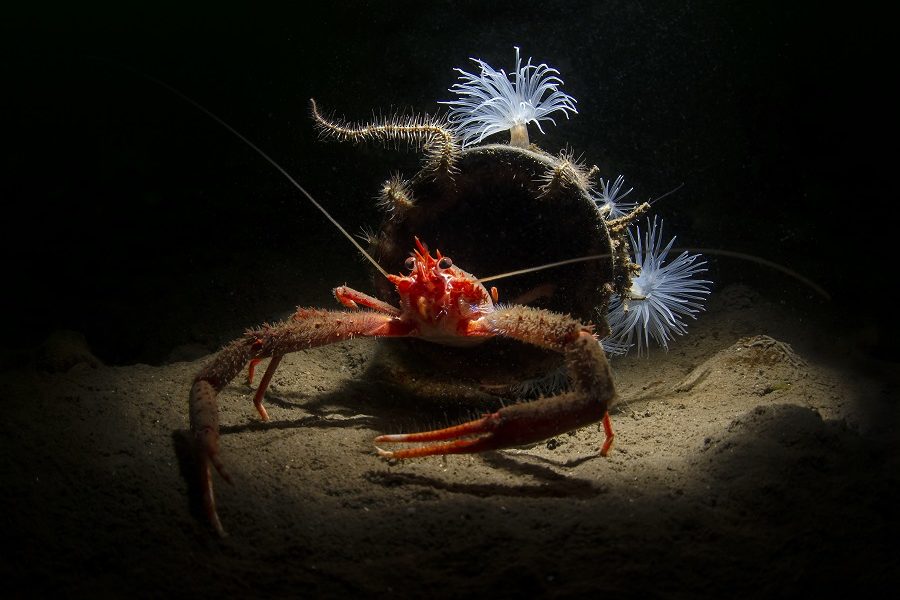
« Easter 2018, I was diving in Loch Duich, on the west coast of Scotland. The subject of my photo was a Pachycerianthus multiplicatus anemone which was on the muddy seabed towards the top of the loch. However, while looking for these elements, I spotted a length of plastic pipe partially buried in the mud. Acting carefully to avoid stirring the silt, I reached the open end and was delighted to find this collection of marine life: a lobster, proudly posing in front of its artificial home, which it shared with numerous friends, while delicate anemones adorned the entrance. To capture the beauty of this scene, I chose to limit the lighting, creating a spotlight effect to avoid illuminating the unattractive background and obtain the angle to light inside the pipe and give the lobster a black background. »
Jury comments, Martin Edge: « One of my mantras is: “What’s important is not what it is. It’s where it is” and this lobster is perfectly placed to create a memorable image. The author, instead of “lighting it up” with light, went in the opposite direction by restricting the lighting to a spotlight in order to illuminate only the features of the lobster and the anemones. Many photographers invest their time in what they want to illuminate. This is an example which, in my opinion, perfectly illustrates the opposite, highlighting the striking black background, the delicate shades of dark sand, the lobster’s features, topped by the anemones. »
1st place “Living together in British waters” (man and the underwater world) category: Victoria Walker (United Kingdom)
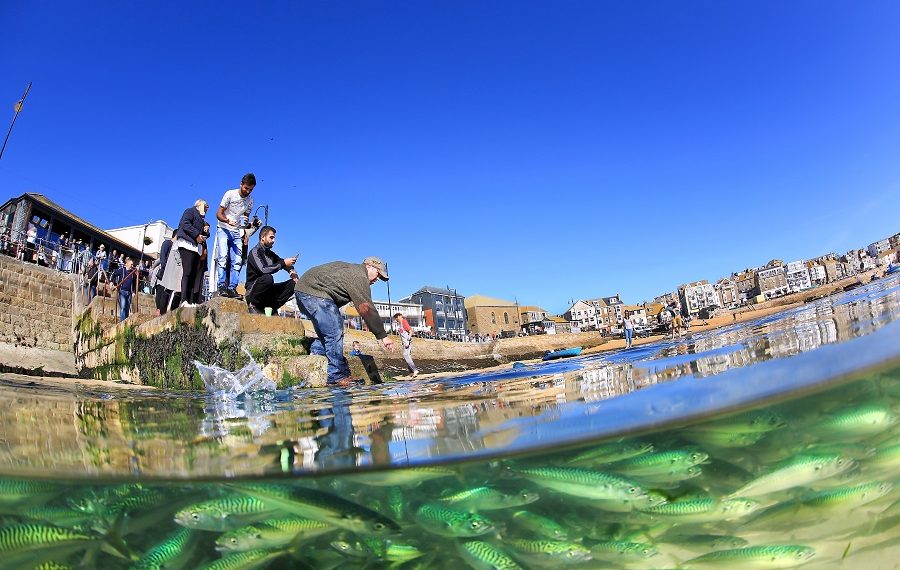
« This huge shoal of mackerel forgot to check the tide schedule! Caught by the spring low tide in St Ives harbor, hundreds of mackerel were trapped for a few hours until the tide came in. I had gone swimming to test my new weight belt with my camera when I came upon this unusual event. A local fisherman told me that this happens very rarely, so I slowly immersed myself in the water to capture this spectacle. I had to sit very still, not wanting to panic the fish, and after just a few minutes, they were swimming all around me. I wanted to capture the audience watching from above, with what was happening below. Fortunately, I had my wide-angle lens to get the composition I wanted. »
Jury comments, Peter Rowlands: » Images tell stories, and those well thought out and executed say a lot. This is an example that feeds the eye with tales of summer days by the sea, lively marine shows, and human interaction.«
1st place “Compact in British waters” category: Martin Edser (United Kingdom)
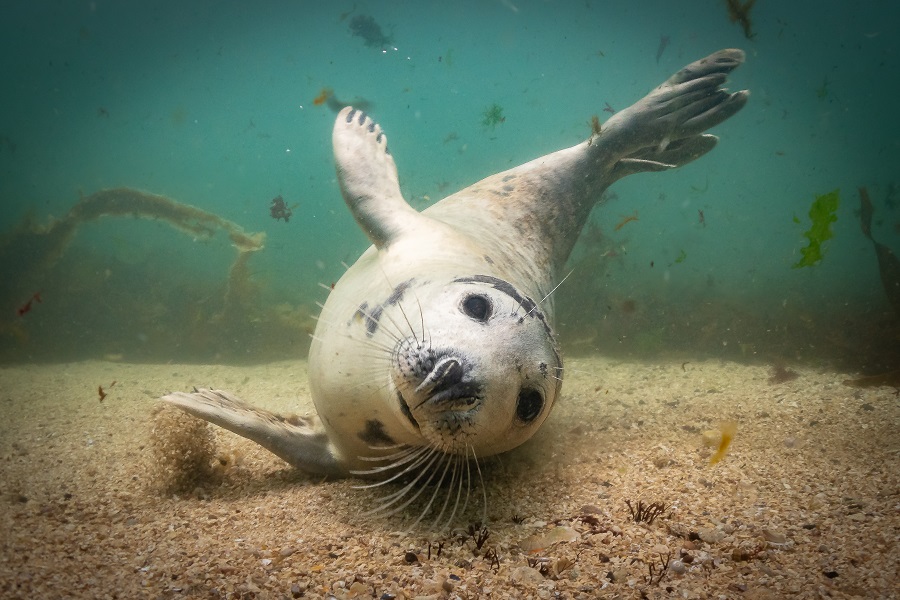
« I love diving and photographing seals, and I have dived with them all around the UK, but this was my first trip to the Farne Islands and what a “seal festival”! The younger ones were particularly curious about us, the big heavy black monsters. This is great for us photographers, as we can wait for them to become more and more curious. This adorable seal twirled and sketched arabesques around me before slipping and throwing sand on itself in a final attempt to make me play – and it almost worked! Using ambient light and managing the aperture and shutter speed, I tried to focus and lock on the face while also capturing an impression of movement, but the pose and irresistible eyes are the work of the seal. »Jury comments, Alex Mustard: « Does British diving get any better than the fun encounter with a baby grey seal? The relaxed and curious face of this youngster is beautifully captured by Martin, making us want to be there too. »
You can find all the awarded images here: