


Even if you listen closely underwater, you won’t hear the loud scallop sing – Scyllares latus. This large crustacean is rather shy and discreet unlike its land counterpart, which loudly announces the return of good weather. Encounters with the large scallop are rare, but generally, when a group has the chance to meet one, the whole boat is quickly informed.
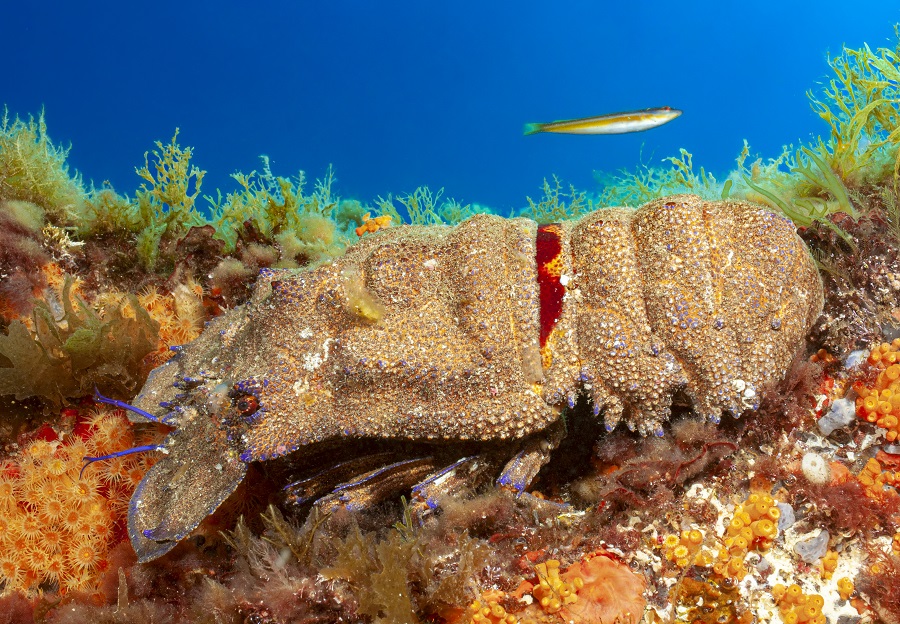
1- A wasp waist… no! A scallop: The large scallop looks like a big flattened lobster whose antennas have disappeared in favor of two large ‘paddles’ acting as shields on the front part of the animal. Its bulky body can reach a respectable size between 35 and 50 cm. It is a sort of underwater tank whose armor gives its predators a hard time.2- A solid armor: It belongs to the subphylum of crustaceans and thus has a rigid, articulated shell that covers almost its entire body. This external protection, although very effective, has the drawback of not following the growth of the animal. Therefore, to grow, it must shed the shell that has become too small and create a larger one. This complex phenomenon is known as molting, and the shell left in nature is called the exuviae. As the animal ages, the intervals between molts become longer.3- Things are moving with scallops: Large scallops are decapods. They move on various substrates with five pairs of legs located under the thorax, unfortunately imposing a certain slowness… In case of danger, however, it will show great speed by quickly folding its abdomen on itself to flee backward.4- An all-terrain camouflage: The shell of the large scallop is reddish-brown and blends wonderfully into the cracks and caves where it resides. Its rough appearance clearly enhances this camouflage. However, it retains a small touch of perfectly identifiable color with purple edges bordering the various plates composing its head. The oldest individuals, who molt the least frequently, see their shell covered with numerous microorganisms that further enhance their ability to hide.5- Varied habitats: Found in the Mediterranean and along some coasts of the Eastern Atlantic Ocean, the large scallop is mainly encountered in caves, cracks, and cavities located near detrital bottoms. It can live in areas ranging from 4m to over 100m depth.6- It’s time to eat: The large scallop is primarily carnivorous and loves to feed on mollusks, small bivalves, and gastropods like limpets. The strength of the end of its legs is a formidable tool that allows it to pry prey off their support and open shells with ease. That said, the large scallop can also be opportunistic and does not hesitate to feed on the remains of decomposing animals that it encounters along its way.
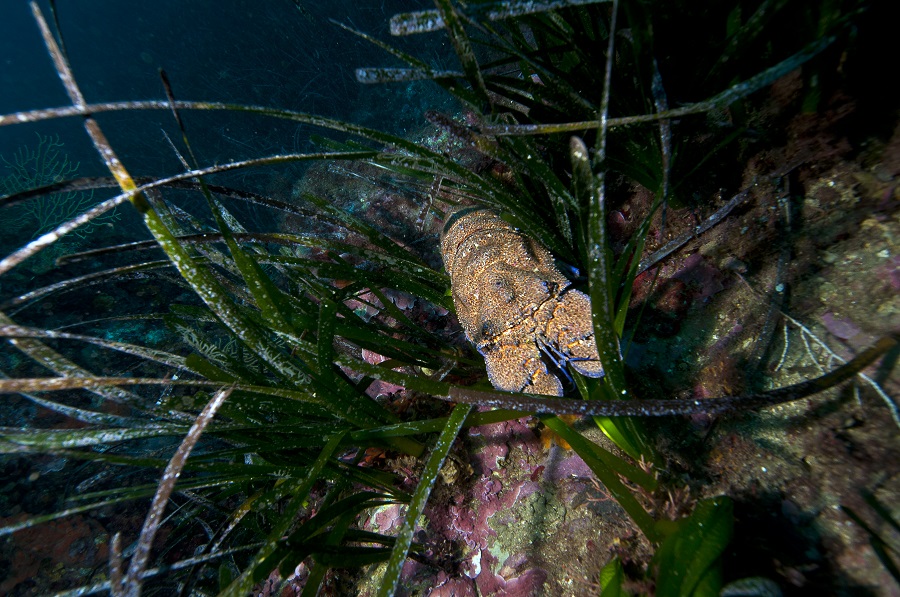
7- Hair on the legs: the numerous cilia and hairs on the legs of the large scallop are highly effective sensory organs. Thanks to them, it can feel the movements of surrounding predators as well as potential prey it would like to enjoy. Indeed, it has the ability to detect vibrations that animals can produce and thus track them down, even if they are buried a few centimeters deep.8- Night is party time: like many crustaceans, the large scallop is primarily nocturnal. Except for some disturbances, it will remain hidden deep in the crevices it inhabits. Despite this, it is an animal that dislikes solitude and prefers to live in groups. This gregarious behavior is complemented by gatherings in specific places during breeding periods.9- The scallop and its young: The large scallop generally reproduces during the warm months of summer and spring. Following this, the female will retain all her eggs under her abdomen until they hatch. She has small pincers on her posterior legs allowing her to access her clutch and maintain it properly. The rest is still poorly understood as few larvae have been found and observed to date. Hypotheses lean more towards planktonic growth followed by a phase where juveniles would return to the seabed.10- A sought-after dish: Though rare, the large scallop was a sought-after and appreciated delicacy among seafood lovers. However, since the decree of November 26, 1992, this species is fully protected in France. It is also part of the species named in the European directive on habitat preservation. Unfortunately, these protections end at the simple borders of countries, and specimens along the African coasts are still under heavy fishing pressure.
Fabien Valladier
https://vimeo.com/274271196.Cover image © Nicolas Barraqué