


Named for its wing-like fins, the lionfish (Pterois volitans and Pterois miles), also known as lionfish or scorpionfish, is today considered an invasive species. Endemic to the Pacific and Indian Oceans (and the Red Sea for Pterois miles), it has gradually colonized the Caribbean arc and has recently appeared in the Mediterranean basin, where it threatens ecosystems and biodiversity.
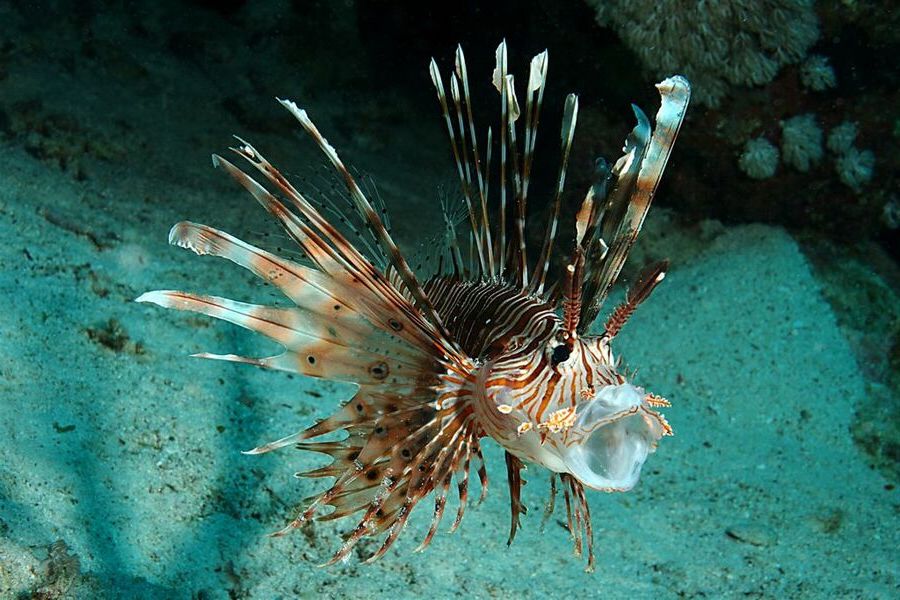
1) Escaped from an aquarium! Following Hurricane Andrew in 1992 on the Florida coast, lionfish were released into the Atlantic Ocean. The species is now considered established in the Caribbean and has more recently appeared in the Mediterranean, most likely arriving through the Suez Canal.2) Invasive exotic species: the lionfish can destroy up to 80% of the surrounding local species. It belongs to the category of Invasive Exotic Species (IES), meaning a species introduced by humans outside its natural distribution or dispersal area.3) Voracious: the stomach of the lionfish can expand to 30 times its own size, allowing it to feed abundantly. Prey are captured with a quick snap of the protrusible jaw followed by suction. The observed populations are increasingly larger, with some individuals reaching up to 38 cm long.4) Remarkable defense: the stripes on its body signal a warning to its predators. Indeed, the lionfish has 18 spiny rays on its dorsal, pelvic, and anal fins, each possessing a pair of venom glands. When they come into contact with a predator, they secrete a neuromuscular toxin into the victim’s body.5) A non-lethal venom: the lionfish can cause excruciating pain, paralysis, and breathing difficulties. Fortunately, it is not fatal to humans, and the venom is thermolabile: its effects can be mitigated by a heat source.6) A nocturnal hunter : Pterois volitans mainly hunts at night, though some individuals have been observed active during the day. Caution, at night it is particularly attracted to divers’ lights…7) Rapid proliferation: lionfish are sexually mature after just one year, and their reproduction occurs at night every 4 days. A female can lay up to 40,000 eggs, which she envelops in mucus forming two masses that are then fertilized by the male.8) The shark, its only potential predator: this species has virtually no predators. Only sharks can identify them as potential prey, but do not naturally approach them due to their strange appearance. Since 2011, teams from marine parks of various Caribbean islands have attempted to train sharks to feed on the invasive fish.9) An edible fish: to fight against their proliferation, permits are granted to divers to allow them to kill the lionfish with spears. This fish is indeed edible, and restaurateurs are strongly encouraged to add it to their menus.10) A robot, the ultimate solution? Studies have revealed a denser presence of lionfish at 200 meters depth. A prototype robot capturing lionfish appeared in 2015, currently in a testing phase. The RISE program (Robots in Service of the Environment – Robots in the service of the environment – https://www.robotsise.org/), an independent non-profit organization, recruited scientists, all volunteers, to develop ROVs (remotely operated underwater vehicles). One of the first two prototypes is equipped with a spear, the second model electrocutes the lionfish with a robotic arm equipped with two metal electrodes.
https://vimeo.com/410113089Where to find it? The lionfish is mainly located in the Indo-Pacific ocean, the Red Sea, and the Caribbean.
Lisa Ferré