


In the distance, a shadow emerges in the blue. The outlines of the silhouette slowly take shape. As if emerging from a dream, a fantastic creature appears in our field of vision. Gently gliding towards us, a manta ray comes to meet us. A magical moment… As if cut off from the world and time, the graceful and aerial movements of this extraordinary ray hypnotize us and are etched in our memory forever. A wonderful encounter that only Mother Nature can offer us!
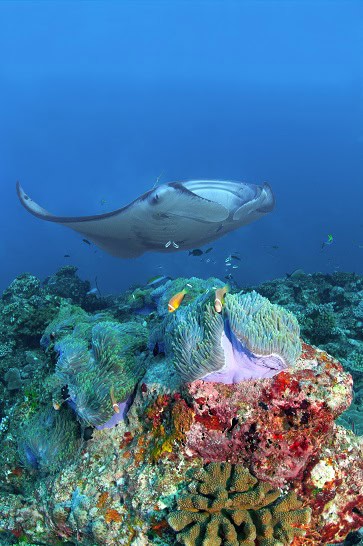
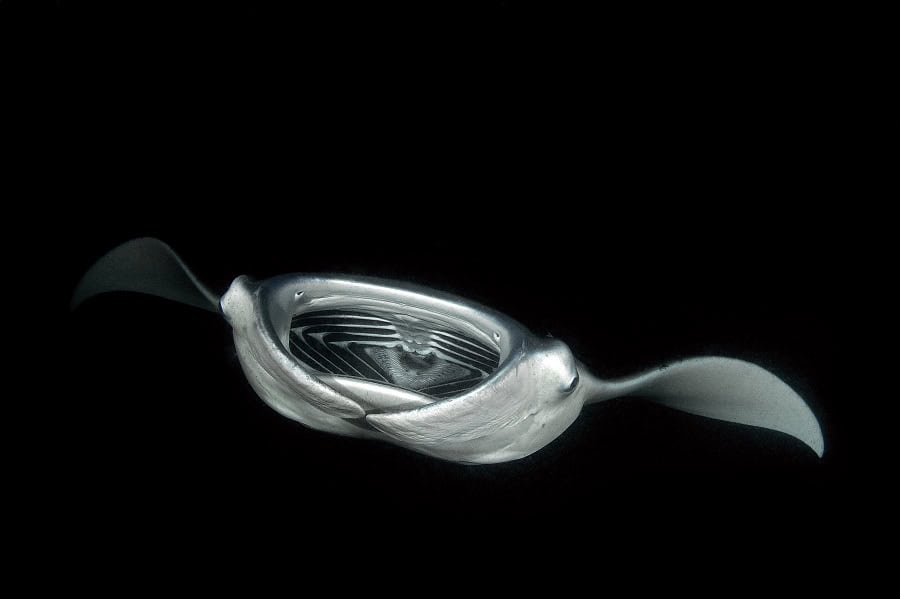
1- I am confused: the reef manta ray (Mobula alfredi) is apparently the most « commonly » encountered species but it has often been confused with its giant cousin, the oceanic manta ray (Mobula birostris). Besides the larger adult size of the latter, coloration is one way to quickly distinguish them while diving. The dorsal side of the reef manta has softer and more graduated color transitions between black and white, while the oceanic manta shows much more contrasting coloration between these two shades. Of course, this is not the only criterion, but observation time is often limited…2- Newly recognized: the highlighting of the species Mobula alfredi is very recent, as genetic studies conducted in 2010 validated its taxonomic existence, allowing it to be differentiated from Mobula birostris. Its name is a tribute to Prince Alfred I, son of Queen Victoria.3- A big creature: The reef manta ray is one of the most impressive species of cartilaginous fish. This close relative of sharks has two immense pectoral fins that can give it a wingspan of over 5 meters! The whip-like tail is longer than the body, and the mouth, located terminally, is surrounded by two so-called cephalic fins. It does not have a caudal spine and therefore poses no danger to humans. Its skin is covered with fine denticles, whose primary function is to offer better fluidity in movement.4- Who said « light » breakfast?: Contrary to what its wide mouth might suggest, the manta ray mainly feeds on plankton and microorganisms. Its cephalic fins unfurl to form a true funnel that channels food directly into the animal’s mouth. Of course, amidst the vast amount of ingested plankton, some small fish may slip in, enriching the menu.5- A regular encounter: As its name suggests, the best way to encounter the reef manta ray is to position yourself above the reefs where it seeks food and also accesses a very important site: the cleaning station. Manta rays position themselves near these areas to benefit from the help of small cleaner wrasses that rid them of parasites and other elements developing on their bodies.
6- Unique companion: Remoras often accompany manta rays. They benefit from their imposing size to shelter from potential predators and don’t hesitate to feed on small fish that sometimes swim near this large flagship. We can speak of commensalism between species here because in theory, the remora does not disturb the manta ray. But in some cases, we are on the edge of parasitism because the number of remoras can be too large for one animal to carry, and especially the traces of the remora’s « suction cup » can cause injuries to its host.7- Under the tropical sunlight: reef manta rays are found all around the tropical zone in the Indian Ocean and the Pacific Ocean. They are not great travelers and often remain tied to a specific area or archipelago. However, vertical movements can occur from the surface to up to 500 meters deep to seek food.8- Limited reproduction: The reef manta ray is ovoviviparous. The eggs hatch inside the mother’s belly after a gestation period of 12 to 13 months. Generally, only one pup is born (very rarely 2), but it will already have a respectable size with a wingspan of about 1.50 meters. These animals can live for about thirty years, but reproductions are very spaced apart and only begin with sexual maturity, reached after 6 to 8 years… This low reproduction rate is currently contributing to the fragility of the populations.
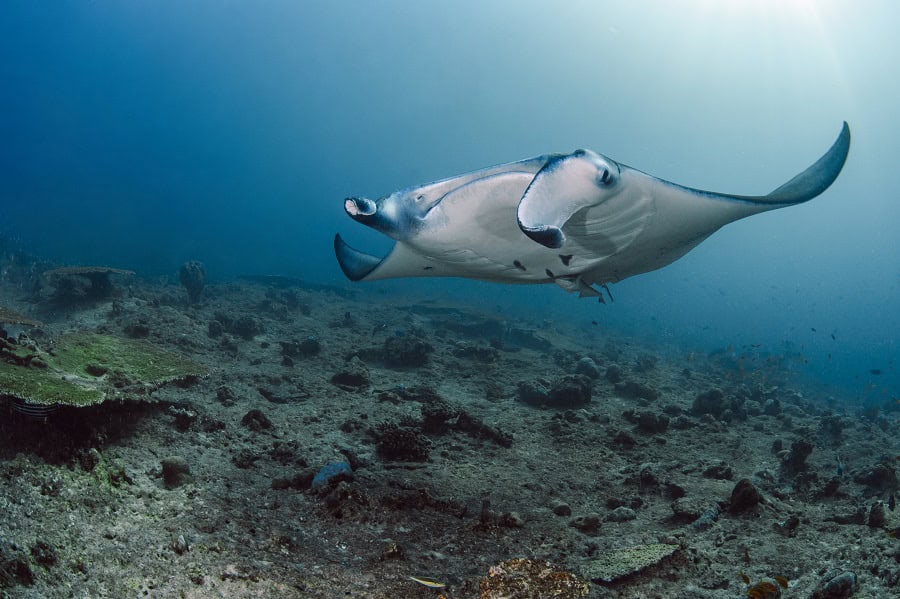
9- The legend of fäfä tipi: Ancient Polynesian legends tell that mantas could take fishermen’s boats into the depths. Others claimed they could easily cover pearl divers with their great mantle (from the Spanish manta) to prevent them from retrieving treasures from the ocean floor. Of course, none of this is true. The manta ray often symbolizes freedom mixed with wisdom and humility: this desire to remain in the shadows despite its large size and important place.10- To protect: Today, all manta rays are classified as vulnerable species on the IUCN’s (International Union for Conservation of Nature) Red List of Threatened Species. Due to very low migration rates among populations, protection measures are often implemented locally, although regulations on the sale of this species have significantly tightened since 2013. There is still much work to be done if we wish to continue observing these extraordinary animals!
Fabien Valladier