


The sand tiger shark – Carcharias taurus – is one of those species recognizable among thousands. Its relatively stocky morphology and threatening appearance allow it to be easily identified. Present in many seas and oceans around the globe, this shark from the Odontaspididae family is a « peaceful » swimmer that leaves a lasting impression on those who have had the opportunity to encounter and swim with it.
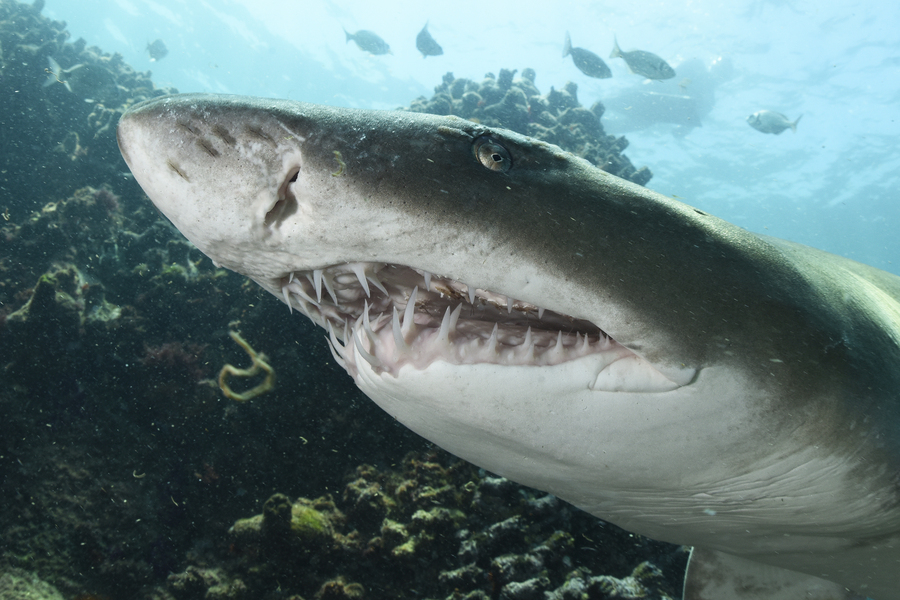
- Dimensions that command respect: most sand tiger sharks observed measure between 2.50 m and 3 m, weighing around 160 kg. But in the Mediterranean, a specimen measuring 3.80 m long has been recorded. This size, combined with its iconic dorsal curve, reinforces the animal’s impression of power.
- An inhabitant of the world: the geographic distribution of the sand tiger shark is impressive. It is found in almost all the seas and oceans of our planet. It inhabits temperate areas of the Atlantic, Pacific, and Mediterranean coasts, as well as more tropical regions of the Indian Ocean, the Red Sea, and the Australian coasts.
- Guilty by appearance: the sand tiger shark, like all sharks, has rows of teeth that are continuously renewed throughout its life. For Carcharias taurus, 3 rows of teeth are constantly operational. These numerous pointed teeth, always visible from the outside, prevent it from closing its mouth properly. As it always swims with its mouth open, this dentition gives it the recognizable appearance that many want to immortalize.
- A floating buoy: a peculiar trait of the hammerhead shark is that it does not have a swim bladder to maintain itself between the water layers, but it can, however, ingest air on the surface to create a small buoy in its stomach to help stabilize itself. To date, it is the only known shark to exhibit this type of behavior.
-
Playground: particularly nocturnal, it likes to move and hunt near the bottom in search of its prey. The hammerhead shark can thus frequent different types of bottoms, whether rocky, sandy, or coral, from the surface to slightly more than 200 meters deep.
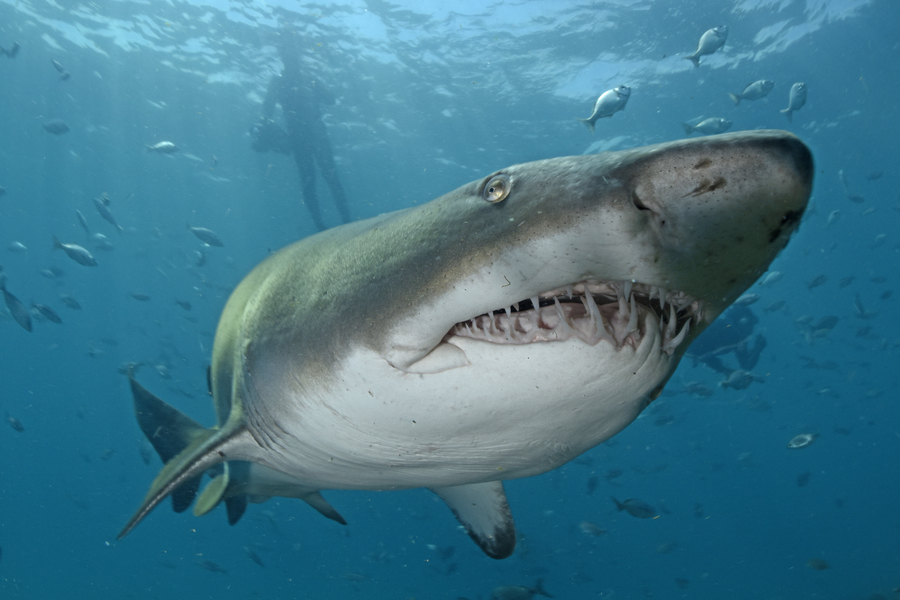
Despite its fierce appearance, the sand tiger shark is placid and easily approachable by divers. © Nicolas Barraqué - Dinner’s ready!!! The large teeth of the sand tiger shark clearly indicate that it does not have a vegan diet. Pointed and sharp, these are formidable weapons for capturing fish (bony or cartilaginous), cephalopods, or even crustaceans. The relatively short snout of this shark allows it to track its prey into their hideouts.
- Sand Tiger Shark, tough love: mating is not a leisurely activity for Carcharias taurus. The male will first eliminate all competition from other contenders. Then he will circle the female and try to immobilize her by biting her on the flank before mating with one of his two reproductive organs (one on each side to optimize reproduction chances depending on the side he positions himself relative to the female).
- Reproduction, shall we do it differently? Carcharias taurus is an ovoviviparous species. The eggs produced following mating are not expelled into the wild but are stored in the mother’s uterus, where they complete their development. According to scientific studies conducted, there are between 15 and 25 eggs in each reproduction.
- Oophagy : after an incubation period that can range from 9 to 12 months, the first individuals to hatch in the uterus will feed on their siblings. This results in true intrauterine cannibalism, leading to the birth of only one or maybe two individuals who will already measure nearly a meter long. The reproduction rate is thus very low.
- A fragile species: unfortunately, like all shark species today, the sand tiger shark is not exempt and is among those threatened with extinction. On the IUCN (International Union for Conservation of Nature) red list, it is classified in the red zone with the mention « critically endangered. »
https://vimeo.com/463132550Where to find it? To be certain of observing sand tiger sharks while diving, one must go to South Africa (the spotted ragged-tooth sharks or “raggies sharks” are visible from June to December on Aliwal Shoal and Protea Banks, and during the southern summer from November to March on Sodwana Bay) or in North Carolina in the United States (where they are called “sand tiger sharks”).
Fabien Valladier