


Combining scuba diving with a military career necessarily involves going through the onboard diver course. For some, it is an end in itself, for others a step in their training: all have six weeks to prove themselves and obtain the coveted certification.
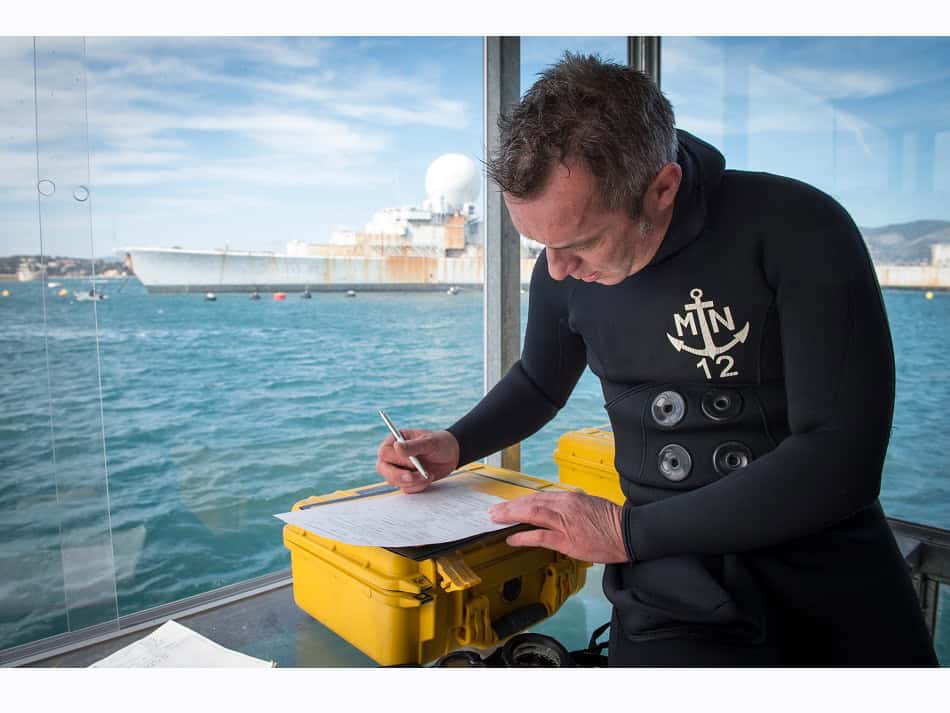
Today, there are over a thousand personnel onboard, certified as onboard divers. Indeed, it is not a full-fledged profession but a certification, an additional skill accessible to all Navy occupations. In other words, an onboard diver can also be a cook, mechanic, doctor… and hold any rank. Their role is to intervene underwater if necessary, to inspect a hull, a propeller, seal a leak… And students have only six weeks to acquire both diving techniques and the maneuvers that will allow them to ensure the safety of their ship! A real challenge that leaves no room for approximation, requires a tight schedule under constant pressure, punctuated by weekly evaluations. « When they finish the training, admits Chief Petty Officer Sandy, instructor, they still have a lot to learn in the field, but they dive safely, both for themselves and their partner.».
Learning the basics of diving in two weeks
The first two weeks are undoubtedly the most decisive. For students who mostly have never dived – and experience in this area is not necessarily a guarantee of success, as some have acquired bad habits – it’s about mastering the basic techniques and notably the management of ascent speed.
« Today, within the framework of the onboard diver course, explains the school commander, we focus on more advanced technical learning. I have notably developed a lift simulator that combines a virtual reality headset, a connected vest, and a breathing apparatus to teach them better vest and speed management. We also conduct mental preparation sessions, using potential optimization techniques (TOP) to manage students’ stress facing the importance of the stakes for them. I will never sacrifice the level of exit, he insists, but I aim to do the maximum to ensure they all succeed.« . The teaching methods have evolved. « We try to constantly readjust our teachings to the students, to support them more individually than before« , confirms Chief Petty Officer Sandy.
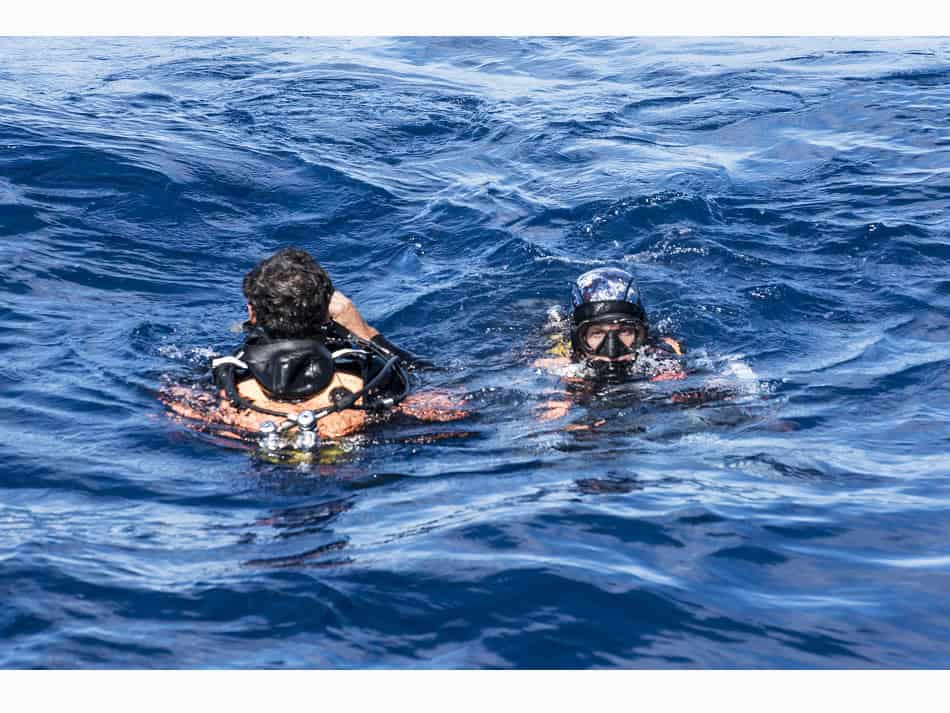
« Some, continues the instructor, understand immediately, others need a few more days to have the click. » By the end of this decisive fortnight, « a real lever for their learning« , some unfortunately already have to give up, at least temporarily. The others then move on to assisted ascents, at 18 and then 30 meters, throughout the following week.
Mastering work tools
The rest is mainly dedicated to mastering the tools that will allow them to intervene up to 35 meters in the air. In the water area of the Saint-Mandrier diving school, they learn lift techniques, practice conducting hull inspections, day and night, conducting circular searches, fixing plates on a hull… They also learn, at the end of the course, to use the diver-deminer’s vest. « In general, given the intensity and short duration of the training, admits their instructor, those who fall behind can hardly catch up. » The same goes for those who suffer an injury along the way, like this young candidate who, when we conducted these interviews, was suffering from an ear barotrauma. For her, the adventure ends there. « But everyone has the opportunity, nuances Chief Petty Officer Sandy, to try again. Those we exclude, beyond injuries, it’s for their own good, for their safety. However, one shouldn’t be afraid to come. And they should do it with curiosity..
« I’m 23, attended the Naval School, and am currently onboard. My project is to become a combat swimmer. I’m trying to have a 10-year career vision. The onboard diver course is therefore a first step for me. Even though I passed my level 1 in civilian life, you really have to get into the mindset that we’re relearning everything here. But the progression is very structured; we have a briefing the night before each exercise and another in the morning, so we get in the water knowing exactly what we need to do. We also learn to work in pairs: each must ensure the safety of the other, help in areas where they’re less comfortable, and vice versa. What motivates me today is venturing into the unknown by pushing myself, working with people who have great rigor and humility, and integrating these values. You also have to arrive physically ready. We run a lot, every day, not to mention numerous and lengthy fin sessions. And always keep in mind, as I already feel after just a few days, that the goal is not to eliminate us but to truly support us.
Ensign 1st cl. Jean, in the first week of the Onboard Diver course
Boardé, a secondéoccupation
Master Romain, specialist in information and communication systems (ICS), has been an onboard diver for seven years. « During the training, he recalls, we know we can be failed at any moment, but it’s a positive stress that leads us to surpass ourselves. Upon completion, we are ready to carry out the missions that will be entrusted to us. » Concretely, it’s primarily about checking the integrity of the ship’s hull about once a month.
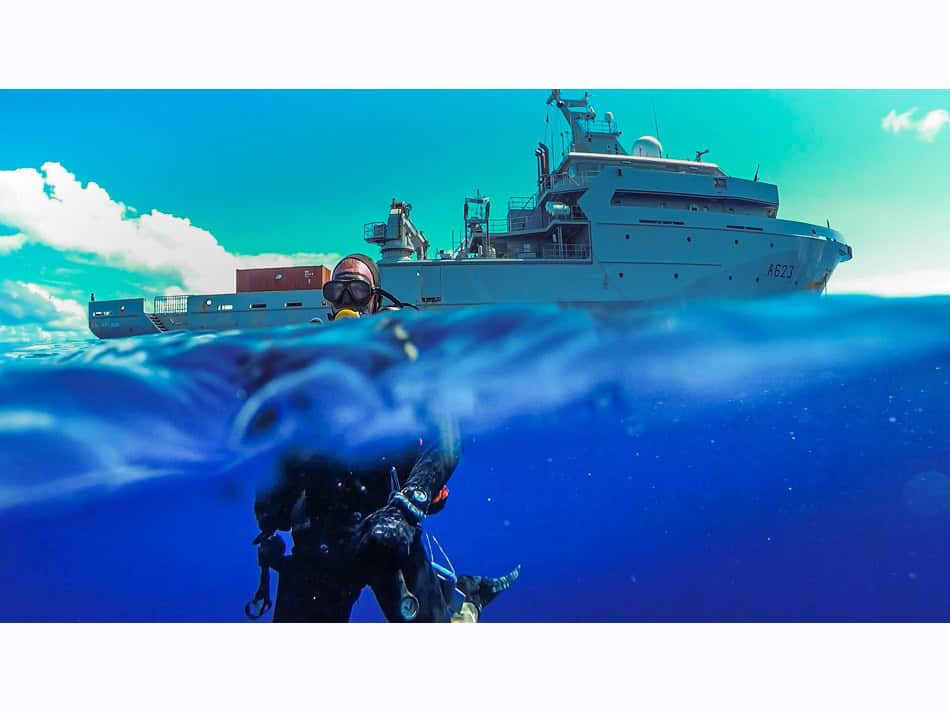
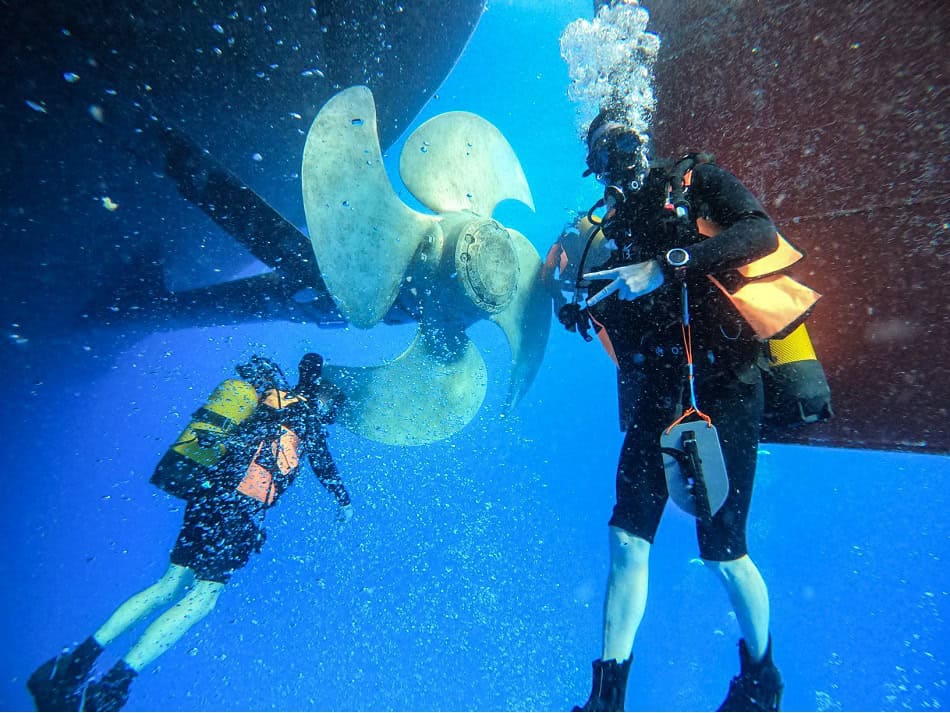
But they can also be called upon to place sealing plates, take readings on the propeller shaft lines for the mechanics to adjust the blades, or intervene in a man overboard recovery. « Most dives are done at the dock, he specifies, but some are in open sea, in the blue, a dimension one also has to get used to.« . All dives are conducted in pairs, following a precise briefing of the dive profile and the task to be performed. « Systematically, emphasizes Master Romain, we brief, do, and debrief. And, at the beginning of each dive, we also perform safety exercises with our partner. » The team is completed on the surface by a diving director (DP) or diving safety supervisor (SSP), a qualification accessible after training at the Diving School. They are not divers, but trained to monitor and verify the profile of the intervention. On average, an onboard diver enters the water once a week, making diving a second occupation.
the préerequisites
Already be engaged in the French Navy.
Medically fit.
Be over 18 and under 33 years old at the course start date.
opening image © Lisa Bessodes / French Navy / Defense