


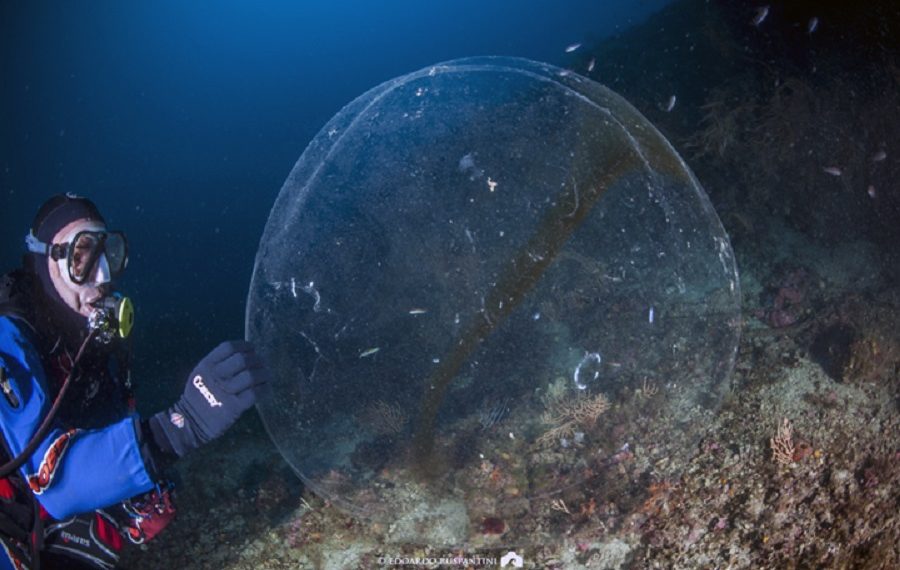
Between 2001 and 2018, 46 large transparent spheres have been observed in European waters. Scientists are currently studying these organisms and need, to discover exactly what they are, tissue samples. They are asking divers who encounter these spheres during dives to collect samples for this purpose.
During the summer of 2017, a number of divers filmed or photographed these immense transparent spheres, attracting the attention of the media and a group of scientists. These scientists, from several European countries, have worked together to collect all available information on these spheres and discover what they are.
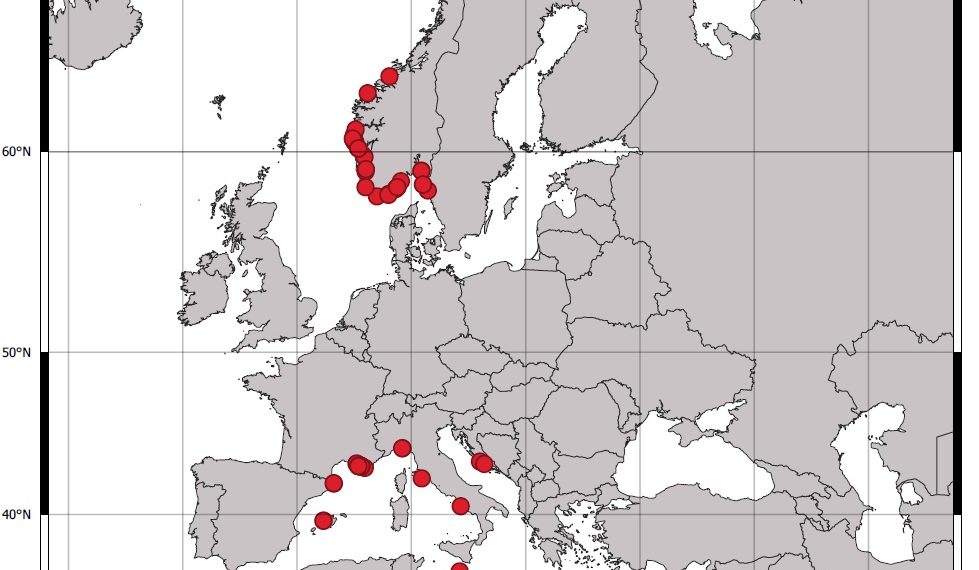
They have been seen off the coasts of Norway and Sweden as well as in the Mediterranean. Although no samples had been taken at the time, scientists discovered a fairly similar phenomenon, described as a concentration of eggs of a pelagic squid species from the Pacific Ocean and the North African coasts. One may therefore hypothesize that a squid might be involved in the formation of the recently observed spheres. If divers can collect a sample and send it to this team, this mystery could be solved through DNA analysis.
Their diameter can range from 30 cm to 2 meters and they have generally been observed between April and September. The images currently available were taken by recreational divers, with most observations occurring off the southern coast of Norway and the western Mediterranean (Croatia, Italy, France, Spain, and Malta) at depths ranging from 50 cm to 52 meters, in water temperatures between 10 and 21°C.
27 of the observations have been collected in a scientific article in the journal Marine Biology Research (Ringvold & Taite 2018), and 19 have been reported after publication. The document compares the egg capsules of cephalopod species worldwide. Observations of the transparent spheres appear different from anything previously observed. Scientists have a theory that the European squid Todarodes sagittatus, could be a candidate, as no one has ever described eggs or wild spheres of this species. But for the moment, without evidence, there’s no way to be certain.
Procedures for taking a sample
Researchers need you to take tissue samples from one of these spheres if you come across one during a dive.
– To obtain a sample, you must cut a piece of the sphere. A small piece the size of a thumbnail will suffice. Try to cut through the wall of the sphere, do not just scrape the surface. Surface tissues may indeed be contaminated by bacteria and algae.
– The sampled tissues must be brought back to the surface (in a small jar or bag if you have one).
– The sample must then be kept frozen as soon as possible. To do this, place it in a clean plastic bag in the freezer.
– Finally, contact the scientific team who will guide you on how to properly preserve the sample and prepare it for analysis.
– In addition to the tissue, the researchers would like to have a note on the approximate size of the sphere, the most exact location possible, as well as the depth, temperature, and habitat. If you could also provide photos or a video.
For more information, please contact Halldis Ringvold by email, from Sea Snack Norway: post@buzzingkid.no and Gro I. van der Meeren, from the Institute of Marine Research: grom@hi.noText by Halldis Ringvold, Sea Snack Norway/ Gro I. van der Meeren, Institute of Marine Research (IMR)/ Manuel AE Malaquias, Museum, Natural History the University in Bergen/ Geir Johnsen, Norway University of Technology and Science (NTNU)/ Arne Fjellheim, UNI Research Environment/ Roberto Sandulli, DiST, Università di Napoli « Parthenope ».
Translated from English by Margot Harty