


Deminer divers, unlike the qualification « ship diver », come to learn a full-fledged profession. Their 10-month training qualifies them for dives up to 80 meters and trains them in specific demining techniques.
The profiles of those selected to start the course are varied: some come directly from the civilian world, others are already ship divers and wish to change their specialty. Finally, there are officers selected by their hierarchy during their application school, usually 6 per year. These start with the basic deminer diver course before continuing, in the second part of the curriculum, with higher certifications (see testimony) for the Command part. « But pfor us, when they arrive, explains Chief Petty Officer Laurent, instructor, there is no rank, whether it’s a young person just out of Conflans or an « old » officer, it’s the same. »And for those who start without any certification, it takes two years of training between the various selections and the actual courses to obtain the deminer diver’s certificate; plus an additional ten months for the BS, the higher certificate.
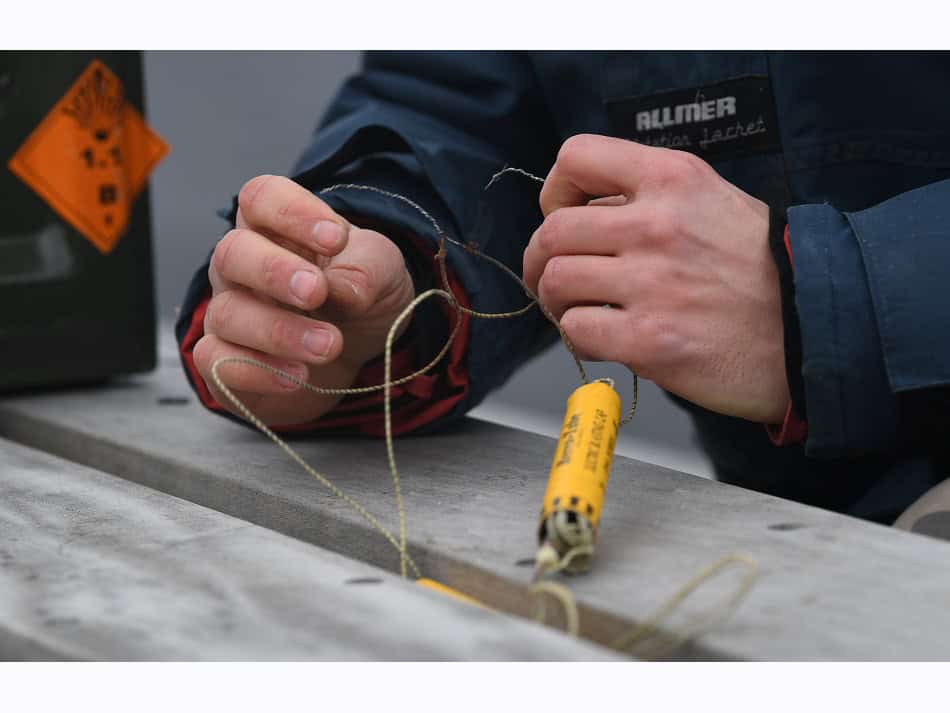
All, when they start the course, are already divers and holders of the ship diver certificate. After a quick overview of the acquired knowledge, they must then continue training in the air to 50 meters, progressing in increments of 15 meters, to reach a depth of 80 meters, the limit of their area of operation. For 4 months, diving remains at the center of their training.
Narcosis, the enemy of élèdeminer diévers
In recreational diving, many have already felt the effects of narcosis. During exploration, the experience usually ends well, provided one calmly makes their way back to the surface. But for aspiring deminers, it is unacceptable. And no one is equal in their sensitivity to the onset of the first symptoms: « We must quickly detect, explains Chief Petty Officer Laurent,if our students are sensitive by making them perform underwater courses. They must absolutely remain clear-headed up to 50 meters, a sine qua non condition for continuing the training. » Depending on the sessions, two or three students usually turn out to be too sensitive and, for obvious operational safety reasons, are permanently excluded. Their ability to use the FROGS, the combat swimmer’s closed circuit, is also tested to see how they physiologically handle 100% oxygen.
Explosives and underwater work
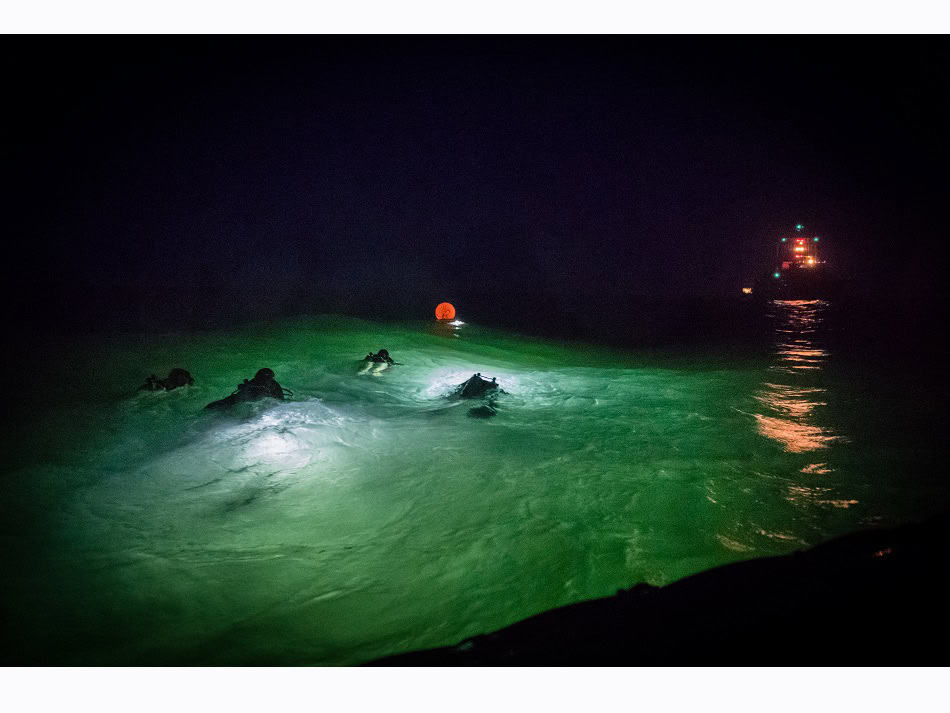
Once the « diving » element is mastered, they begin to fully learn their profession. This second part then focuses on handling explosives and underwater work. They learn to implement explosive charges underwater as well as on land, as they may intervene in the intertidal zone, up to the highest waters depending on tides. « It is also an important filter in training, » specifies their instructor. Anyone for whom it generates too much stress cannot aspire to become a deminer. » They also receive basic training in underwater work, in the submerged workshop located at the Diving School: welding, cutting, assembling structures, equipped with an air supply… so many technical gestures that they may also be brought to perform in the field.
«Physical endurance, concludes Chief Petty Officer Laurent,is very important. Do not forget that the equipment weighs 50 kilos! They must also have great aquatic ease. » And be able to withstand the pressure imposed on them. « It’s tough, you have to be rigorous and motivated, he admits,but it’s a fantastic job! We do sports, we’re in the water, and there’s real variety in the work, there’s no risk of boredom setting in ».
After leaving the course, certified deminer divers can be assigned to different types of units: either to one of the 9 minehunters of the Navy, based in Brest and Toulon; or they will be part of one of the three GPD, Deminer Diver Groups, in Cherbourg, Brest, or Toulon; or they will join the Mine Warfare Flotilla, created in view of the arrival in the Navy of the future mine warfare system. But, embarked or not, in training or operations, they will indeed be in the water every day.
« In 2013, I obtained my ship diver certificate to diversify because there were none aboard my vessel. Then I wanted to continue. In 2016, I attempted the deminer diver course but failed. I think I lacked diving experience. In 2017, I tried again and, this time, succeeded. The first 4 months are actually the hardest. Then, assigned to a minehunter, then to the GPD in Toulon, I was selected internally for the BS deminer diver course, which allows us to become mission leaders. It involves having an overview, being capable, in the field, of taking all the necessary measures and decisions. I believe that to succeed in this job, which is never fixed, you have to be able to continually adapt, question yourself, listening from top to bottom. And accept self-surpassing, without forgetting to be very curious. Many don’t dare, thinking they won’t make it. You shouldn’t stay with that mindset. Nothing is impossible, you just need to get informed.
Master Vincent, in higher training (BS) to become a group leader
They are in the’water every day!
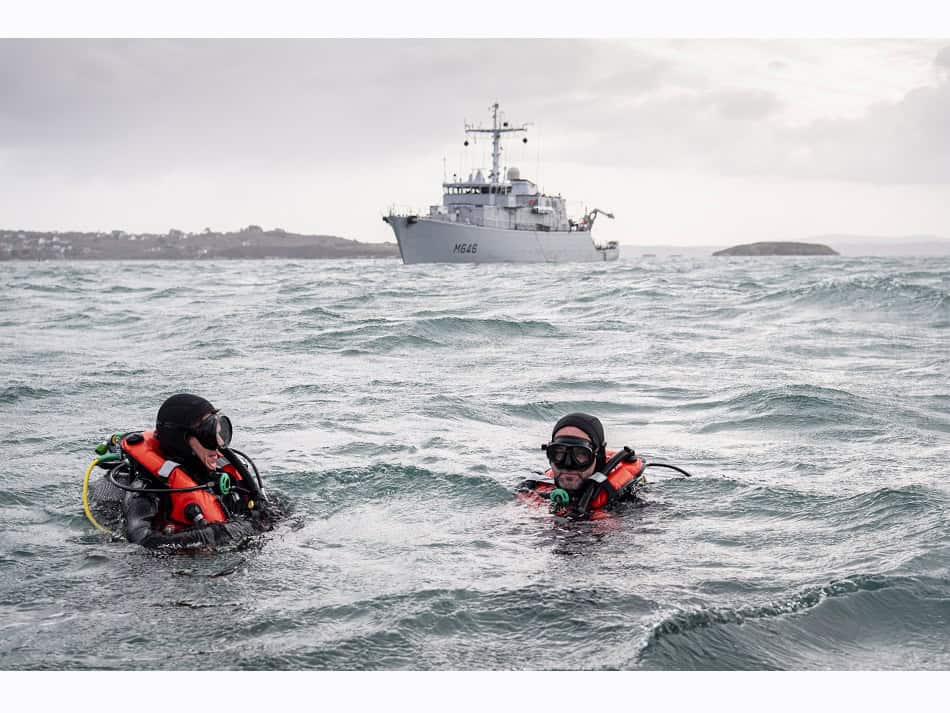
« Even if operational phases account for only about a third of the time, I want my divers to lose nothing of their training and reflexes,« , explains Commander Mathieu Fadde, commander of the GPD Manche. « They thus multiply their dives each day from 0 to 80 meters. « And the deeper they go often, the better!« . They tirelessly train in the use of detection tools like handheld sonars, visual spotting, and implementing explosives. Each gesture must be perfectly mastered, which will allow them to adapt to the day’s specifics during an intervention. « And when they leave the school, he estimates,in my opinion, it still takes a year, even though they are operational, to be fully trained in the local specificities, notably concerning tides and currents. It’s a profession that is truly learned only in the field.»
In operations, deminers work as an autonomous team: two supervisors, one of whom is the mission leader, and two team members. « When’it’s about div’es that are partéicularly demandingè, especially in terms of depth, we increase theéteam’intervention team, so that’they can take turns,’especially since we always use the MN90 tables which impose long decompression stops’autant plus que nous utilisons toujours les tables MN90 qui imposent de longs paliers de dé, clarifies the responsible officer. », précise le responsable ».
Hundreds of thousands of ammunitions à déto destroy
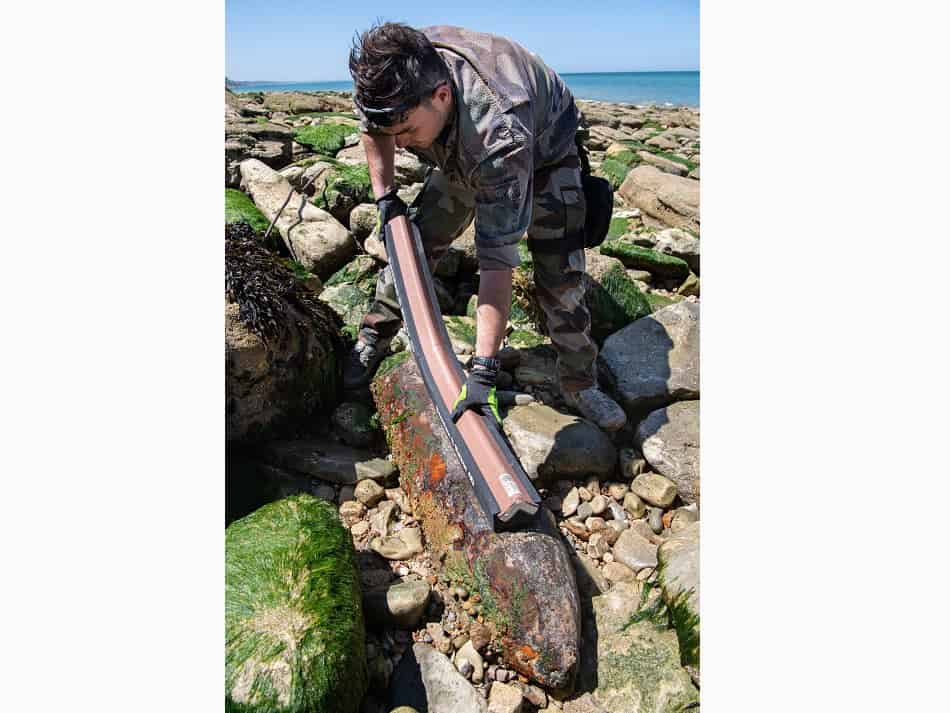
They usually depart for a week, with vehicles and a zodiac, armed with a checklist of ammunitions to destroy between Cherbourg and Calais. An exception to the rule is when they are very degraded and close to populations; an intervention team is sent on-site urgently to deal with ammunition posing an immediate danger to the public.
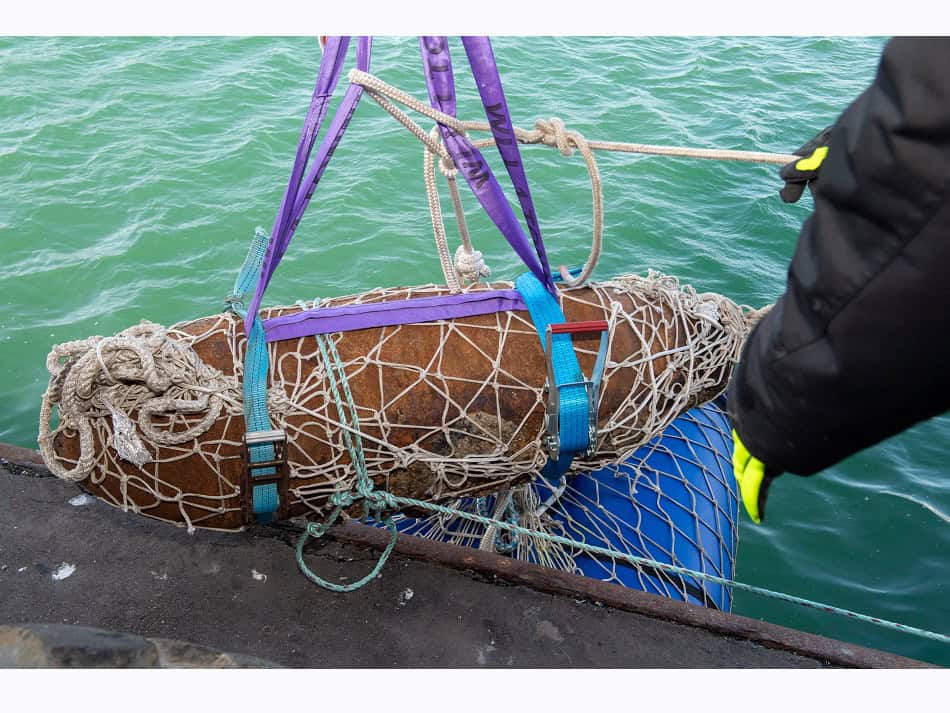
« There is still, on average today, one discovery per day, most of the time by walkers, says the commander, there are hundreds of thousands of unexploded ammunitions left in the region! Given their age, and therefore their instability, we do not seek to neutralize them, we destroy them. » On land, the matter is quickly resolved. After determining a safety and evacuation perimeter, the ammunition is partially buried to avoid metal fragment projections, and it is exploded. At sea, the mission is more delicate. Depending on the information provided by fishermen, who may have the unfortunate surprise of finding ammunition in their nets, it can sometimes take two to three days to relocate them before dealing with them. « These are often mines that contain more than a ton of explosives, explains Commander, so they cannot be detonated too close to shore. They must be slinged, possibly unsand, then lifted with a cow and moved, placing a camel for more surface stability. » The maritime prefecture then provides an intervention position to follow for destruction, usually beyond 6 nautical miles. They explode between two waters, trying to minimize their impact on the seabed. Deterrence methods before firing also preemptively move cetaceans that would be in the area away.
At GPD Mediterranean, manage landing operations
Former navy commando, Chief Petty Officer Florian is now a mission leader at GPD Mediterranean. « The group’s specialty, he explains,is what is called VSW (Very shallow water), whose aim is to secure the surrounding seabeds and the beach itself to allow troop landings. » Using drones and divers, it’s about locating and neutralizing any obstacles, ammunition or otherwise, blocking access to the shore, training for potential operations in conflict zones.
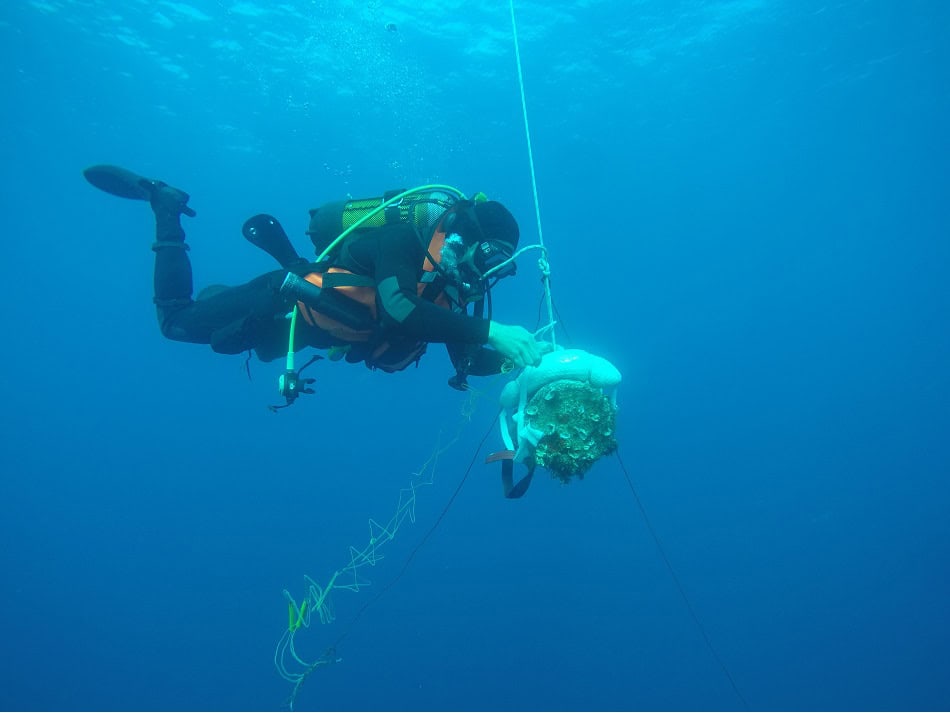
Their mission also involves destroying explosive devices found by sea users, even though their number is much less significant than for the GPD Manche. They also carry out underwater works, such as cleaning, salvage of wrecks, cutting. Like their colleagues in the Manche, they are also in the water every day between training and intervention. A passion profession that matches well with what the chief petty officer had imagined, particularly when interacting during various assignments, as a commando, with deminer divers. « Anyone can do it, provided they are extremely motivated! You also need to be very physical, because, beyond the weight of the equipment, you have to lift and moor extremely heavy weights, fight against the cold, current. You have to think under stress and effort and manage narcosis. You have to have a taste for effort, teamwork, and know how to stay humble, he concludes.
Prereé-quisites
Be of French nationality.
Be medically and physically fit.
Be between 17 and 30 years old. Hold a high school diploma.
Preéparatory training for divingécareers in Conflans-Sainte-HonorineéA unique center in France recruits about twelve young people per year externally to turn them, after two years of training, into deminer divers. A highly supervised curriculum that puts all chances on their side.
Un centre unique en France recrute en externe une douzaine de jeunes par an pour les amener, au bout de deux ans de formation, à être plongeurs démineurs. Un cursus très encadré qui met toutes les chances de leur côté.
« L’The goal for these young people, âgéaged 18 à to 24 years, explains Michel Ravoisier, responsible for training, is really to become deminer divéers « . But when they submit their file to the center, accessible from the age of 18 provided they have a diploma, they start by undergoing a selection week at the Diving School of Saint-Mandrier. There, no tanks on their backs, just a first approach of aquatic skills and group life, essential cement to their success. Out of about 35 candidates, a dozen are selected.
Then begins the adventure at the School of Conflans for them, which, if all goes well, will lead them, two years later, to their dream job. From September to late April, integrated into a marine maintenance high school, they train in mechanics, welding, theory taught in the Ship Diver course. They also learn the basics of diving, in a 20-meter-deep pit located near their school. Two weeks of sea dives and a month of boarding complete their practical experience. During these eight months of « prep », students live and work together permanently. Since September 2022, they share a barge moored on the banks of the Seine, near their teaching location. A lifestyle that further increases group cohesion and multiplies their chances of success. In parallel with their curriculum, they are also currently renovating a 1907 schooner, in partnership with the students of the vocational high school that hosts them. Enough to dream of heading out to sea.
In 17 years, since the center’s creation, not one of them has dropped out: 88% have stayed in the French Navy, and 43% end up becoming deminer divers after going through the ship diver course. This allows the youngest of them to be certified at 20! They then commit to ten years, of course, renewable. « C’It is aépassion job, and this’est çgives them all the ability à to succeedé , insists Michel Ravoisieré. Of course, they must be athletic, aquatic, but not necessarily divers. What I advise before anything else insiste Michel Ravoisier. Bien sûa young person who wants to embark on this training ê, is to meet former studentsé, especially through social media or during selection tests. And bear in mind that there are a thousand ways à to practice the deminer diver’job,’on land or at sea, élèin France or ab à road. Itéis also this desire to discover new horizons that we wish to instill in them.élection. Et il ne faut pas oublier qu’il y a mille façons d’exercer le métier de plongeur démineur, à terre ou en étant embarqué, en France ou à l’tranger. C’est aussi cette envie de découvrir de nouveaux horizons que nous souhaitons leur transmettre.«
opening image © Sarah Lacarrere / French Navy / Defense