


I remember a friend’s father complaining that red plastic bits like confetti were scattered on the rocks where he swam… Had he worn his glasses to distinguish that these big confetti were moving, he might have realized that he had the chance to see a gathering of pink flatworms. Speaking of seeing colorful animals, some clarifications are necessary.
1 – Completely flat
It’s a real worm, without legs, almost completely smooth, 1 to 2 mm thick so… flat (Euryleptidae, among the Platyhelminthes, thenairs, for the mnemonic technique). Without the ‘little branchial tree’ that other worms have (like the Dalmatian doris for example), this animal breathes directly through its entire body. It ‘is’ its own gill. planaires, pour le moyen mnémotechnique). Sans le « petit arbre de branchies » qu’ont d’autres vers (les doris dalmatien par exemple), cet animal respire directement par tout son corps. Il « est » sa propre branchie.
2 – Eye-catching
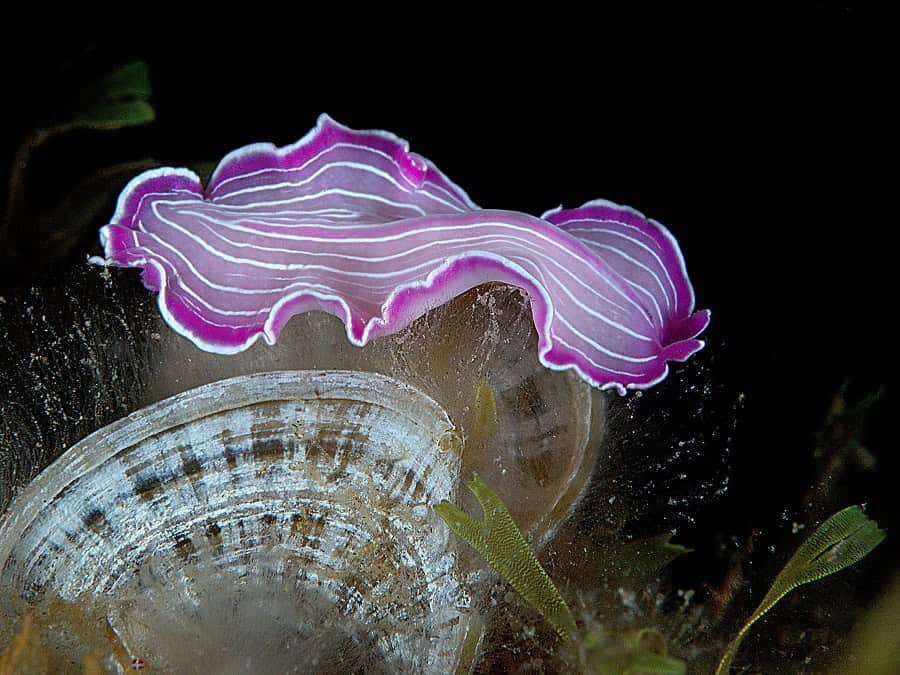
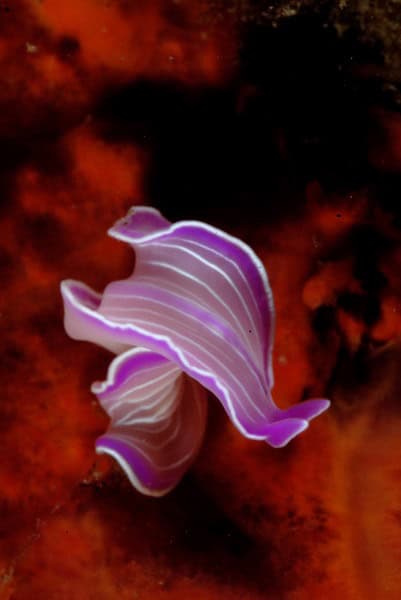
First, you need to find this pink flatworm. With its slightly violet pink color (paler on the underside), this elongated oval and its 2 cm length can attract attention on often orangish or greenish backgrounds. Especially since this pink patch bears 5 concentric ovals on its back, while being surrounded by white and red circles. With the median line and the tentacles (which have many small eyes) on its head (without a brain!), also a bit pinkish-red, it’s a real moving target for photographers.
3 – Why there?
Moving target because one of these little beauties can crawl across the bottom quite quickly. Its constantly waving edges also allow it to ‘swim’ to reach small holes on vertical surfaces that serve as shelter, among the calcareous algae and other colorful animals. From the surface to 60 m deep, you may encounter gatherings of these gregarious flatworms (hence the pile of big confetti…).
4 – Climate change?
Described for the first time in the Bay of Naples (Lang, 1884), this species was reputed to be only Mediterranean. However, in 2010, a study captured a few specimens for the first time at about 20 m in Portugal, thus in the Atlantic. Since then, observations have multiplied from this coast to Senegal, but not further north… With currents washing over the French coasts or the upper part of Spain, it might still be a bit chilly.
5 – Looking for prey
When talking about worms, many people imagine a vegetarian. This is not the case, you are looking at a great predator. Of what? That’s where the problem arises. It was thought to be a predator of sessile animals (this seems more like grazing I admit) like many other flatworms, but P. roseus is specialized: it targets small ascidians Pycnoclavellaof the species nana especially (the small, yellow tunicates).
6 – But where’s the mouth?
How to say… From above, this pink flatworm seems completely smooth. Viewed from below, however, there is a hole. A small hole. Which serves as a mouth, anus, trash can, and straw at the same time. Imagine its ‘stomach’ is like a sack. What is swallowed (pieces of rocks, bits of calcareous skeleton, wanted prey, seawater, etc.) goes into this sack, which must be emptied from time to time by turning it outwards. But this evagination capacity is also useful for this worm: it can extend a part directly onto ascidians, secrete digestive mucus, and suck up the resulting mush.
7 – A male or female flatworm?
Both actually! Each individual has both sexes during its life (hermaphrodite) but it is first male (protandric), producing only sperm. Then it gradually becomes female, producing more and more eggs and less and less sperm. Yet, it does not self-fertilize: partners meet and mutually fertilize each other in summer, the male part of one with the female part of the other. And vice versa, as you might have understood.
8 – No circulatory system
As previously stated, this flatworm has no respiratory system, just a part of a digestive system but it’s even more perplexing for reproduction: there is no sexual cavity. The male part acts like a syringe that pierces the female and directly injects sperm into the body. They will swim inside until they encounter the eggs and fertilize them. The eggs gather before being laid in a package the same size as the adult…
9 – Regeneration
The pink flatworm therefore has neither a brain (yet it reacts), nor a respiratory system (yet it breathes), nor a vascular system. Almost every part of its body is similar to the others. It can regenerate a part that may have been inadvertently eaten. Under certain conditions, even when cut in half, each part can regenerate a complete adult by scissiparity!
10 – Attention
As you have understood, this is not a dangerous animal for any diver. That’s no reason to destroy its habitat with fin kicks scraping the bottom or bother it by pressing your big fingers on it to make it reproduce by cutting it! Diving is sometimes much more beautiful and colorful when you try to pay attention to the little things hidden at the bottom!
Jérémy Delille