


A benthic cephalopod with striking camouflage, the flamboyant cuttlefish (Metasepia pfefferi) stands out from other cuttlefish by its vibrant colors, which vary with a single purpose: to warn predators of danger. This species, which ‘walks’ on the sand, is particularly venomous.
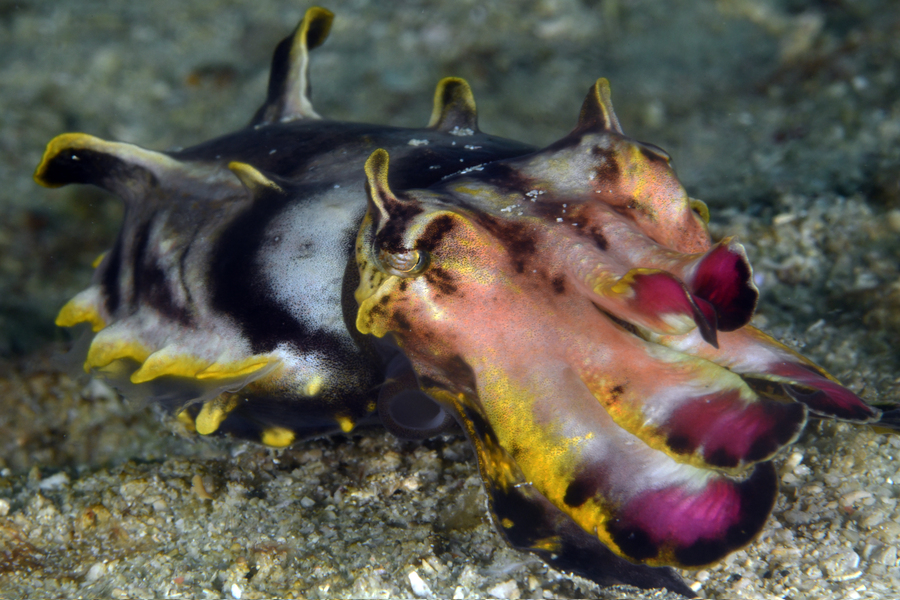
1) An atypical walk: the flamboyant cuttlefish walks to move around. It can swim, but only over short distances and when attacked. Unlike other cuttlefish, its bone usually used for buoyancy is very small, which is why it’s difficult for it to stay afloat in open water.2) Iridescent colors… : red, yellow, white and brown… the colors of its coat come from chromatophores, pigmented cells capable of changing hue. These flamboyant colors are particularly used to impress their partner during reproduction.3) … and hypnotic: by instantly changing the color of its skin, the flamboyant cuttlefish hypnotizes its prey, especially small shrimp. Like other species of cuttlefish, it can also transform the texture of its skin, making it smooth or rough.4) Venomous: a study conducted in 2017 hypothesized that the flamboyant cuttlefish is highly venomous, with its flesh containing a toxin rivaling that of the blue-ringed octopus (Hapalochlaena lunulata/ maculosa).
5) A very small body: the body of the flamboyant cuttlefish averages 5 cm excluding the tentacles. It’s one of the smallest species of cuttlefish.6) Reproduce, the goal of a lifetime: flamboyant cuttlefish reproduce only once in their short life (about 1 year). Like many cephalopods, they die shortly after reproduction and egg hatching. Towards the end of life, they enter senescence, a biological aging process where the cell cycle stops, motor control becomes defective, and lesions appear on the skin.7) Arms and tentacles: around the mouth are eight arms equipped with suckers and two tentacles with a flattened tip to grasp prey. Males have an ‘hectocotylus’ arm that carries spermatophores (capsules containing sperm cells) and allows them to transfer their sperm into the female’s mantle cavity.8) Three hearts: like all cephalopods, the flamboyant cuttlefish has three hearts, a main heart and two branchial hearts. Moreover, even though it doesn’t visualize colors, its vision is one of the most developed in the animal kingdom.9) A diurnal predator: unlike other species in the same family that are nocturnal predators, the flamboyant cuttlefish hunts during the day.10) A terrific view: with its two eyes enormous in proportion to its body, Metasepia pfefferi possesses a particularly developed vision, which is one of its greatest assets.
https://vimeo.com/409803906Where to meet it? The flamboyant cuttlefish is visible between 3 and 85 meters in the tropical waters of Australia, Papua New Guinea, or Indonesia, where it roams shallow sandy bottoms. Divers particularly encounter it in the sandy areas of the Lembeh Strait.
Lisa Ferré