


Rather placid and tranquil, the leopard shark is not the shiest, and divers often have the time to properly observe and photograph it. Its morphology and coloration are very characteristic, leaving little doubt about its identification. Encountering this specimen in the wild is always a source of a great diving memory!
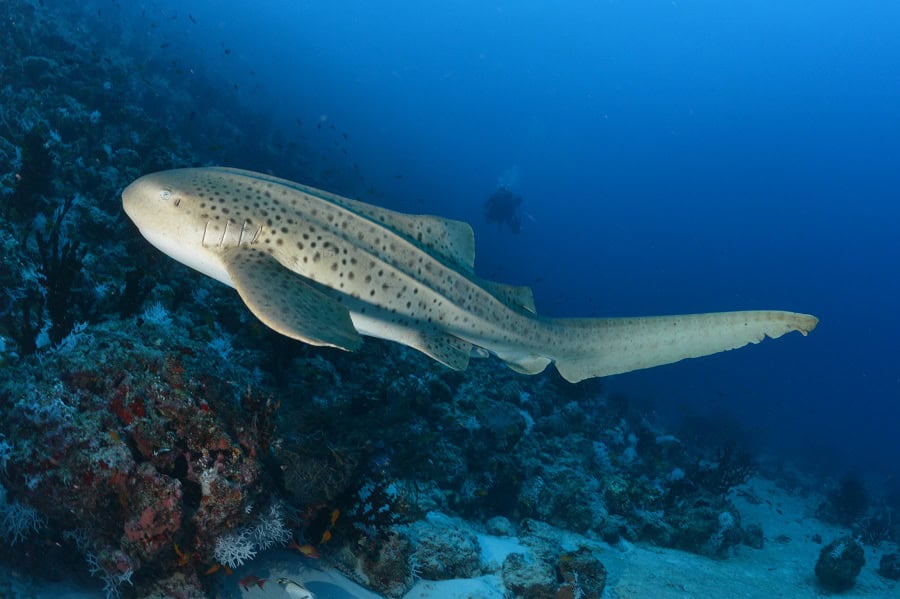
1- I love the tropics: This species of shark is found throughout almost the entire Indo-Pacific region, including the Red Sea and the Persian Gulf. Its range extends from the surface to about 70m in depth.
2- Easily recognizable: The leopard shark can reach up to 3 m for the largest specimens. Its lifespan is estimated to be over 25 years, with a weight that can reach around 30 kg. The full-bodied adults are traversed from the head to the base of the tail by large keels, giving the impression of a stretched canvas on the animal. The caudal fin is almost as long as the body and, notably, it does not have a lower lobe.
3- It’s meal time: Stegostoma fasciatum is a benthic shark. Present on sandy bottoms or areas covered with debris on coral shelves, it is a nocturnal hunter that primarily feeds on crustaceans and mollusks. Naturally, if a small fish comes within reach, it won’t hesitate and will certainly enjoy a tasty little dessert.
4- The pretty teeth: Like all sharks, the teeth of the leopard shark regenerate continuously. They are mounted on a kind of « conveyor belt » which allows them to renew constantly throughout the animal’s life. Our friend’s teeth are rather short and equipped with 3 points to allow it to hold its prey properly during meals.
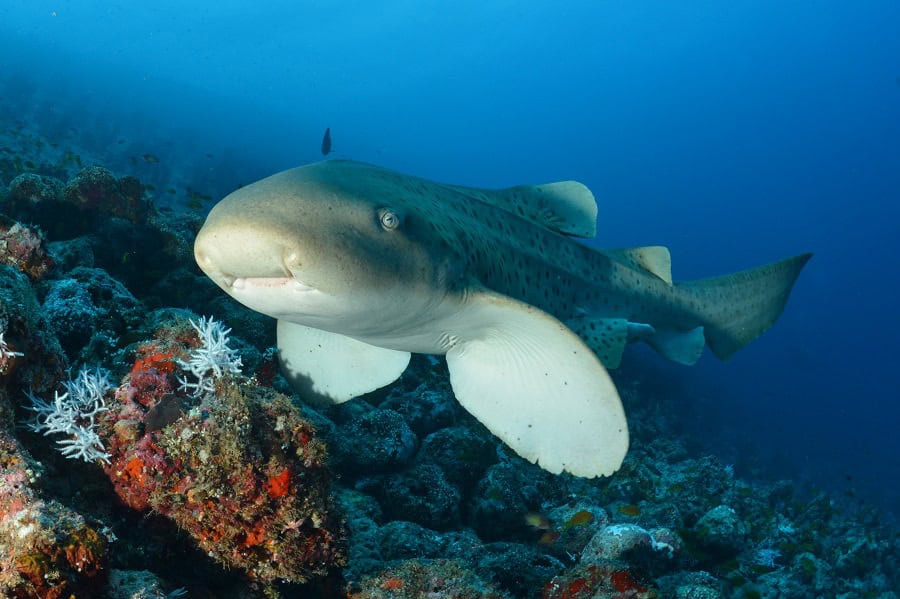
5- One animal, 2 names: The leopard shark is also known as the zebra shark. These two names come from the fact that the juveniles have alternating light and dark stripes that disappear as they grow, giving way to small scattered spots on the animal’s body. It thus goes from a zebra-striped pattern to a leopard-like coat over its lifetime, which at one point created confusion among scientists who then thought they were dealing with two different species.
6- Hard-boiled or fried: among the various reproductive techniques recorded among sharks, it is oviparity that is used by the leopard shark. The laid eggs resemble large, relatively rigid brown capsules that mix into the substrate. The incubation time can vary between 4 and 5 months depending on the average water temperature. The higher it is, the shorter the duration will be. To this day, a peculiarity has been observed in captivity. A female leopard shark reportedly became parthenogenetic after having multiple periods of sexual reproduction. She would have freed herself from males in order to reproduce…
7- Rare and precious: Highly sought for its skin, from which a strong leather is extracted, as well as for the oil found in its organs, the leopard shark is also appreciated for its flesh and fins. It is classified as an endangered species on the IUCN Red List (International Union for Conservation of Nature), and unfortunately, its fishing is not subject to any particular monitoring.
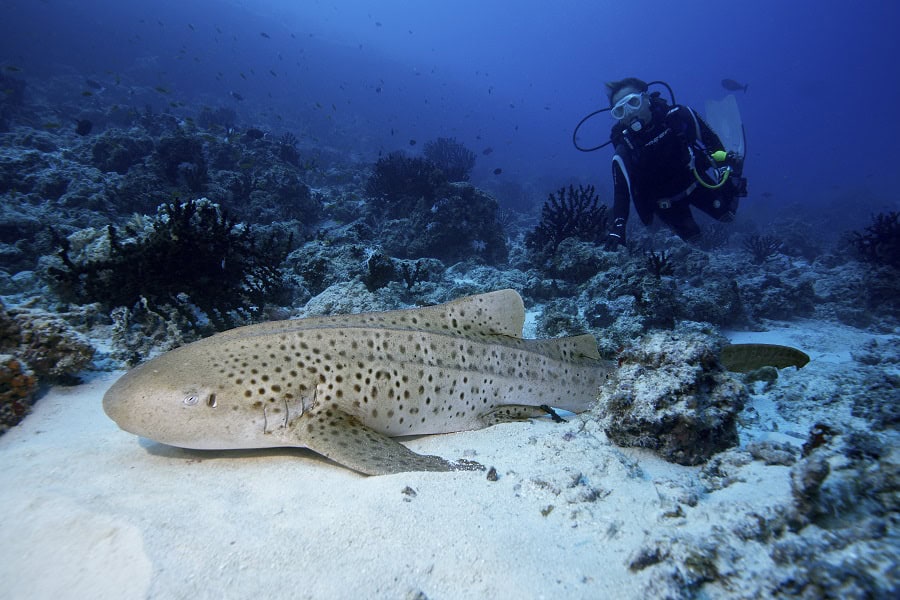
8- A unique representative: The leopard shark alone represents a well-defined family and genus: the stegostomatidae. The peculiarity of this family and genus stems from a kind of thick ridge surrounding the mouth of the animal to ensure better resistance to the friction of the mouth on the ground when it’s searching for food.
9- Size matters: Reproduction is « often » a matter of size. Leopard sharks do not escape this rule. Males become sexually mature when they reach about 1.50 m, while females must wait until they measure a little over 1.70 m to be able to procreate.
10- Towards new horizons: Although they appreciate tropical saltwater, some scientists have observed leopard sharks wandering in estuaries and also going slightly upstream in rivers. The salinity level doesn’t appear to be a major problem for this species.
Fabien Valladier.
Opening image © Nicolas Barraqué