


Chaetodon semilarvatus is a true underwater ray of sunshine. Measuring a bit over 20 cm, this butterflyfish is recognizable by its bright color striped with fine dark lines and by its blue mask surrounding each of its eyes. It inhabits reefs and coral plateaus up to about twenty meters deep, where it can find its food and many refuges. Its meanderings and rapid changes of direction easily catch the eye of divers. It is then easy to observe this splendid ‘butterfly’, which is not very shy.
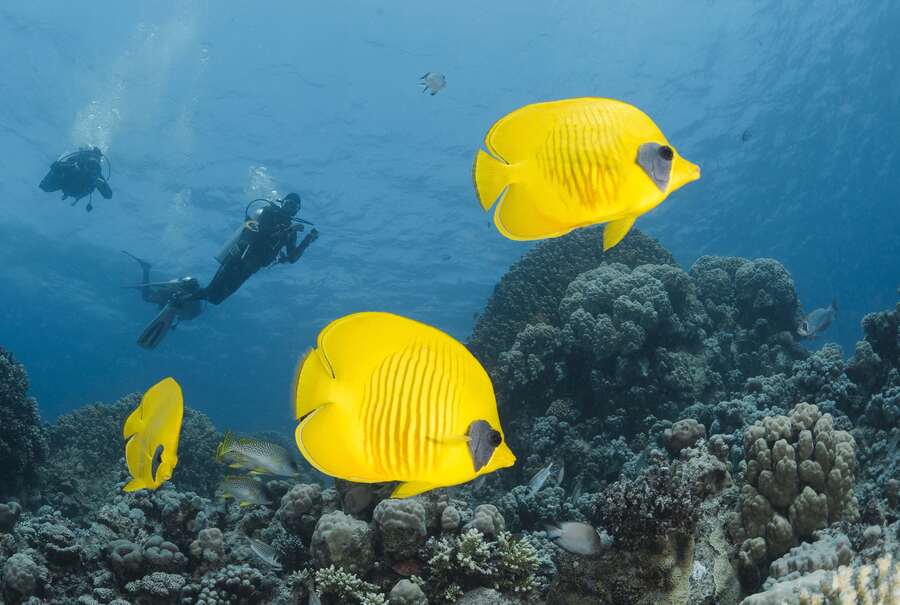
- A large family: the masked butterflyfish belongs to the large family of Chaetodontidae, which includes nearly a hundred species. Butterflyfish have a rounded body, a small prominent mouth, dorsal and anal fins set far back on the body and are strongly laterally compressed.
- The origins of a name: the butterflyfish family derives its scientific name from a combination of two ancient Greek terms: Khaite, meaning ‘silk’ or ‘hair’, and ‘odoùs’, meaning tooth. Thus, Chaetodons are fish that have in common the possession of very small teeth, fine as silk.
- A beautiful dentition: though small in size, the butterflyfish’s mouth is equipped with tiny brush-like teeth that allow it to feed on small polyps and micro invertebrates present on the large coral tables it frequents. This mouth is protractile and extends forward to increase feeding efficiency.
-
A very particular larva: during the larval phase, which lasts a few weeks, the head and part of the butterflyfish’s body are covered with small bony plates. This passive defense increases its chances of survival against the formidable predators of the coral reefs.
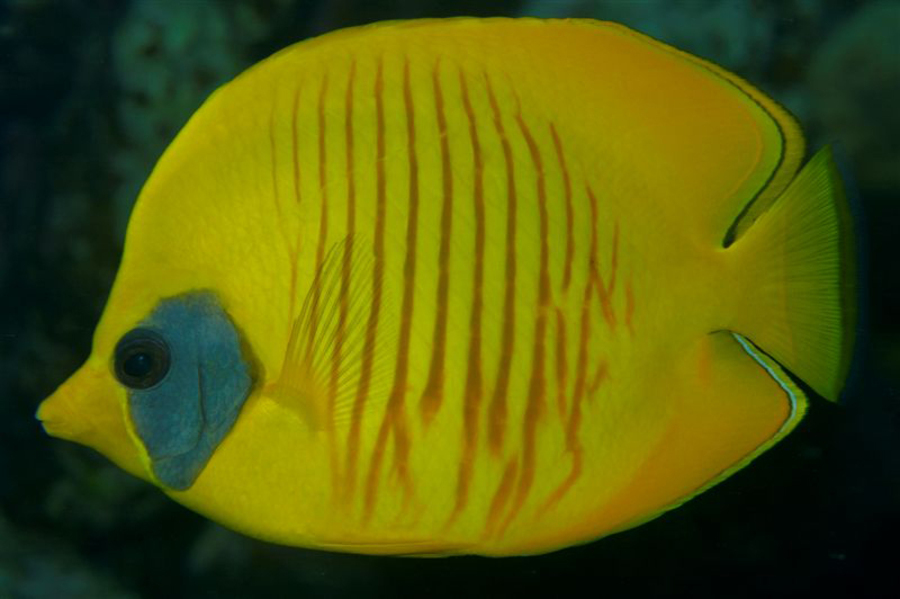
Chaetodon_semilarvatus is easy to recognize with its spot over the eye that appears like a mask. © Nicolas Barraqué - Why butterfly?Butterflyfish owe their name to their resemblance to the flying insects we see in gardens. Their shape, bright color, and movement among the corals are reminiscent of butterfly flight. Some of them, including the masked butterflyfish, have a large dark spot, which, like butterflies, is supposed to imitate the eye of a much larger animal to deter predators.
- Paired for life: the masked butterflyfish seems to be a species that enjoys living in monogamous pairs for life! Small groups of Chaetodon semilarvatus have nevertheless been observed outside of breeding periods, but this remains quite rare.
- An efficient reproduction: Masked butterflyfish couples reproduce in open water. The male and female release their gametes into a column of water, and the resulting eggs will hatch only one or two days after fertilization. The reproduction rate of the Chaetodon semilarvatus could, according to some studies and under ideal conditions, allow populations to double every 15 months!
- A sought-after model: underwater photographers greatly appreciate the contrast that the butterflyfish can bring to an image. The yellow color, enhanced by a light or flash, stands out immediately, bringing warmth to a photo or film where blue is the dominant color.
- A coral-eater revealing the health state of the coral: like many species, notably the Chaetodontidae family as a whole, the masked butterflyfish is considered a bio-indicator of the health of coral reefs.
- Reputed among aquarists: although it is not easy to keep in an aquarium, its color and elegance make it a fish much appreciated by aquarists. It is an essentially specialist-reserved species, and its rather targeted commercialization currently does not endanger its population.
https://vimeo.com/459941103Where to find it?The masked butterflyfish is found in the tropical waters of the Red Sea and the Gulf of Aden. Some sightings have recently been reported in certain areas of the Indian Ocean. It is not uncommon to encounter it resting under the large Acropora plates where it feeds.
Fabien Valladier