


Often mistaken for other scorpionfish, the large red scorpionfish (Scorpaena scrofa) also known as the large red scorpionfish, is a species of the Mediterranean basin well-known to divers. Its name given by the ancient Romans comes from its venomous spines resembling scorpion stings.
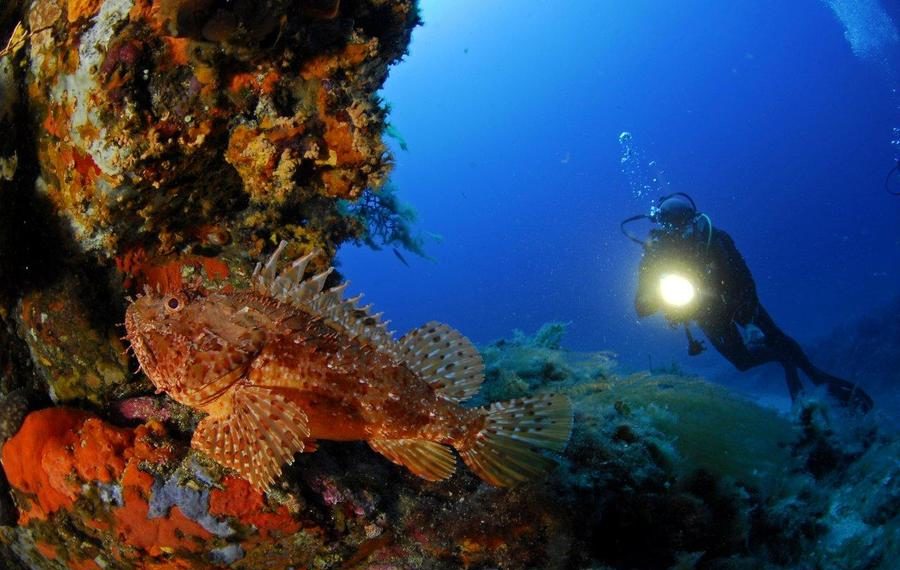
- A massive scorpionfish: characterized by its stout body and massive head, the large red scorpionfish is the largest scorpionfish in the Mediterranean basin with a maximum length of 50 cm and can weigh up to 3 kilos.
- Venomous warning : the large red scorpionfish has hard spiny rays made of venom glands present on all its fins. However, it only uses these spines for defense. The active principle of its venom, very painful, can fortunately be neutralized by a heat source of at least 50°C as it is thermolabile in scorpionfish.
- Camouflaged among the rocks : its marbled red color gives it ideal camouflage within rocky bottoms covered with algae and coralligenous zones. The large red scorpionfish can also be found on sandy or muddy-sandy bottoms, thus it remains most of the time motionless and raises its spines in case of potential danger. Juveniles measuring less than 25 cm are frequently found in seagrass meadows.
-
A nocturnal hunter in ambush : motionless, the large red scorpionfish waits at night or at dusk for the arrival of benthic organisms such as crustaceans or small fish and mollusks. Once they come close enough, its protrusible mouth sucks in its prey.
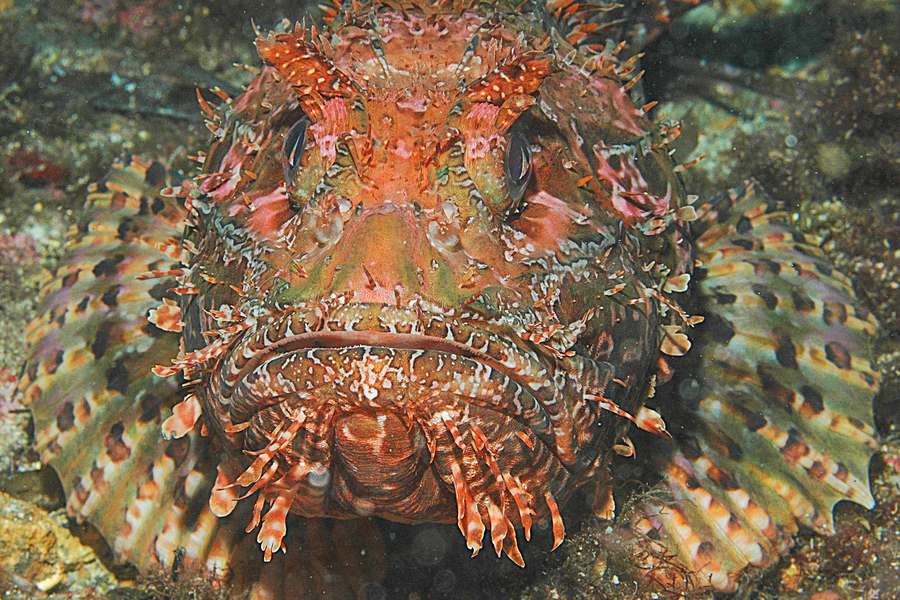
Face-to-face with a large red scorpionfish. © Nicolas Barraqué - A solitary life : the large red scorpionfish lives alone for most of its life. Juveniles develop in shallow waters, then lead a sedentary and territorial life deeper down.
- A tattered scorpionfish : above its eyes, under its lower jaw, and on its nostrils are skin flaps varying in color from red, orange, pink to yellow, contributing to its mimicry. A characteristic black spot is also visible in the middle of the dorsal fin.
- A vulnerable spawning : the large red scorpionfish is a gonochoric species (separate sexes) that reproduces at night between the end of spring and summer to maximize protection of its spawn from predators. Its eggs are pelagic, gathered within mucus, and the larvae develop in open water. Males reach sexual maturity faster than females.
- Better longevity for females : females, larger than males, also have a longer lifespan (up to 25 years compared to 12 years for males).
- Diversity of the genus : the large red scorpionfish belongs to the genus Scopaena which includes over 60 described species to date, including 6 in the Mediterranean.
- A species in decline : the large red scorpionfish is vulnerable to spearfishing in the Mediterranean basin, where its fishing is scarcely restricted. Nevertheless, it is listed on the global and European IUCN Red List as « Least Concern ». A study conducted in 2015 indicates a decline in mass and body length of the species over the past 50 years.
Where to find it? The large red scorpionfish is found in the Mediterranean, particularly in France, and in the Atlantic on the Spanish coasts, the Canaries, Cape Verde, and the Azores between 20 and 200 meters deep. Not very shy, the species can be easily approached by divers.
Lisa Ferré