


Around the world, cutting-edge training centers in Cologne, Houston, and Moscow allow astronauts to prepare for the unique experience of spacewalks. For this, large pools are equipped with life-size replicas of the International Space Station (ISS) modules. Submerged underwater, astronauts practice technical maneuvers and manage physical challenges, in conditions that closely simulate weightlessness.
Spectacular training pools to simulate weightlessness
How to train an astronaut for their first spacewalk? Simulating weightlessness on Earth has always been a major challenge. Space agencies have found their solution: the underwater environment. Thus, they have designed gigantic training pools. The European Astronaut Center (EAC) in Cologne and the Star City in Moscow each have a 10-meter deep pool: the NBF in Europe and the Hydrolab in Russia. Life-size models of ISS segments are fully submerged there.
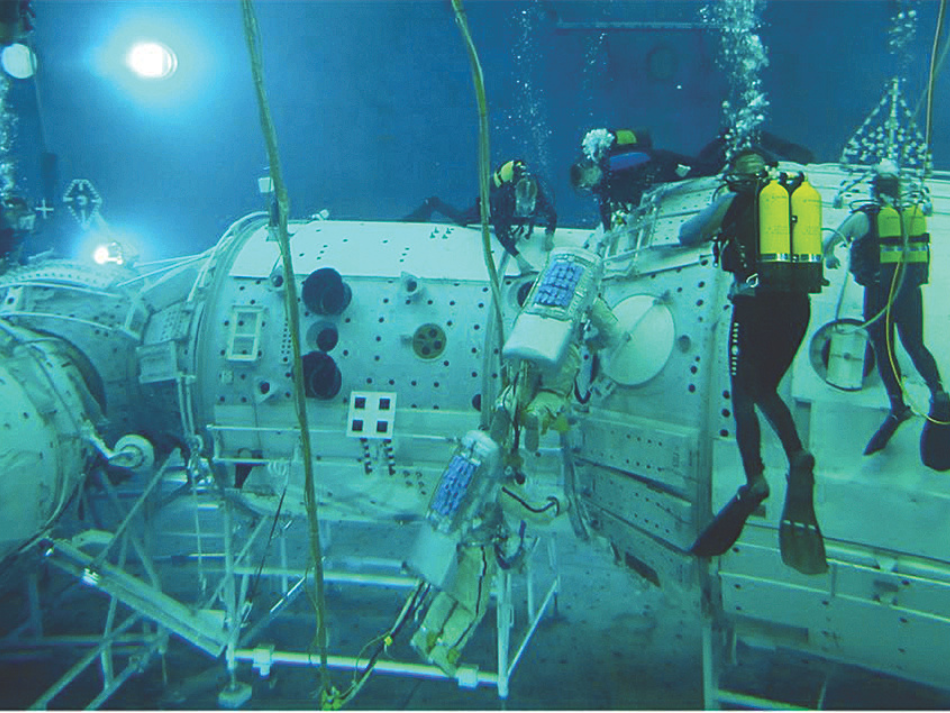
In Houston, NASA even has the NBL (Neutral Buoyancy Laboratory) pool, six times larger than its European counterpart, reaching 12 meters deep to install a complete replica of the American segment of the ISS.
In Cologne, it is the Frenchman Hervé Stevenin, a space engineer turned instructor in 2007, who coordinates spacewalk (EVA) training. He is also responsible for operations and maintenance of the pool at the EAC. Trained in spacesuit handling at NASA and Star City, he explains: “This experience is essential to understand the challenges of EVA training and to effectively guide astronauts.”
Did you enjoy this excerpt?
Read the full article.
READING TIME ≈ 7 min
Dive into the heart of PLONGEZ! Magazine
To enjoy this article and its exclusive content, a modest contribution is required.