


Underwater Sand: An Unseen Living World
It cannot be repeated enough: sandy bottoms are teeming with life. From majestic torpedo rays to enigmatic garden eels, passing through moon snails and heart urchins, the sand is never void of its inhabitants. Sometimes it even becomes a protagonist in its own right when the sand itself is… alive!
Unexpected Dive in the Lembeh Strait
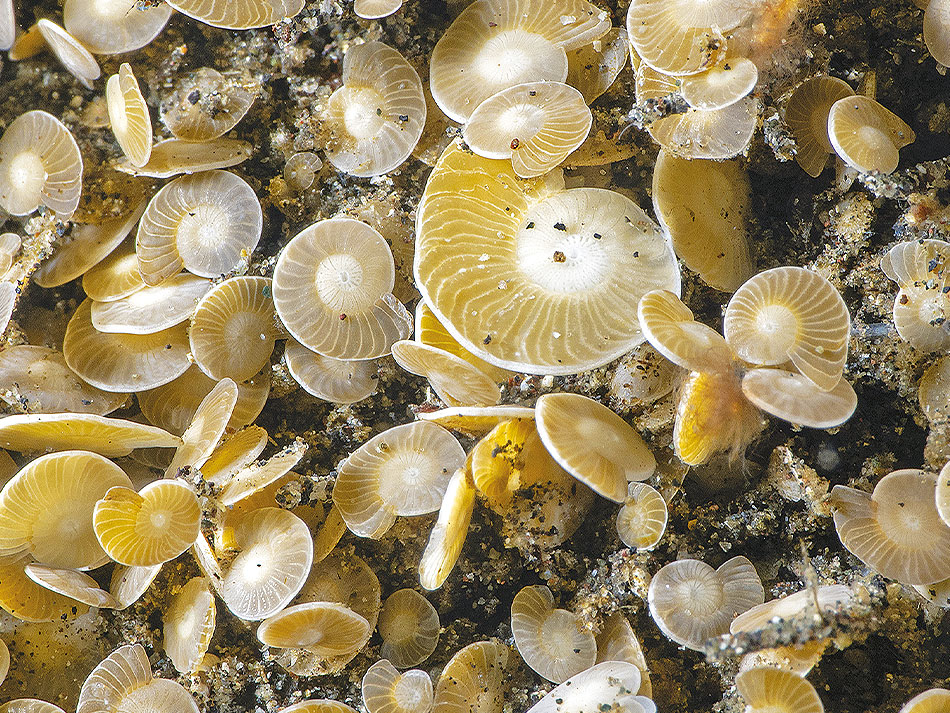
Set sail for Indonesia, in the famous Lembeh Strait, a true paradise for divers who love biodiversity. The adventure begins as soon as we hit the water. After exchanging « OK » signals with the buddy, we start the descent along a vast sandy slope. To my right, my teammate. A little further, another pair, and ahead of us all, our Indonesian guide leads the way. The pace is brisk: here, you rarely scrutinize the slope because it’s much lower that the show begins. Besides, the sand, usually harmless, draws my attention. Something is amiss: it appears unusually coarse. Intrigued, I let myself drift to the bottom to take a closer look.
When Sand Reveals Its Secrets
What I observe up close exceeds all my expectations: the « sand » is nothing other than a carpet composed of millions of tiny calcareous spirals. This sandy bank is actually alive, formed by foraminifera (“bearers of holes”). These discreet creatures are far from rare, even though they are little known to the public: there are more than 20,000 species, both fossil and current.
Foraminifera: Tiny Marine Architects
Foraminifera are protozoa, that is, unicellular animals, which secrete a calcareous shell called a test. This shell can have one or more chambers. As the foraminifera grows, its cytoplasm extends and covers the existing chamber to create a new « room. » This process repeats throughout their life, giving rise to a succession of interconnected chambers, often organized in a spiral shape like a miniature snail.
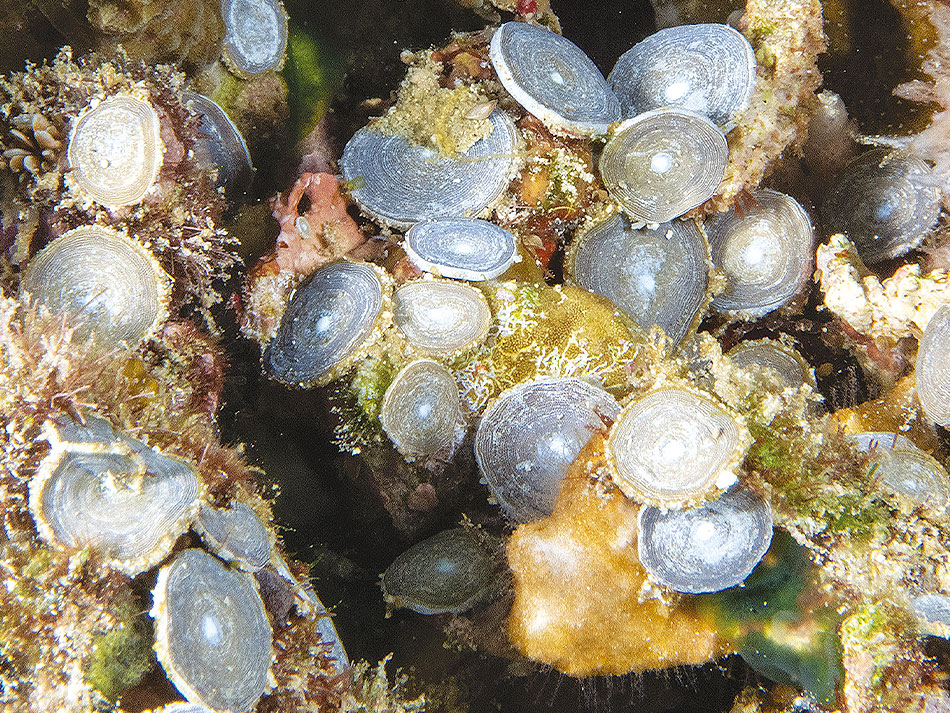
The animal occupies all the chambers and projects filamentous pseudopodia through the tiny pores of its shell, which anastomose to form a net. This net, worthy of a tiny trap, allows it to capture and digest its prey. Sizes range from microscopic (about 50 microns, or 1/20th of a millimeter) to a few centimeters. However, most measure around half a millimeter.
Varied Habitats and a Stunning Diversity
Foraminifera generally lead a benthic life, preferring sheltered areas at shallow depths. Some live attached to hard substrates like rocks, shells, algae, or marine phanerogams. Others slowly crawl among sands and gravel, moved by their pseudopodia. A few species, among the smallest, live in open water, thus becoming part of the plankton.
A Major Ecological Role
Beyond their incredible architecture, foraminifera fascinate with their abundance. In some coastal regions, sands can be composed of up to 90% of their calcium carbonate skeletons. Their significance is mainly revealed in the deep ocean: decade after decade, these skeletons accumulate and deposit up to 6 centimeters of thickness per century, forming dense layers. Foraminifera of the genus Globigerina are particularly abundant and even give their name to « calcareous oozes. » It’s estimated that nearly 30% of the ocean floor, or 100 million km² — equivalent to a quarter of the Earth’s surface — is covered by this ooze!
Sand, Much More Than It Seems
The next time you look at what seems to be an ordinary sandy bank, remember that it hides an ancient story and a true ecosystem, just as fascinating as the rarest fish.
This article, initially written by Steven Weinberg for the print edition of PLONGEZ!, has been adapted for the web.
Images © Steven Weinberg.