


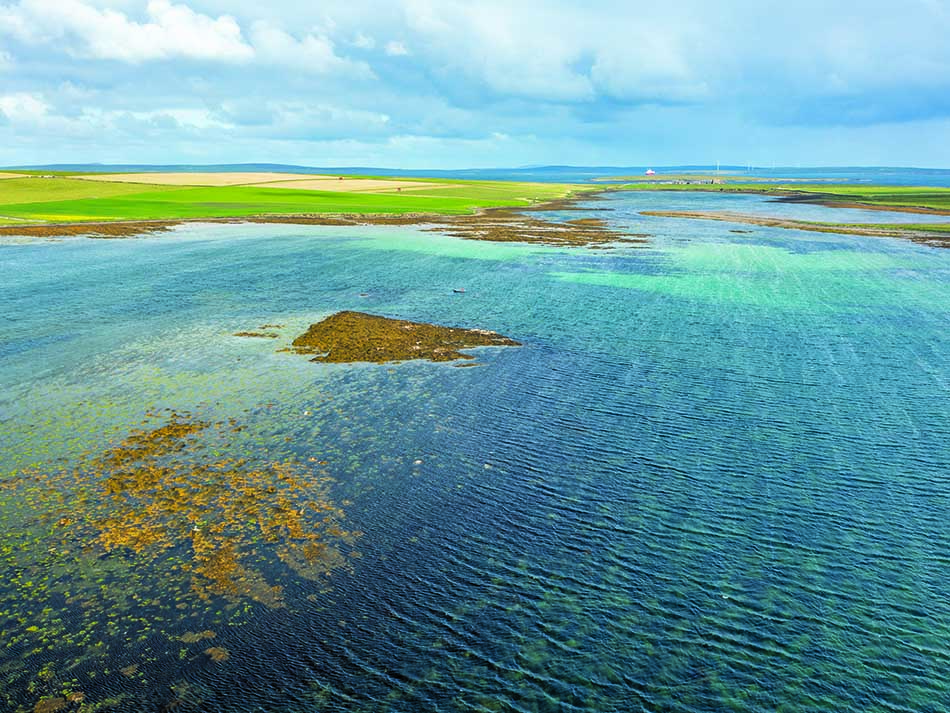
The Orkney archipelago, in the northeast of Scotland, is faced with the power of the elements. Here, the North Sea mingles with the Atlantic Ocean in a strait renowned for its violent currents. However, the sheltered bays of the small islands provide havens for eelgrass beds, essential to the ecosystem. For two years, a team of researchers has been exploring their richness.
A flourishing biodiversity
These wild islands, near the tumultuous currents, teem with biodiversity. The nutrient-rich waters of the Gulf Stream, originating from the Caribbean, foster a mild and varied climate across the 70 small islands. This climate and the richness of the waters attract many fish and half a million seabirds that nest on the cliffs. About 60,000 puffins are present in the spring and summer, with orcas spotted along the coasts.
In the shallow bays, vast marine meadows thrive, benefiting from the sheltered waters. These perennial plants, which are not algae, have thin green leaves and use photosynthesis to create nutrients. Their bright fronds form dense seagrass beds, with complex roots in the sand, hosting a wide array of life forms, including juveniles. A significant portion of global fisheries, such as Atlantic cod and Alaskan pollock, depends on these marine meadows, making their protection crucial for food security and combating climate change.
Did you enjoy this excerpt?
Read the full article.
READING TIME ≈ 7 min
Dive into the heart of the PLONGEZ! Magazine
To enjoy this article and its exclusive content, a modest contribution is required.