


For the majority of us, the call of the deep blue remains a distant dream. Only one-tenth of the metropolitan French population has the privilege of observing the sea or ocean daily. So, how can one satisfy their passion for freediving when the marine horizon drifts away? The answer is simple: the swimming pool! Often perceived as a fallback option, pool freediving is much more than just an alternative. It is a demanding training ground, a full-fledged competition venue, and for some athletes, a true heartfelt choice, complementing their deep-sea explorations. Let’s dive into the stories of three exceptional freedivers who reveal the unsuspected facets of this fascinating discipline.
Pool freediving: static or dynamic, two complementary disciplines
The French Federation of Undersea Studies and Sports (FFESSM) distinguishes two forms of pool freediving, each with its own challenges and specifics:
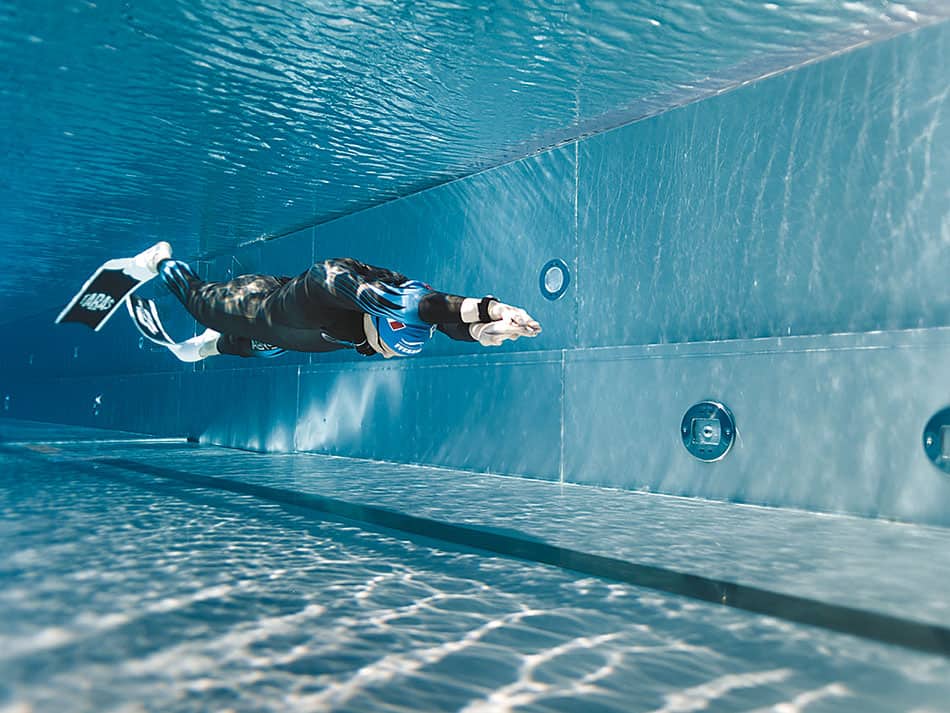
- Static apnea: the art of stillness. Imagine yourself lying on the water’s surface, motionless, the body perfectly relaxed, the mind focused solely on holding your breath. This is the very essence of static apnea. In this discipline, the stopwatch rules. The ultimate goal is to push the limits of time, to grab every second for maximum performance. Far from being passive, static apnea is a true school for self-control, where mental and physical relaxation is the key to success. It allows for heightened body awareness and reactions, valuable skills that translate into improved performances in all other apnea disciplines.
- Dynamic apnea: the quest for distance. Forget about time, here it’s about space. In dynamic apnea, the athlete propels underwater, extending as far as possible on a single breath. Whether using bifins, a monofin, or without any assistance, dynamic apnea demands different qualities: glide management, movement optimization, and energy efficiency. It’s an aquatic dance where every move counts, where technique and efficiency prevail to slice through water and go ever further.
These two disciplines, far from opposing each other, mutually reinforce. Static apnea sharpens concentration and resistance to oxygen deprivation, while dynamic apnea develops endurance and movement technique. Together, they form a complete and balanced training regime for any freediver, be it in the pool or open sea.
Guillaume Bourdila: from lifeguard to world record holder, the aquatic revelation
At 28, Guillaume Bourdila boasts an impressive track record, even more remarkable knowing he discovered competitive freediving just three months after his first introduction to the discipline. Vice world champion at sea, his freediving destiny began to take shape in the more mundane setting of a municipal swimming pool.
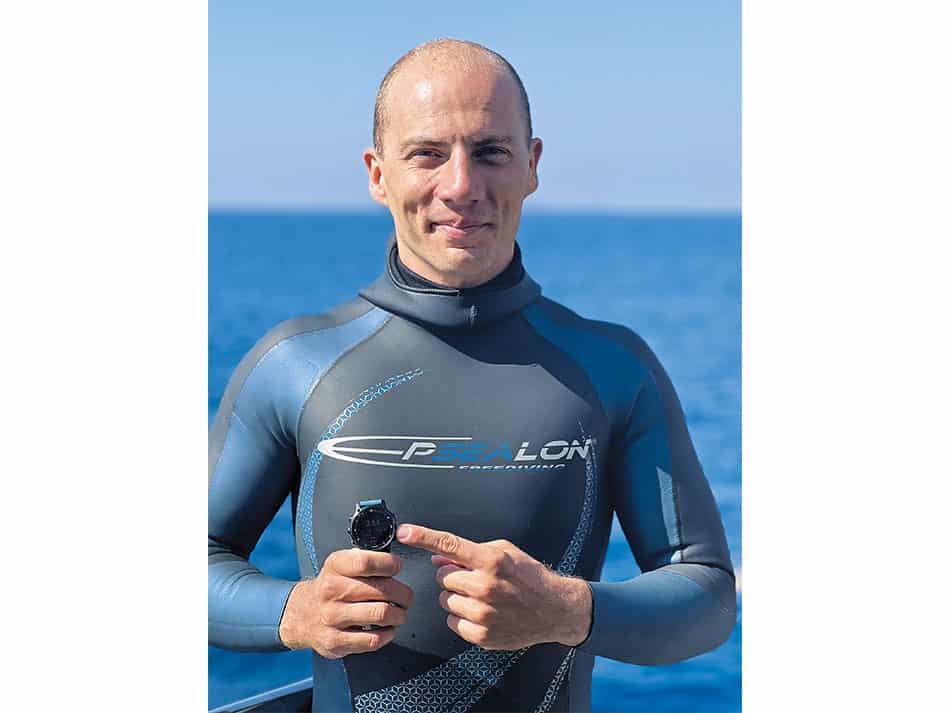
A student at the time, Guillaume worked part-time as a swimming pool attendant. « It was to earn some money during the summer, » he explains. Ironically, by prohibiting pool users from practicing freediving, a difficult activity to supervise, he himself became curious. A challenge was launched among colleagues: who could stay underwater the longest? Guillaume surprised everyone, discovering unsuspected abilities. Within a few weeks, he easily surpassed 100 meters in breaststroke.
Did you enjoy this excerpt?
Read the full article.
READING TIME ≈ 16 min
Dive into the heart of the PLONGEZ! Magazine
To enjoy this article and its exclusive content, a modest contribution is required.