


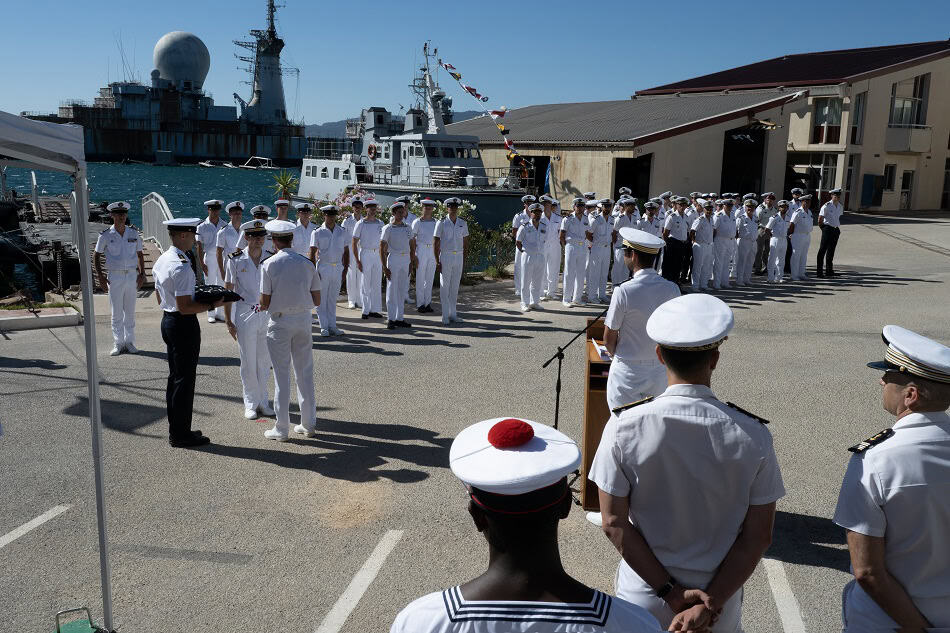
On July 4, 2024, the Saint-Mandrier diving school marked an important milestone with the closing ceremony of the 66th mine clearance diver course. Twelve students were certified, thus commemorating 60 years of a training program that continues the standards of excellence established by its pioneers.
A legacy born after World War II
At the end of World War II, France had to embark on a vast mine clearance operation of its coastline, starting in Toulon. Under the command of Lieutenant Commander Philippe Tailliez, a handful of pioneers, mostly former submariners, began this mission. They innovated constantly, developing breathing apparatus, decompression tables, and various essential tools for the success of their operations. Some even paid the ultimate price for their commitment. In 1953, the mine clearance diver certificate was established, attesting to their training. Commander Jérôme Pernot, head of the diving school, notes that at the time, this certification was a supplement for those working in other Navy trades, such as mechanics or gunners.
From the creation of the diving school to the technical proficiency certificate
Philippe Tailliez, Jacques-Yves Cousteau, and Frédéric Dumas are the iconic figures responsible for the creation of the Underwater Research Group (GRS). This group, later becoming the GERS and subsequently the CEPHISMER, is known today as the Expert Center for Human Diving and Underwater Intervention. This organization is now responsible for the armed forces’ diving doctrine and capability development in underwater interventions.
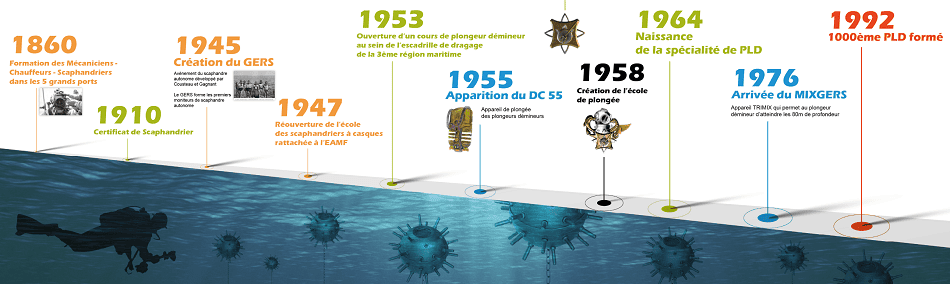
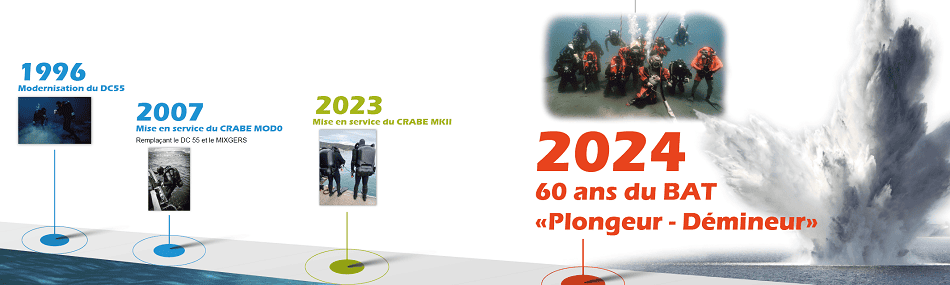
Initially, the training of divers, combat swimmers, and mine clearance divers was conducted in various places. Mine clearance divers were first trained within the GERS. In 1957, the Saint-Mandrier diving school opened its doors, ensuring unified training. Over the years, the number of mine clearance divers trained each year varied between 50 and 60. In 1964, the mine clearance diver certificate evolved into a technical proficiency certificate (BAT), opening definitive career opportunities. This transformation coincided with General de Gaulle’s launch of a nuclear deterrence program, leading to an increased demand for qualified mine clearance divers.
A profession with constant demands
Although diving conditions have evolved, the demands of the mine clearance divers’ profession remain unchanged. Today’s mine clearance divers benefit from the latest technological advancements, able to dive to depths of up to 80 meters with equipment like the CRABE, developed by Aqualung. However, the essence of their profession remains: rigor, commitment, and precision are still required to successfully carry out missions without endangering themselves and their comrades.
The training process lasts an average of 10 months, provided one holds a shipboard diver’s certificate. These 10 months are divided into 4 months dedicated to mastering diving tools and an additional 6 months to acquire the skills necessary to handle explosives, both on land and at sea. They must also master various underwater tasks, such as welding and assembling structures.
Since the start of this training, over 1,600 mine clearance divers have been certified. Additionally, those in service return to obtain the higher diploma (BS), enabling them to become group leaders.
Prospects after certification
Once certified, mine clearance divers have two possible career paths:
- Embarked on minesweepers : The French Navy has 8 minesweepers, based in Brest and Toulon.
- Assigned to the Mine Clearance Diver Groups (GPD) : These are located in Cherbourg, Brest, and Toulon.
Whether during training or in operations, all mine clearance divers spend a significant amount of their time underwater, integrating passion and professionalism. This profession demands top-notch physical endurance as well as essential aquatic proficiency.
This article, originally written by Isabelle Croizeau for the print edition of PLONGEZ!, has been adapted for the web.
opening image © Jonathan Cahoreau