


web premium – free demo article
Discover the Web Premium offer
In the midst of the pandemic, Laurent Ballesta and his team set off for the Aeolian Islands. They spent several weeks diving in an underwater world shaped by volcanic activity where, between lava flows and acid upsurges, marine life perseveres. He recounts an extraordinary expedition for us.
Mediterranean: The Hidden Side of Volcanoes / Full Version 52 min.
The night is beautiful, the sea too. However, the water is cold despite an early spring. It’s the paradox of the sea, changing and restless, yet slow to follow the seasons. The Victoria glides slowly to the south. For once, I’m at the helm. The first and last time I relieve our captain a little. Once the mission starts, the deep divers will, as often, be exempt from night watch, to sleep well between long, challenging dives.
I could easily follow my course by looking at the sophisticated instruments on the bridge, let the autopilot do its job… But how can one resist an ancient navigation guided by a small glowing light, far off on the horizon ? It’s called the Mediterranean lighthouse, but it isn’t man-made, rather it comes from the burning depths of the earth. It’s the crater of the Stromboli island-volcano, in the Aeolian Islands archipelago, north of Sicily. From afar, this flickering glow is hardly noticeable but it has persisted for millennia.
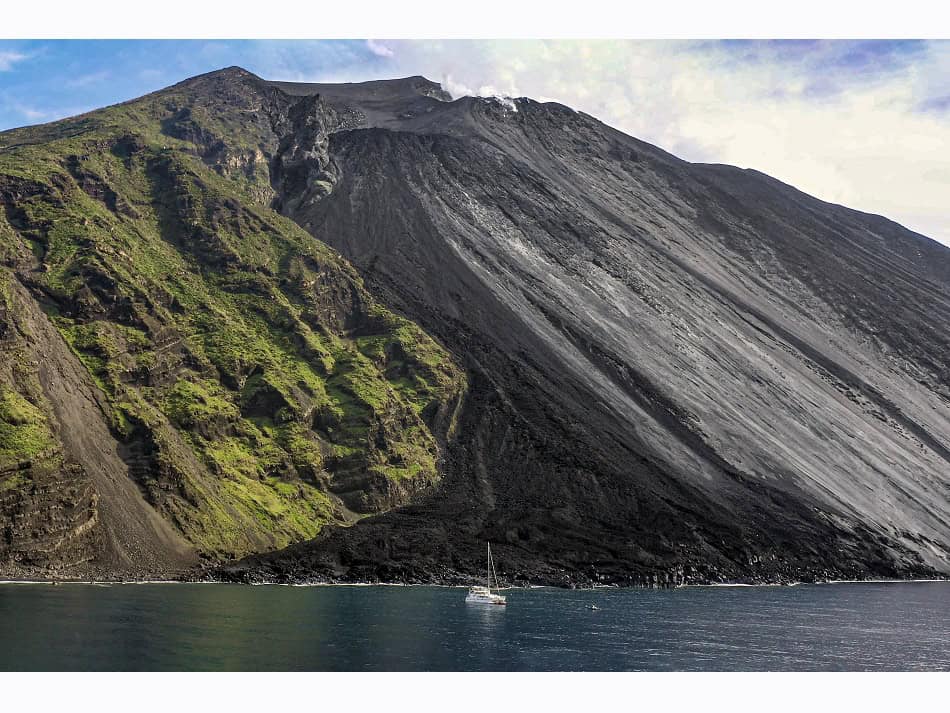
We have a meeting with Italian volcanologist Francesco Italiano. It was he who discovered and then revealed to my diving friend Roberto Rinaldi the existence of deep volcanic phenomena… Roberto, after diving there once, told me about this incredible place. The seed was planted. Two years passed, the time needed to build a meaningful mission, i.e., one that could serve local scientists and help them in their research. Leaving just to ‘go see’ has never fully satisfied me. Our journey must unravel some secrets and it’s all the better if beautiful images follow. The beauty of the world is not nothing, but it’s less fascinating than its mysteries.
We are in the midst of a pandemic. The last G7 summit was held via video conference. They confidently tell us that the global economy will bounce back when vaccines are ready. Nothing more, as if there were no other lessons to learn from a tiny virus that brings humanity to its knees ! Heads of state are remote, and we are at sea under the sky, on a tourist-free Mediterranean. After 4 days at sea and a stop in Naples to pick up Roberto, we still haven’t seen a single yacht, barely a ferry, no cruisers. Cruising along the high cliffs of Capri, encountering only a fishing boat, is more than a privilege, it’s like a journey back in time. The surroundings of this limestone castle appear to us as they did centuries ago, without visitors.
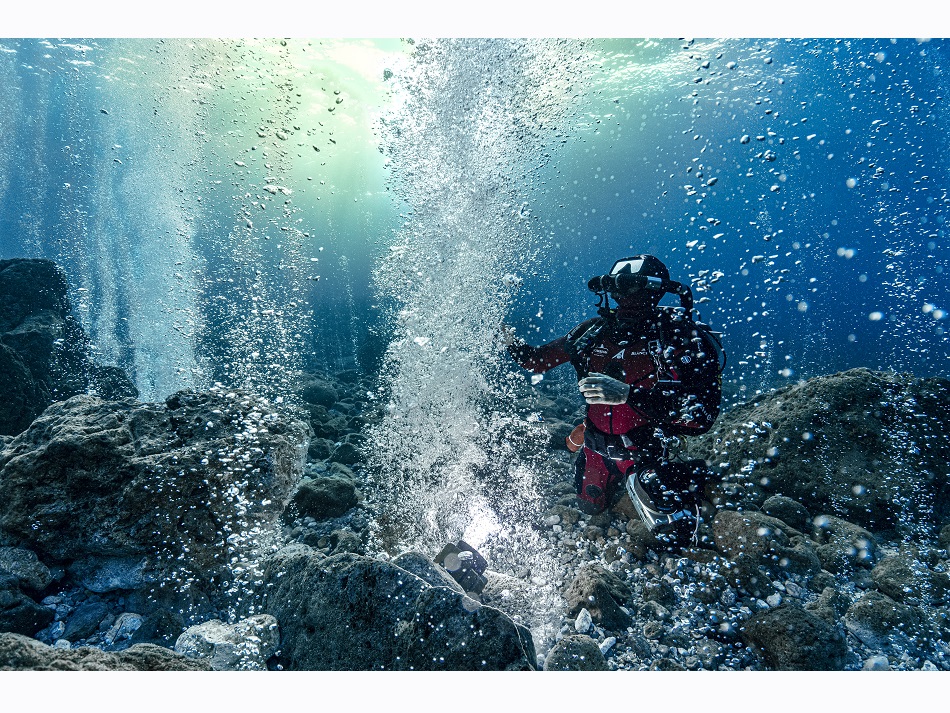
The Acidic Hot Tubs of Panarea
For now, we continue on our route, pass the lights of Stromboli to return later, and reach Panarea. This island is a dormant volcano and its rumblings remind us : here and there, natural hot tubs buzz on the surface.
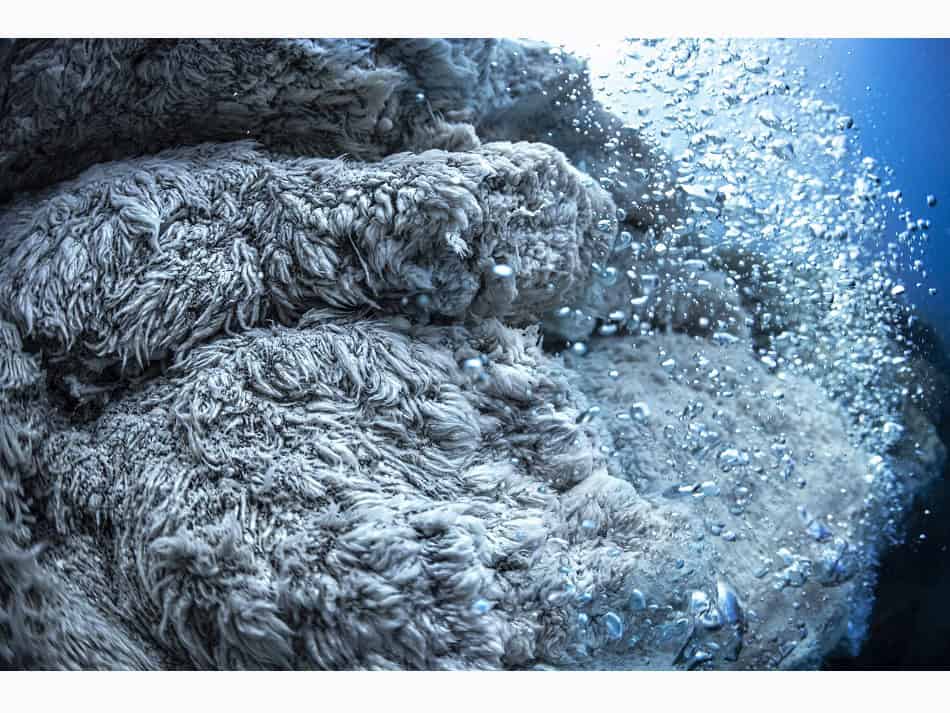
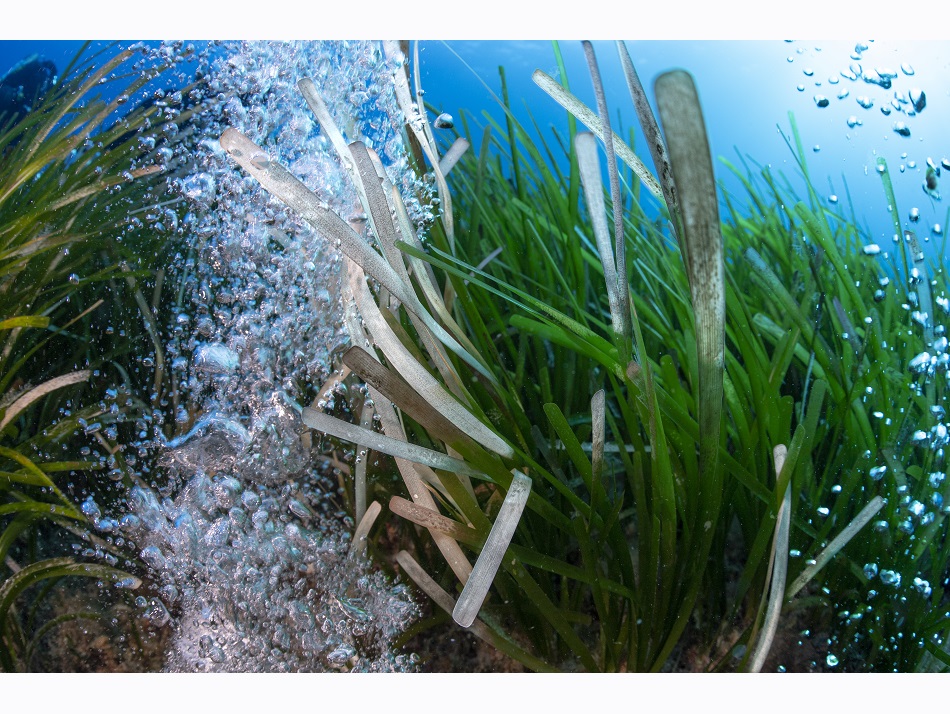
A sulfurous smell emanates. We anchor nearby, and our first dives will take place in shallow but acidic waters! Bubbles rise like rain falls. This reverse storm is so corrosive that the Romans once used it as a cleaning station. They would anchor their ships above the bubble curtains voluntarily so that the acidic gases would clean the hulls infested by ‘aquatic vermin’, algae that slowed navigation, and boring worms that ate the wooden planks. Today, I still see the effect of this acidity on biodiversity : no calcareous organism, shellfish, or coral develops around. A reckless marine worm attempted the suicidal adventure of settling too close to the bubbles. Already, its calcareous tube is slowly dissolving. Elsewhere, posidonia meadows have bleached leaves, as if burned. Only anaerobic bacteria, which thrive on CO2 and sulfurous material, seem to prosper. On the rocky walls, they form a thick, immaculate felt that undulates under the acidic caress. After a few hours in this stinging atmosphere, it’s with irritated cheeks and lips that we return to the Victoria. Even the chrome on our diving equipment taps has oxidized.
This dive just beneath the surface served as a test for our equipment. Therefore, we are moving on without material worries. We are here for deep dives on a unique site named ‘The Valley of the 200 Volcanoes’. This is a discovery made by Francesco Italiano during a mapping campaign. Along a slight depression, straight over 100 meters long and 15 meters wide, thin and tall chimneys appeared on his side-scan sonar screen, over 10 years ago. A line located in a strangely perfect axis between Panarea and Stromboli, whose smoking summit can be seen in the distance.
In the Martian landscape of The Valley of the Volcanoes
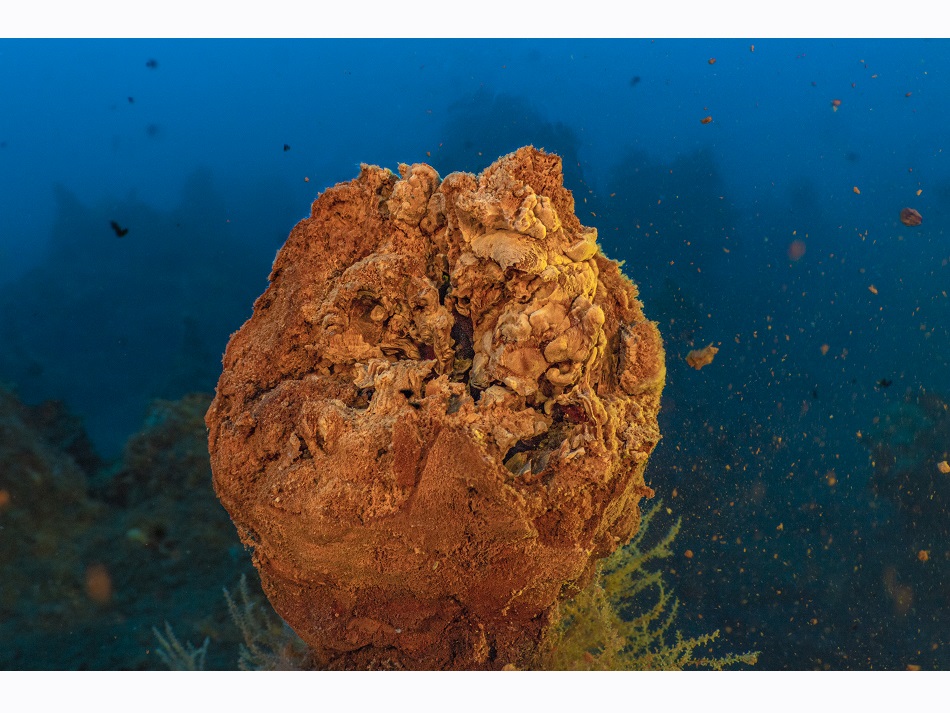
Upon reaching the bottom, the depth gauge reads -78 meters, but the scene resembles an oceanic ridge at -3,000 meters, deep in the Atlantic. There’s an eerie ambiance to this forbidden place, as if down here, the sea was suffocating from excess activity. It exhales, it groans, it spits. At the top of the narrow chimneys, gas and boiling water escape. They are made of crystallized ferruginous and ferric material precipitating on contact with the cold deep water. The colors of the decor are Martian : red, ochre, yellow… As one chimney is built, another seems to be extinguishing, still another is already collapsing.
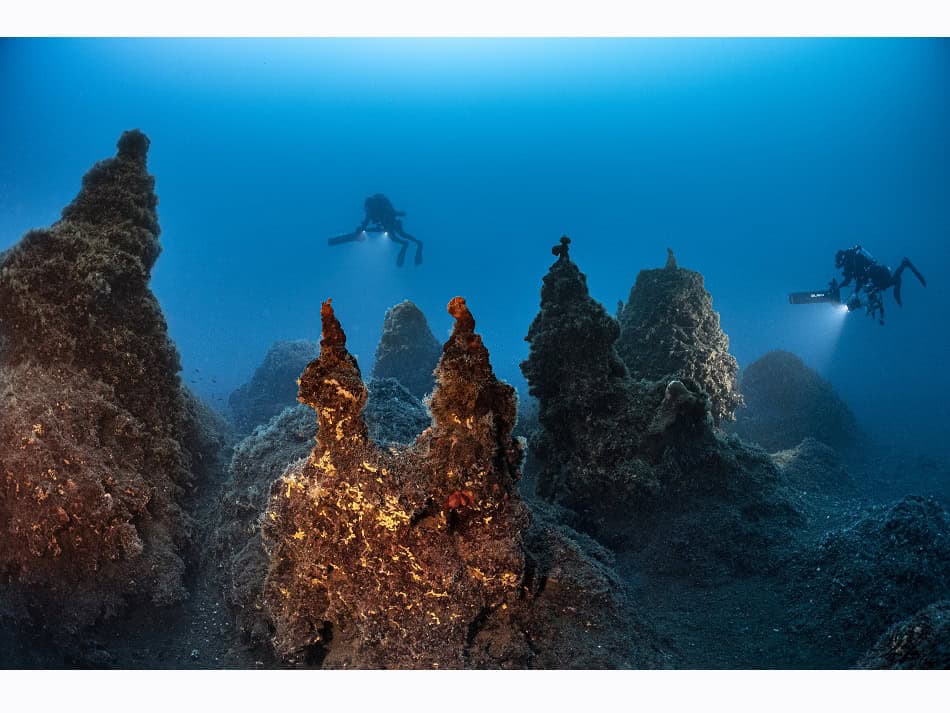
Here reigns great precariousness, but marine life is like this, both fragile and stubborn. A small flatworm, like a creeping fingerprint, slides incognito on the fronds of the udotea leaves, these small pioneer algae covering the red slopes of chimneys with a small forest, hopeful green. This flatworm is indeed bold, venturing all the way to the top of the spurted. Hard to understand what its interest might be in wandering on iron oxides in an acidic water loaded with carbon dioxide.
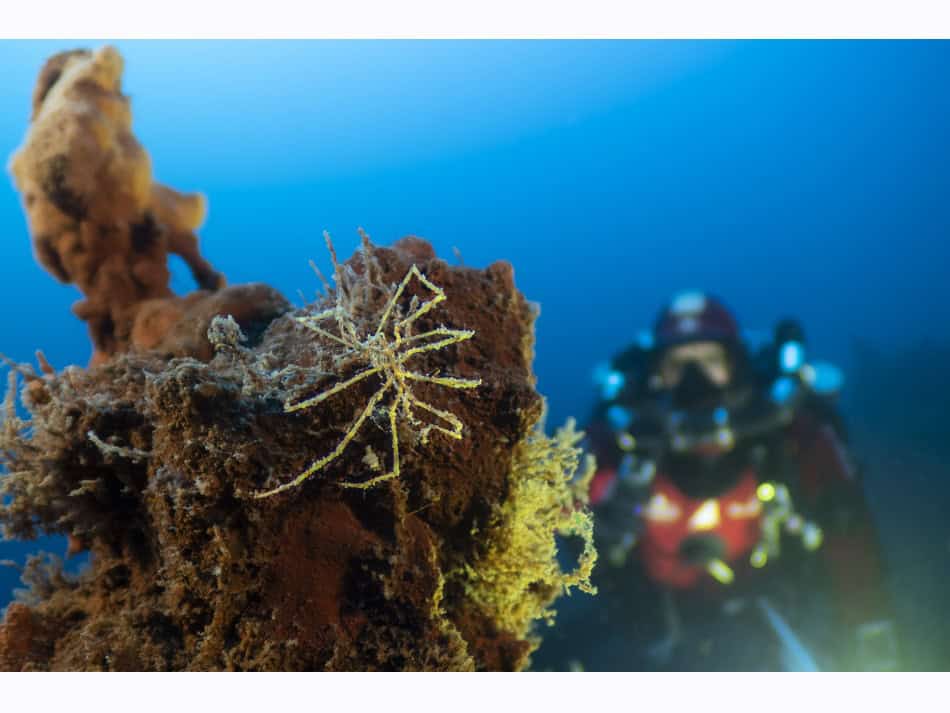
In this same inhospitable environment roams the pantopod. A marine arthropod, its long legs converge towards a body that seems absent given how extremely reduced it is. So reduced that, due to a lack of space in its abdomen, part of its digestive tract is inside its legs. Upon closer inspection, its four eyes can be distinguished in periscope on top of a small head, giving a semblance of coherence to this improbable creature.
Collecting data for research
Contemplation gives way to observation. The remaining time is entirely devoted to the scientific protocols Francesco asked of us. At each chimney, a thermometer is stuck into the small crater, a sample of hot water and another of gas, then we proceed to the next chimney. There are 200, but we will do only about twenty. We’ve been at the bottom for an hour already, three more await us during the ascent for decompression. Our samples also need to decompress. As we ascend, the water pressure on the test tubes decreases. However, the gas inside is trapped under high pressure as it was taken from nearly 80 meters. Therefore, we must take care to purge them every 10 meters to prevent the glass from exploding.. From the analysis of these samples, Francesco Italiano will soon demonstrate that there is a direct link between the 3 main volcanoes of the archipelago. Thus, Stromboli, Panarea’s emissions, and Etna seem to be connected to a giant magma chamber.
Aboard the Victoria, our journey continues. We followed the direction indicated by the alignment of the Valley of the 200 Volcanoes, and here we are at the foot of the immense Stromboli. From its 900 meters in altitude, we can hear the dull, regular noise of explosions as well as see the light from the red lava jets. We approach the island in front of the village, pausing for a stopover. After the privilege of solitary navigation comes that of an ascent. No one has climbed to its summit for two years. Our guide is thrilled to announce to us : the last part, near the crater, constantly reshaped by eruptions, has never been trodden.
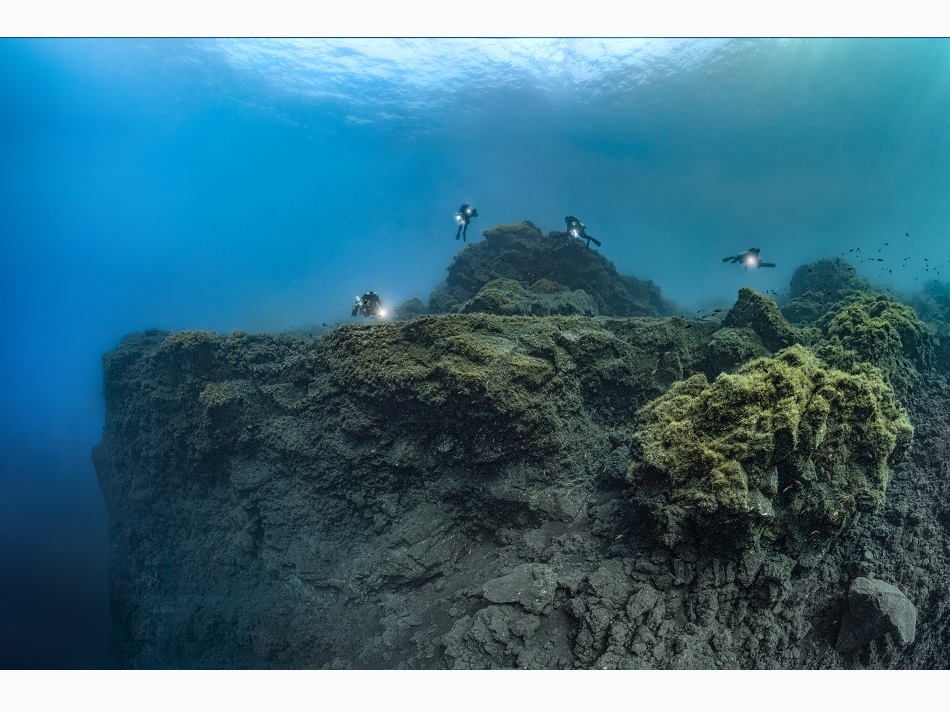
Under the path of fire on Stromboli
From the smokey heights, we take stock of the place. On one side, the village on rather green slopes sprinkled with a few vineyards, olive trees, and fig trees, and, on the other side, the devastated slope. It’s the ‘sciara’ (the path of fire in Arabic) this vast black and vertical corridor, entirely mineral, where lava, rocks, and ash flows unceasingly pour down. It’s easy to imagine that underwater too, the matter spill must be incessant and destroy everything in its path. But marine life is more resilient than on land. I’m curious to see how the ecosystem restarts after each landslide. The last one was 4 years ago. Following a jolt, a huge section of Stromboli, from 400 meters above sea level down to 1500 meters deep, detached from the island and slid into the abyss. Roberto dived there over 30 years ago and recalls a magnificent volcanic rock pinnacle, like an erected needle, 40 meters high. Will this majestic edifice, once covered in marine life, still be there after all this time and the disasters that followed ?
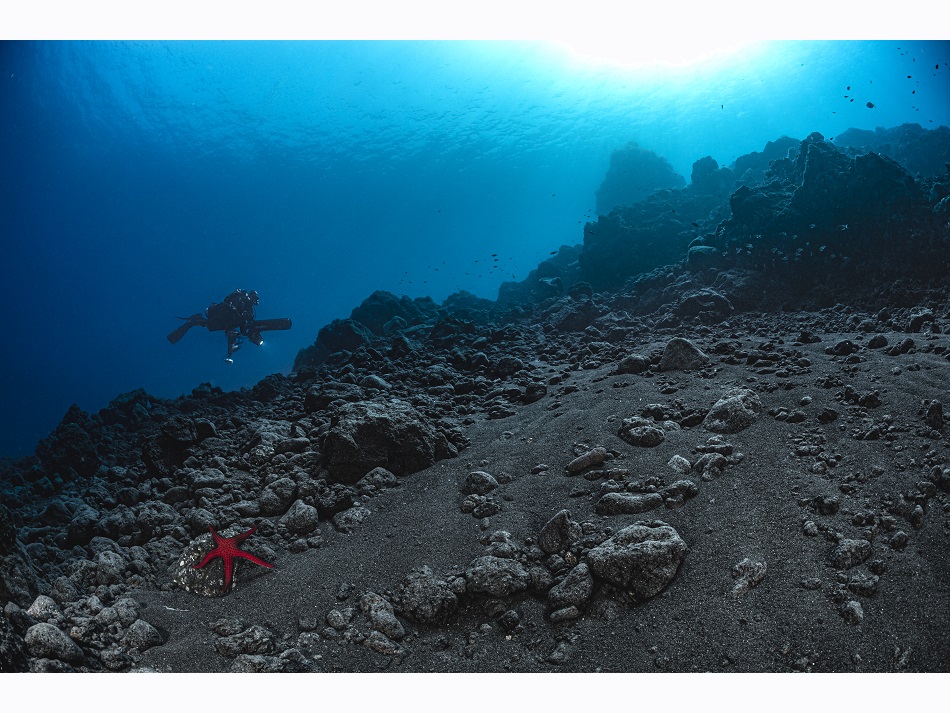
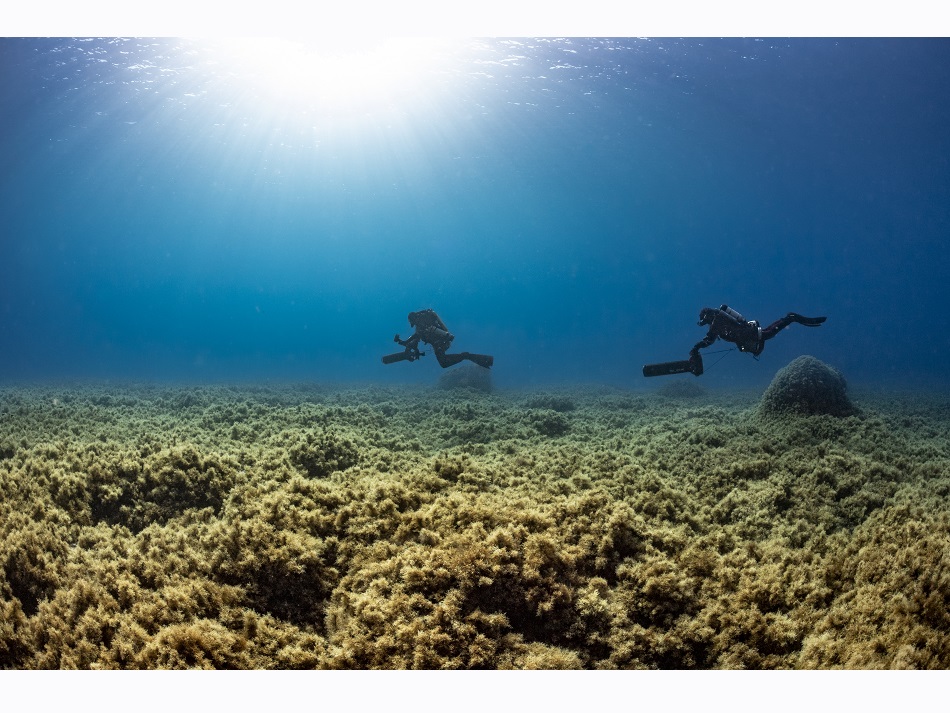
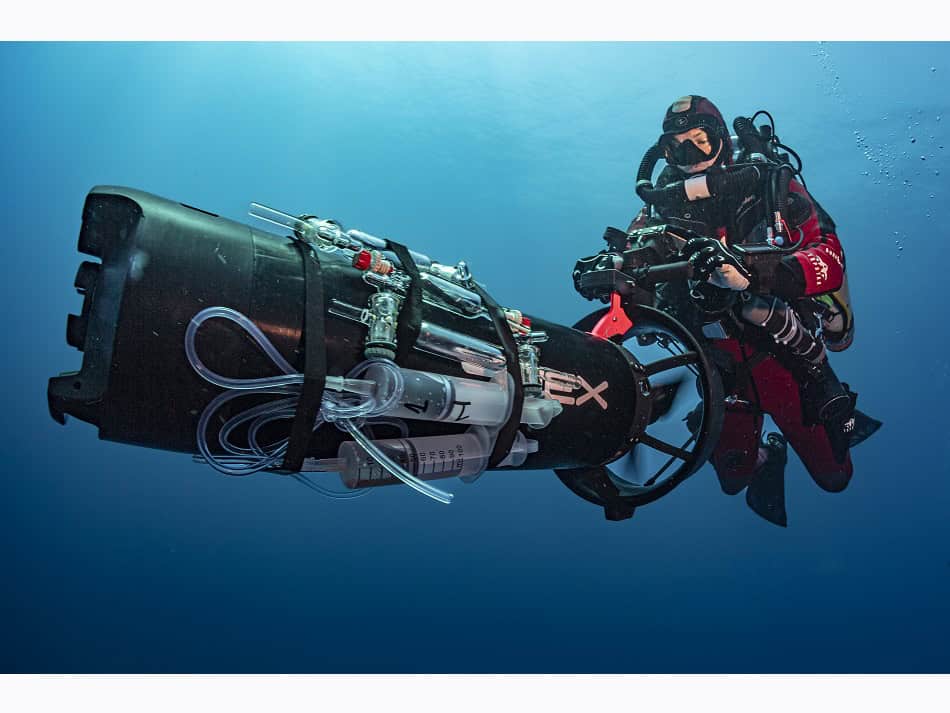
Diving conditions are problematic. It’s forbidden for a boat to anchor under the sciara. An explosion is always possible and burning clouds that rush down the slope like an avalanche at 500°C burn everything in their path. A boat isn’t fast enough to escape if it finds itself on the ‘path of fire’. Underwater, paradoxically, the danger is lesser. There’s no risk of being asphyxiated by burning gases. The decision is thus made to leave the boat near the coast but far from the sciara ; therefore, to enter the water away from the site, then start by swimming about 2 km, hugging the coast just below the surface. Once we reach the middle of the sciara corridor, then, and only then, will we start descending into the depths. With our propellers, the journey to the tipping point will take us about thirty to forty minutes, then the descent to 80 meters, barely one more minute.
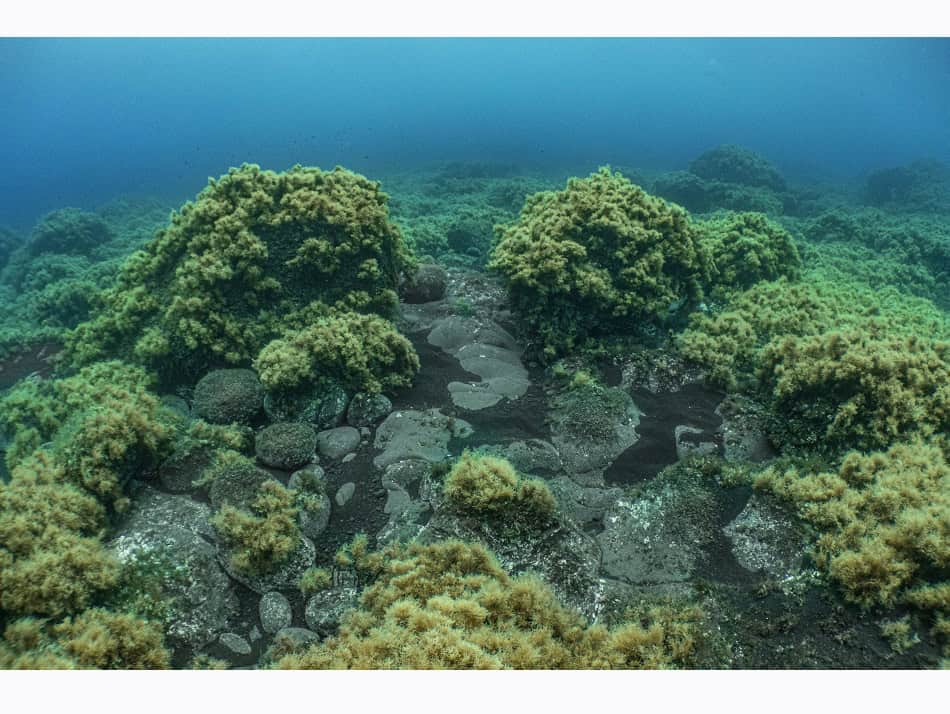
Bottoms redesigned with every eruption
No need to calculate the distance covered. The scenery has just changed suddenly. The fields of cystoseira, these yellow algae bushes rich in hidden fauna, stop abruptly. The transition is brutal ! It’s nothing but black sand and tortured stones. The descent begins. Everything is devastated. I feel Roberto cannot find the landmarks from his 30-year-old dive. Not surprising. Here, with each new eruption, the bottoms are redesigned. One could think they are on a barren planet if not for the silhouette of an anglerfish emerging from the anthracite dust whipped up by our fins.
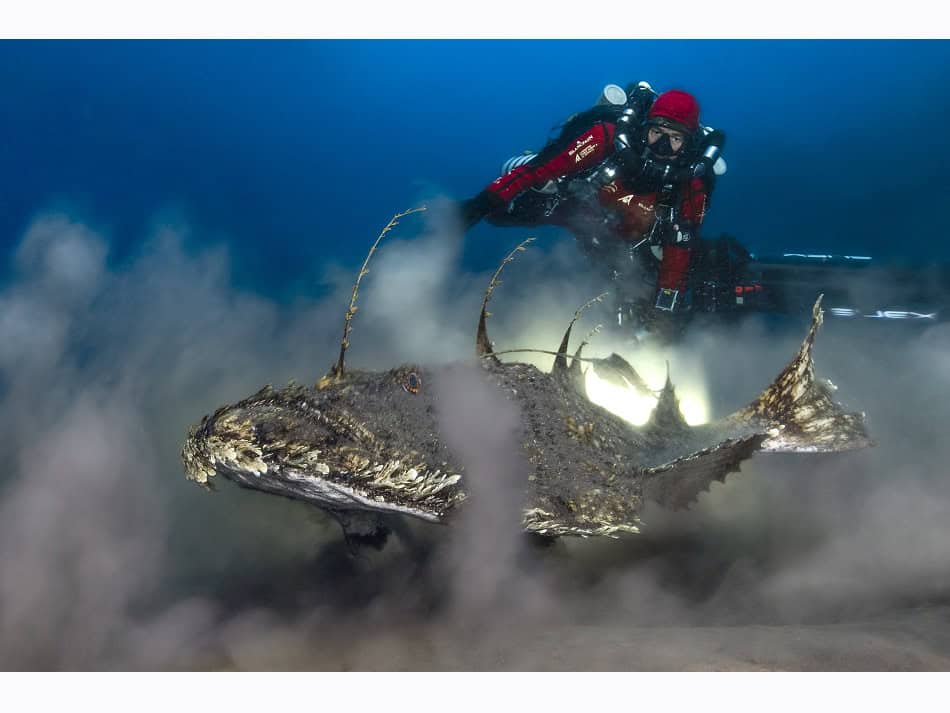
Underwater nature abhors emptiness even more than its terrestrial counterpart. Upon closer inspection, a whole series of pioneer species, tiny bryozoans, ‘moss animals’, have begun their work of reconquest. Life insists on settling between catastrophes. Giant clavellina, crystal bell-shaped invertebrates, seem to find here conditions sufficient for them to thrive, despite the constant threat of eruptions.
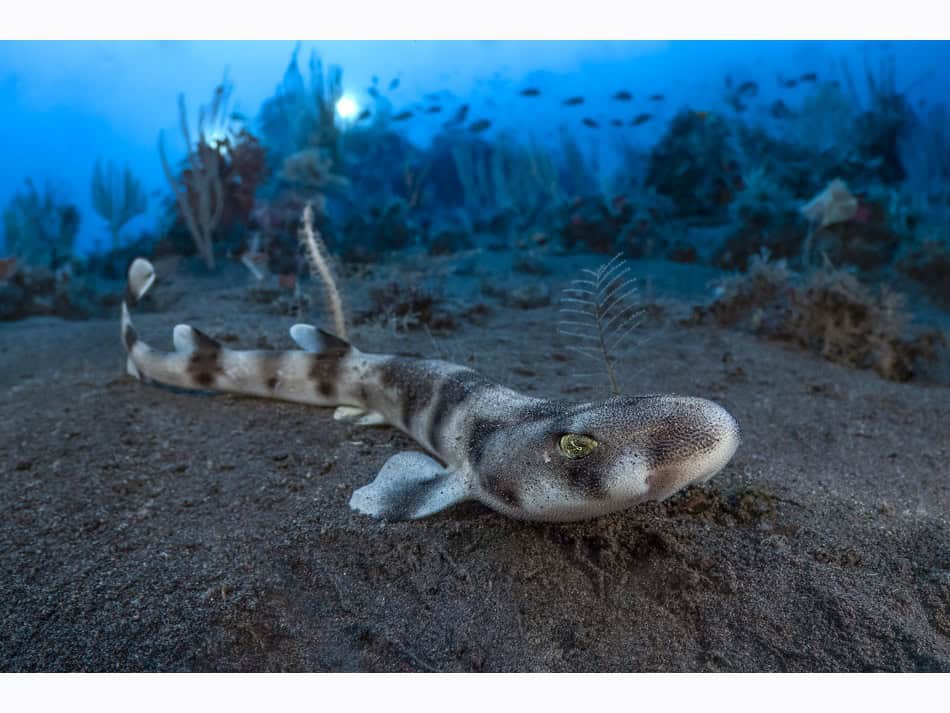
Regardless of the precariousness of the undertaking, a day will come when their work, constantly renewed, will cover these mineral, monochrome foundations with an organic and multicolored veneer. A little further on, a field of white gorgonians narrowly escaped, half-buried in the black sand from a recent flow. There, a juvenile small-spotted catshark 20 centimeters long roams. This baby shark, of uncertain destiny, perfectly symbolizes this reborn ecosystem.
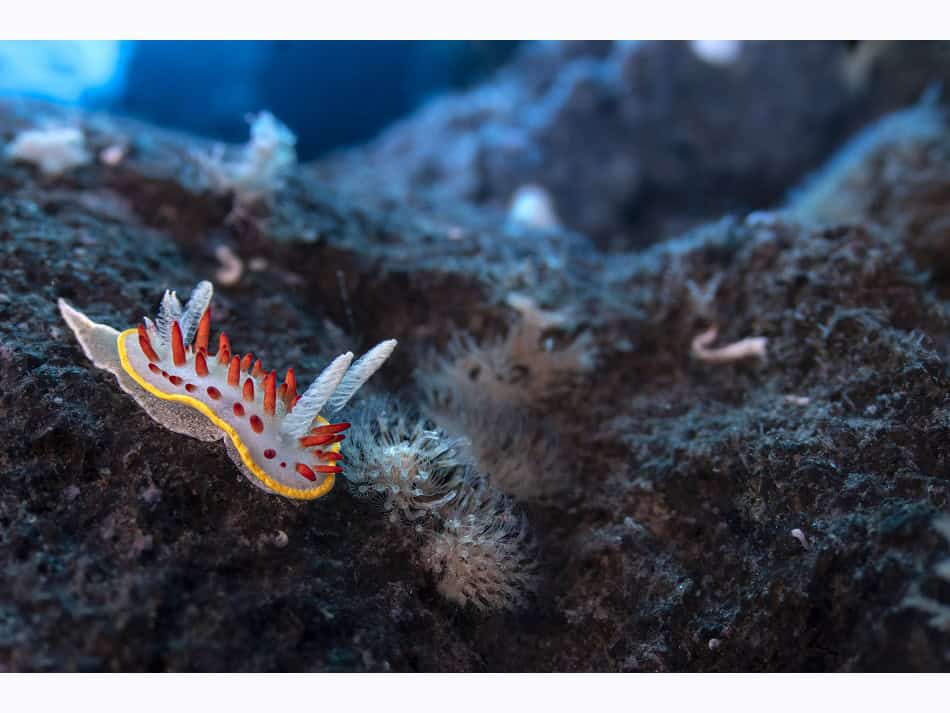
The indestructible pinnacle of Stromboli
After a few days chaining these dives and a side-scan sonar pass to better understand the topography, we finally find the pinnacle that had marked Roberto’s memory. The petrified lavas that constitute it are so hard that they withstood the multiple eruptions that ravaged the surroundings. It is indeed still there, 40 meters high, intact and solid, hosting a more thriving marine life, as it’s been more spared. Here we are at the top of this lava tower, I briefly leave my companions, the time to step back and take in at a glance this immense volcanic cathedral. All around the animal city has disappeared… but Our Lady of Stromboli has not burned.
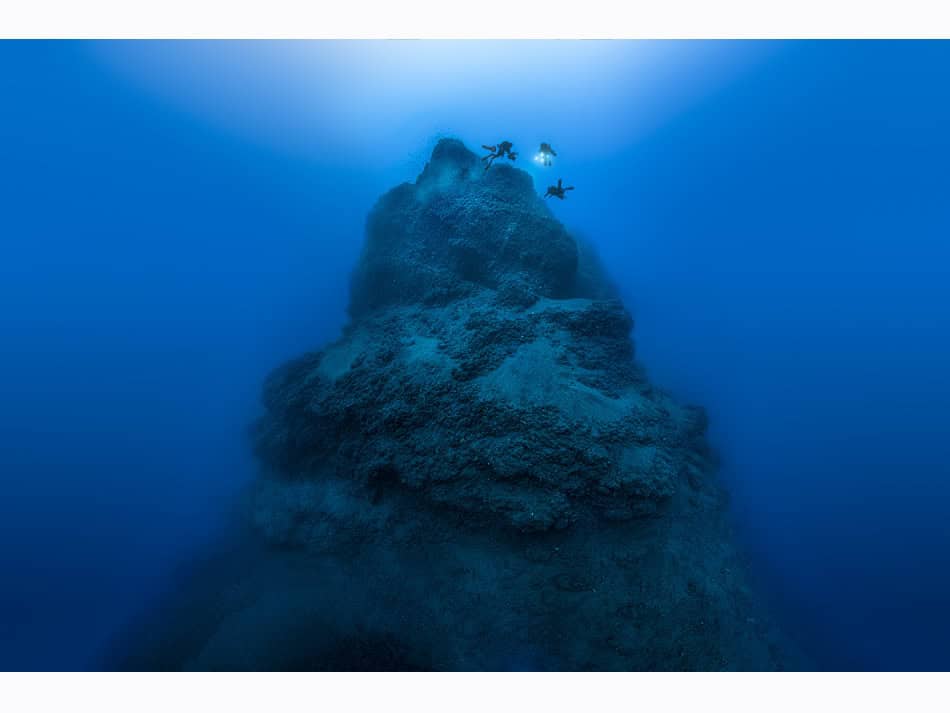
Back to civilization. A few days later, our boat is in front of Naples. Three million men and women live here between the sea and the volcano. Neapolitans know that the catastrophe of Pompeii, which took place in AD 79, can happen again tomorrow. Carefree or daring, they accept this situation of being hostages of Vesuvius, caught between water and fire.
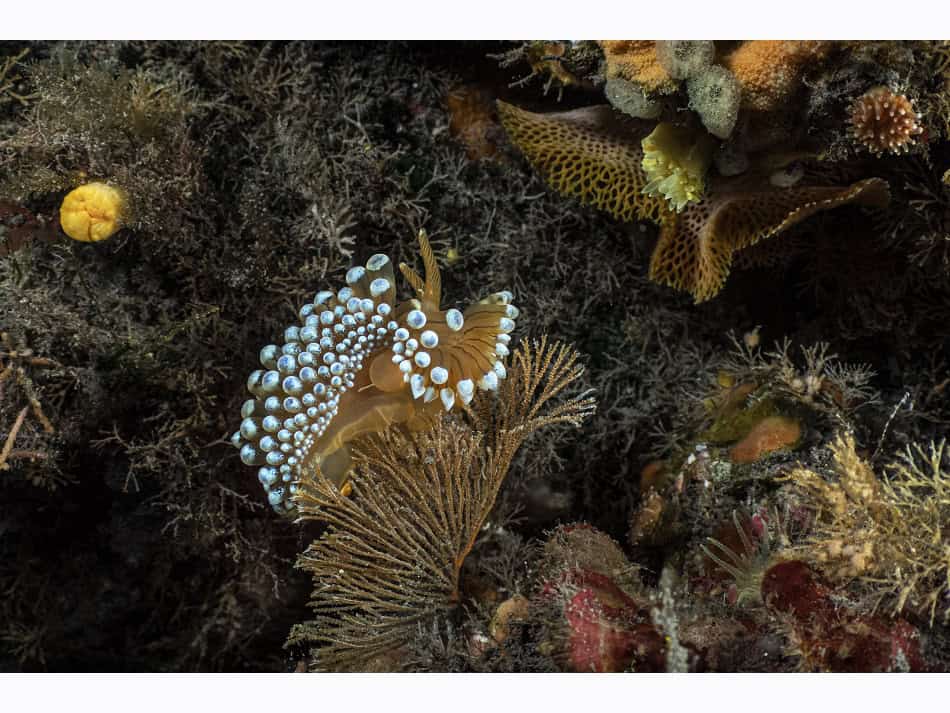
We are here because a friend of Roberto’s – he has many in Italy – is seeking ways to explore and study a strange formation. ‘C’It is a hole at the bottom of the sea ’, the researchers, who know little more, tell us, and they have come in numbers to witness our dive. Each hopes for samples and data specific to their field : rock pieces, sediment for volcanologists and geologists, temperature, acidity, currents, and light recordings for oceanographers, and perhaps life samples, if any, for biologists.
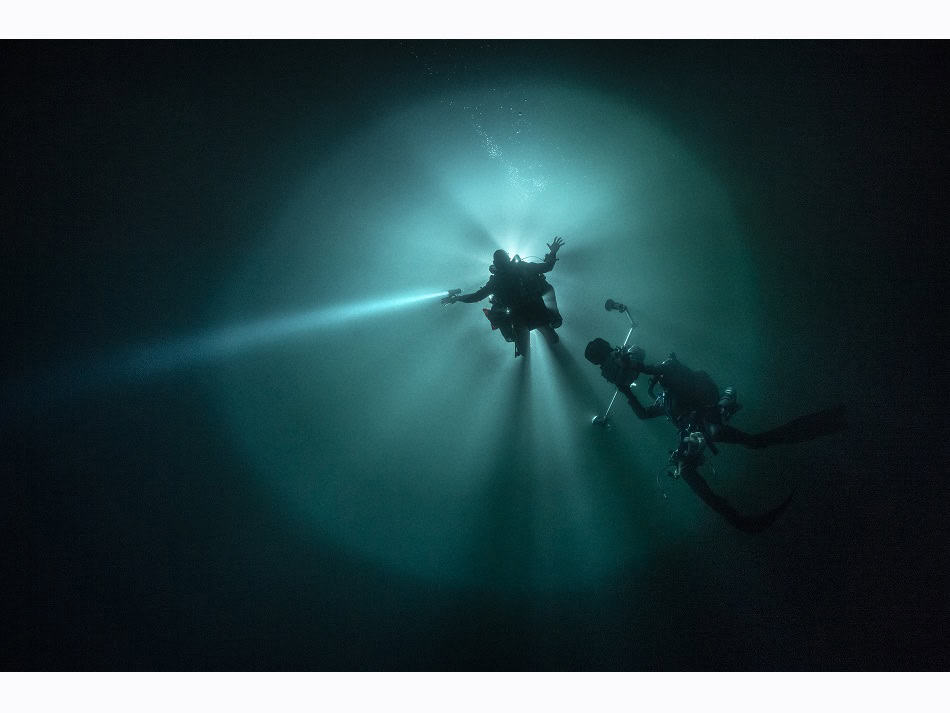
A chasm in the Bay of Naples
To say this dive is attractive would be lying. There is nothing that might entice, with water so green, murky, cold. As for the bottom, it is flat, muddy, littered with debris from the nearby megacity. We are in the Bay of Naples, less than a mile from the coast. There is nothing to see, but there is a curiosity to satisfy. Is it really possible that, on a flat, soft bottom for miles around, there is the entrance to a vertical, rocky cave whose depth no instrument has been able to sound ? Fishermen have a legend, a ‘mouth’ at the bay’s bottom that swallows nets, lines, traps. What they put in the water here does not always come back.
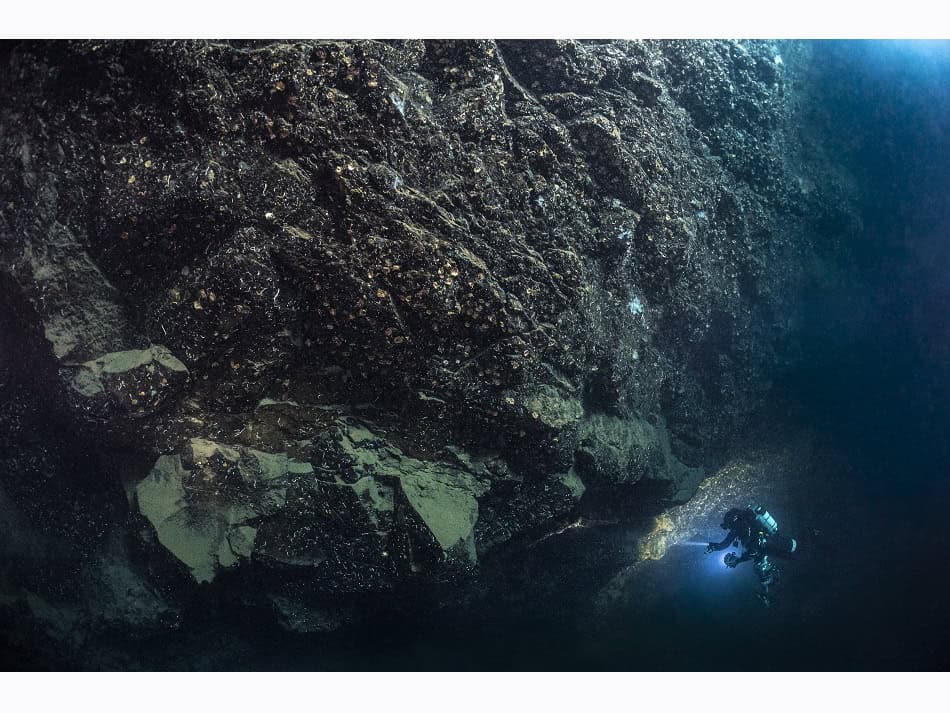
That’s why, just a few hours after our arrival, we are in the water. Indeed, approaching the indicated point, in the obscure fog that our lights are vainly trying to pierce, fishing lines and remnants of nets seem to converge at the same point, towards which we are also heading. Suddenly, the edge of the ‘mouth.’ The soft mud gives way to black rock. I feel like I’m standing at the edge of a well. The water is too murky to see the entire perimeter, but given the curvature, one can imagine a large well, probably over 10 meters in diameter. My depth gauge already shows 50 meters when we tilt into the black hole. It’s an almost perfect cylinder. We sink slowly. First surprise, the water here is clearer than outside. It shows 55, 60, 65, 70 meters… One might think that this gigantic well will sooner or later narrow and then completely plug, but the opposite happens. At 75 meters, it’s no longer a well, it’s a chasm that opens before us. So large that the beams of our lights are lost in the blackness without finding a wall. The descent continues: 80, 85, 90, 96 meters… Finally the bottom, littered with fishing equipment. Looking up, there is still a faint green glow, that of the great entrance well now becoming a small mouse hole.
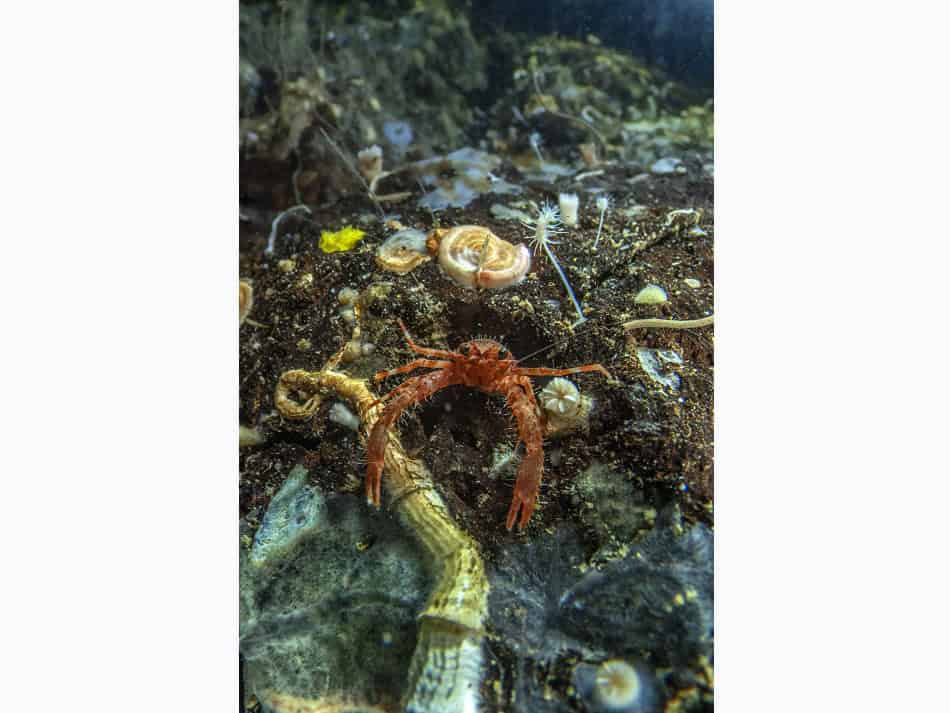
A dive beneath the sea floor
At 96 meters, we don’t have much time ahead of us. Once the measuring instruments are properly installed – they will remain there for 6 months – the decision is made, not to ascend back to the small green glow, but to try to find the walls of the chasm. We have a significant advantage as one of our propellors is equipped with sonar that compensates for our blindness. It informs us that the walls are within a 25-meter radius around us. We are therefore at the center of a vast circular chamber. The image of the cavity starts to take shape in our minds. The cave resembles a massive wine carafe. A long narrow neck then, without transition, a wide basin. It is probably an old magma chamber emptied of its lava, which will sooner or later collapse on itself, causing a sort of small tsunami that will gently lap at the beaches of Naples.
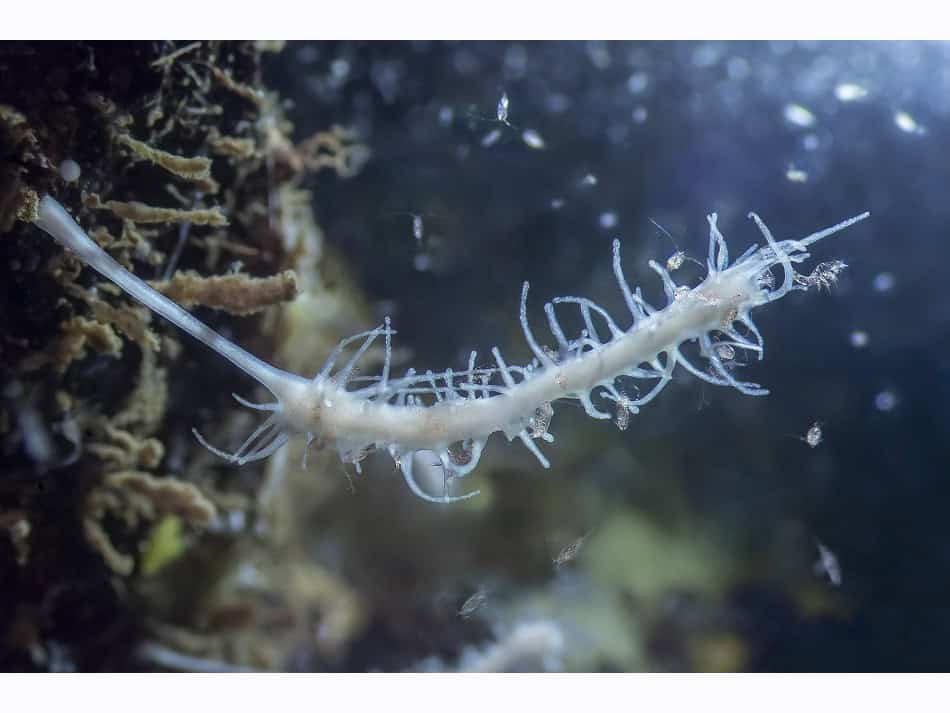
Meanwhile, an ecosystem has taken place inside. The walls, which we finally reached, are covered with small filtering invertebrates and sparsely populated with long-clawed crustaceans. Among all this little world in suspense, a very rare species, described only at the end of the 20th century in another Mediterranean cave, the carnivorous sponge! If the name is chilling, the appearance is less intimidating, of an immaculate white, resembling a mundane miniature bottlebrush. Its hooks catch small crustaceans that venture too close, and the sponge’s tissues develop around the prey until engulfing it in its flesh. No sudden attack, no violent struggle, just a simple and gradual assimilation of one being by another, over a few days.
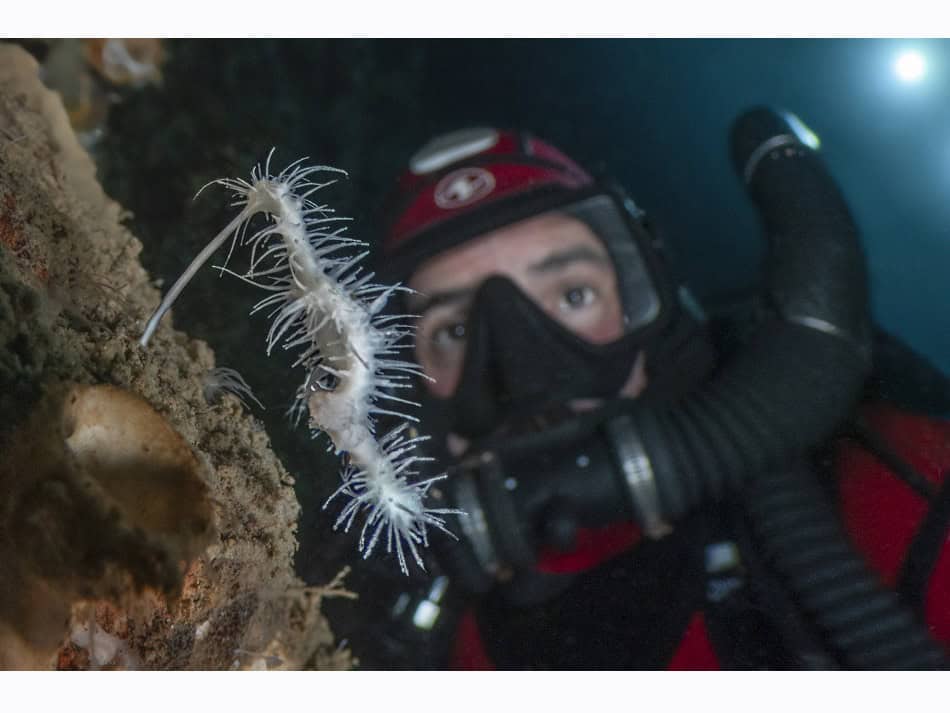
The ascent finally begins. What a strange sensation! We didn’t dive to the bottom of the sea, but rather sous the sea floor. We made a dive within a dive. A descent into the abyss… Initially, the desire wasn’t there. And yet, we will return three more times in the following days, stringing together immersions more than 4 hours each time. It takes time to witness the imperceptible predation of the carnivorous sponge… The few individuals we collected will teach us, a few months later, that it is a new species for science, currently being described. Once again, the exotic and the unknown were not far away, making the joy of discovery all the greater.
A Mediterranean Sea from another era
Three weeks have passed and already the Victoria is leaving southern Italy to resume its northwest course towards Corsica. Still no other boats on the horizon, except for a few rare fishing boats. We are sailing on the Mediterranean of another era, and that’s fine by us. I don’t recall seeing as many dolphins as in this particular year. Fishing friends have told me they’ve had their best catches in decades. It’s common to speak of nature’s fragility, but this journey opened my eyes to the condescension of that expression: nature is not fragile. In fact, quite the opposite! Although it’s attacked and wounded, despised and reduced, it holds on, it resists, it waits for its moment. At the first slowdown of human activities, there nature reclaims its rights without delay. Three weeks at the feet of volcanos that devastated civilizations have shown me our vulnerability. Nature is not fragile, it’s us who are… Poor runners, poor swimmers, doomed to perish if our antibiotics, supermarkets, and high-speed internet were to disappear. It takes the Earth just to simply cough to remind us of our insignificance. A little volcanic sneeze, nothing at all for the Planet, and it’s an apocalypse for us: explosions, pyroclastic flows, tsunamis. Our great civilizations are little houses of cards.
Better than video conferencing or large world hotels, the G7 summits should be held at the feet of these active volcanoes. Not in the hope of seeing our arrogant leaders disappear into a lava flow, but for them to measure their fragility, like that of all humanity, to put their power in perspective, so trivial in the face of these colossal forces. If the world’s beauty no longer moves them, if its horrors no longer outrage them, let us bet that the demonstration of the almighty power of Mother Nature will teach them the humility and respect they so often lack.
Text and photos Laurent Ballesta
PLONGEZ! Magazine articles finally available🚀
With Web Premium, scubadiving.news offers you an immersive reading experience tailored to your passion for diving. For over 10 years, PLONGEZ! Magazine has been introducing you to underwater wonders, and today, we go even further by offering our magazine in a digital web version.