


The concept of legal responsibility can be a source of apprehension for divers, and even more so for the managers and leaders of organizations. However, it is omnipresent in our daily lives, whether driving, working, or in our sporting activities. In diving, specific risks and regulations make us think about it more consciously.
Many seek an absolute guarantee: « How can I be sure I will never be held responsible? » Unfortunately, this question has no simple answer. Peace of mind comes from a good understanding of the concept of responsibility.
Which Responsibility Are We Talking About?
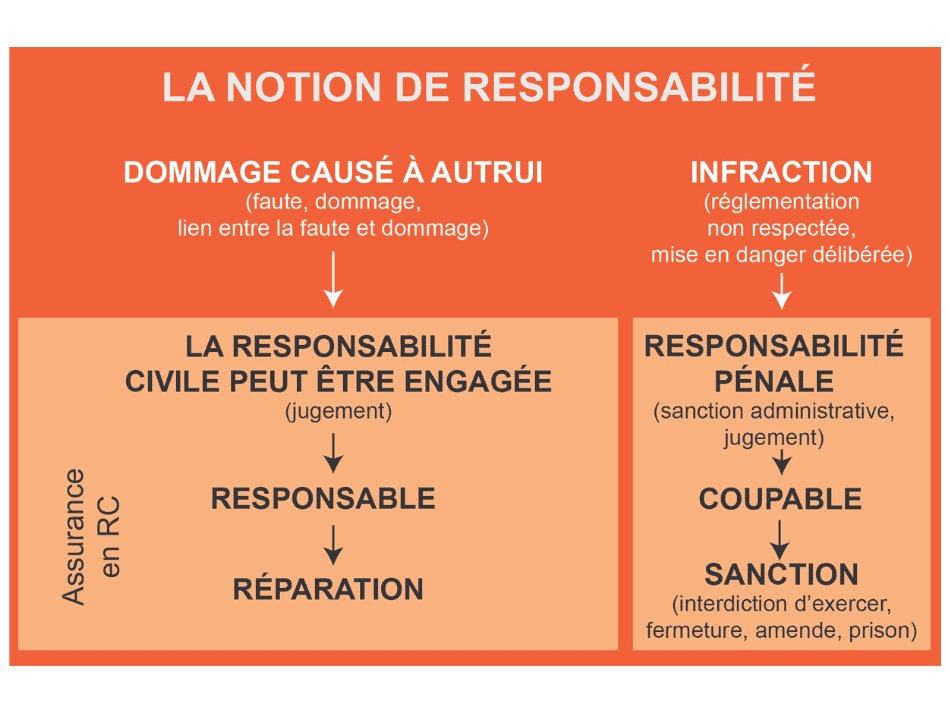
Responsibility is defined as « the obligation to answer for one’s actions. » There are several types: criminal, civil, administrative, disciplinary. We will focus on the first two.
Criminal Responsibility
Criminal responsibility involves answering for actions defined as offenses by law, with prescribed sanctions. The offense can be intentional (murder, theft…) or unintentional (injuries, manslaughter…).
In diving, unintentional injuries and manslaughter are the most common before the courts. Prosecutions often target dive directors, dive guides, and sometimes club managers, considered indirect authors. They did not directly cause the harm but may have created or contributed to a dangerous situation, or failed to take necessary measures to avoid it.
Criminal responsibility is engaged if it can be demonstrated:
- A deliberate violation of a safety or prudence obligation provided by law or regulation.
- A characterized fault exposing others to a particularly serious risk that the author could not ignore.
Criminal responsibility is not insurable because it involves a sanction (fine, imprisonment) rather than the compensation of damage.
Deliberate Endangerment of Others
« Deliberate endangerment of others » is the intentional violation of a safety rule leading to the direct exposure of a person to an immediate risk of death, mutilation, or permanent disability. The offense is constituted even if the risk does not materialize.
For example, an instructor conducting a baptism dive beyond 6 meters, the maximum depth authorized by the sports code, commits an offense. They potentially expose the novice to an accident. Other examples include: conducting a baptism dive with several people simultaneously, conducting a baptism in a natural environment as level 4 (beyond prerogatives), exceeding the maximum depth with supervised divers, or supervising more divers than the regulations allow.
Civil Liability (CL)
Civil liability (CL) is the obligation to compensate for damages caused to a third party. The compensation is financial, usually covered by insurance if a contract has been taken out and the facts are not excluded.
To engage CL, a damage (material, bodily, moral), a fault (or presumption of fault), and a causal link between the fault and the damage are required.
There are two types of CL:
- Contractual CL
- Delictual (intentional fault) or quasi-delictual CL (unintentional fault).
Contractual CL
In law, a contract is an « agreement of wills between two or more persons, » written or not, gratuitous or onerous, entailing obligations.
Any diving service (introduction, baptism, training, exploration) is a « contract, » even in an associative context.
The diving organization has obligations:
- Obligation of safety.
- Obligation of information on the required skills, especially for inexperienced divers. The lack of theoretical courses, essential for anticipating risks, may fall within this scope.
- Obligation of information on insurance: posting a summary of the contract, interest in individual insurance.
Delictual and Quasi-Delictual CL
This CL can be engaged for a damage caused:
- Directly, intentionally or not (CL for personal act).
- By means of a thing (CL for things).
- By those for whom one is responsible (CL for others).
The Theory of « Accepted Risk »
The « theory of risk acceptance » suggests that a person accepting a risky activity should assume the consequences. It is now largely dismissed by case law in the context of leisure activities.
The Obligation of Means
To avoid being implicated, it is necessary to respect the obligation of means, that is, prove that all necessary means to avoid an incident or accident have been implemented, beyond the regulations: equipment in good condition, consideration of the actual level of divers, adaptation to diving conditions.
In Conclusion
Knowing and respecting the regulations, and adopting a « reasonable » behavior, are essential to minimize the risks of having one’s responsibility engaged.