


This is some fish! This massive solitary spotted under a rocky overhang or in the mud of estuaries is impressive in photos. That’s why it was the preferred target of sport fishing for decades, before being protected, to the delight of the eyes (or the respectful photographer) during encounters.
1 – Well-fleshed
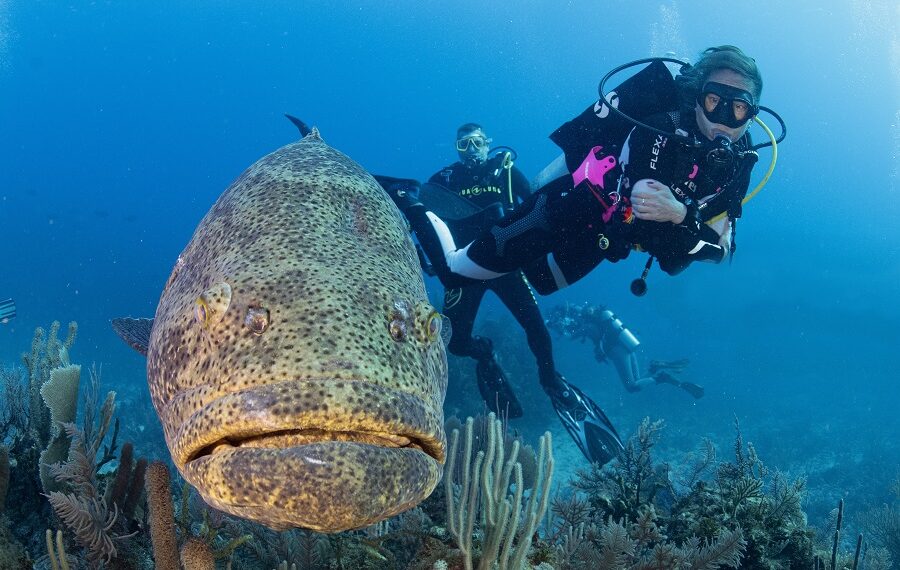
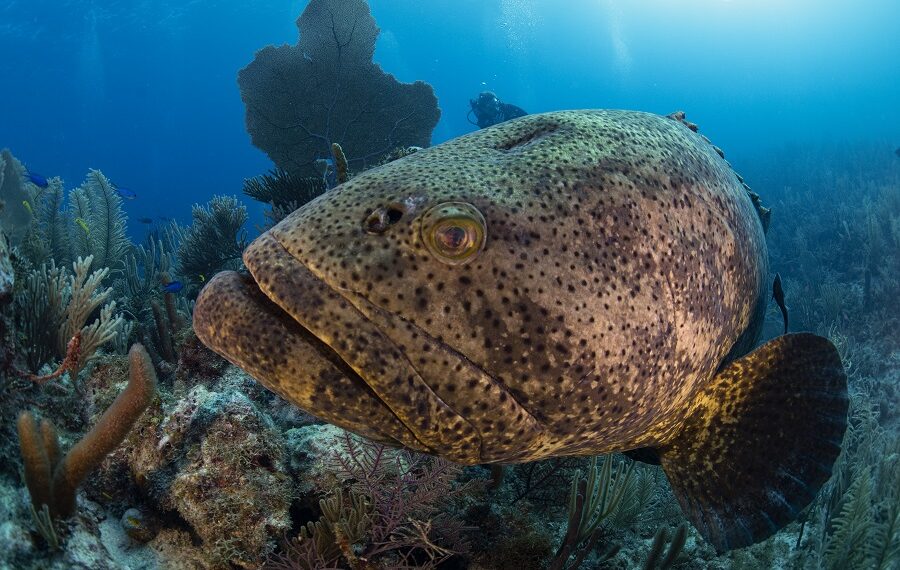
Un itajara is quite burly, 300 robust kilograms for about 2 meters long, with a big lippy head so large that the eyes appear small. This yellowish-brown, grayish, or greenish body is adorned with dark vertical bands near the tail and blackish spots scattered on the head.
2 – Sedentary adult
As a good solitary that doesn’t move much, an Atlantic Goliath often stays near its nook (wreck, hole, reef niche from 0 to 50 meters deep) and feeds on prey passing within reach, including turtles crushed by its teeth or rays! But it mainly focuses on hidden octopuses and crustaceans to dine with minimal effort.
3 – Young wanderer
The larva of theitajara might drift in the tropical Atlantic currents before attaching to shallow depths in mangroves or estuaries: the species is thus found in Africa and Central America, up to southern Brazil. Finally, rather « was present »: 95% of the population has disappeared due to fishing and habitat destruction by urbanization!
4 – Maturational age
It is supposed that, like all other groupers, this species is « sequential hermaphrodite »: young female then older male. Young females reach maturity around 6 years old (1.25 meters), which is late, according to the study of their rays, otoliths (skull bones), and scales. While some males of the same age have been observed, the old ones are only males…
5 – Gatherings
Once a year, males and females gather for the spawning period. But this still needs confirmation with more frequent observations! Due to the rarity of the species, despite them traveling hundreds of kilometers to meet, these reproductive gatherings count only about forty individuals.
6 – Cat food
This fish was overfished, but not for its rather bland taste. Recreational fishing, due to its size, was massive in the 1970s-80s… so that these enormous catches were thrown away, left to rot, or given to cats! Whereas today, thanks to media exposure, accidental catches (with its current rarity) are considered delicacies. Incomprehensible!
7 – Hunting mass
When small, it’s a choice meal for sharks before it gets big enough. Despite its placid appearance, the power of its tail allows it to chase its prey. But it’s not even necessary: with just the vacuum caused by opening its mouth, small prey are swallowed in an instant.
8 – GoliathS
Some Pacific divers say that a Goliath is green with reddish-brown spots… It’s a Pacific Goliath grouper (Epinephelus quinquefasciatus) they are describing! Hence the common use of « itajara » by the locals.
9 – Territorial
Un itajara is loyal to its den, which it will defend to the point of biting those who approach, if they haven’t already been repelled when it opens its mouth to show its good teeth while flaring its dorsal fin rays. Its bulging eyes following us warn: attacking is tiring but will happen if necessary…
10 – Bang
An Atlantic Goliath grouper is so big that it can emit vibrations so powerful they are perceived as sonic booms during dives! Is that an excuse to reauthorize fishing in Florida? This big lazy hunter is not a competitor: it cleans the environment by feeding on sick fish! Decision expected in 2022…
Jérémy Delille