


Alongside photographer Vincent Munier and filmmaker Jérôme Bouvier, underwater photographer and biologist Laurent Ballesta recently embarked on an unprecedented adventure in Antarctica: an artist residency to highlight the emperor penguin, a universal ambassador of this white continent. In mid-October, on the eve of his departure to join the French Dumont d’Urville base, he shared with us the secrets of the preparation and objectives of this exceptional expedition.
Dive in!: How long have you been preparing for this expedition?
Laurent Ballesta: it’s been two years that with the entire team of the association Wild–Touch, founded by filmmaker Luc Jacquet, we have been mobilized. 10 years after the success of the film « March of the Penguins », Luc wanted to return to Antarctica to see what has become of the emperor penguins, the film’s heroes, and to witness firsthand the impact of climate change on the local wildlife.Dive in!: What required such a long preparation time?
Laurent Ballesta: first, we had to defend the project to organizations that have authority over the Dumont d’Urville base: the Prefecture of the French Southern and Antarctic Lands (TAAF) for regulations, and the Paul-Emile Victor Polar Institute for logistics and safety. With Luc Jacquet, we had to explain our objectives for the two months we’ll be present. It’s worth noting that spots are highly coveted on the base, which can only accommodate 80 people during the austral summer, primarily researchers. In the end, we managed to secure 11 spots.Dive in!: And for the equipment, how did you organize?
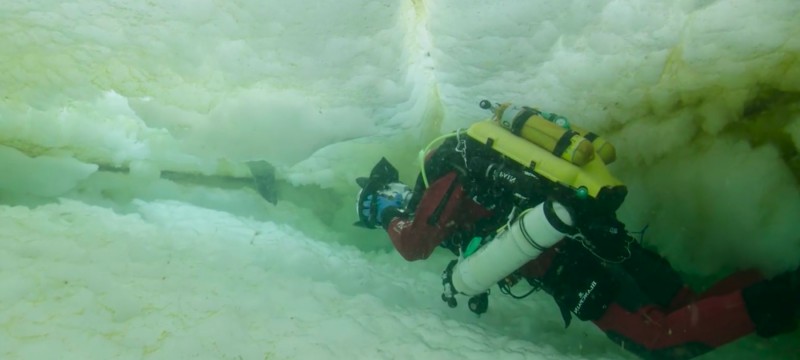
Laurent Ballesta: equipment preparation began about 18 months ago. During the austral summer of 2014-2015, we shipped dozens of diving tanks and machines to make holes in the ice. This year, 3 more tons have been transported to Antarctica: diving suits and our prototype suits with integrated heating systems. Personally, I brought 250 kg of photo equipment.Dive in!: Can you describe how the expedition will unfold?
Laurent Ballesta: I am leaving tomorrow, October 17th, to join part of the team in Hobart, Tasmania. There, we will board the Astrolabe, the polar institute’s ship, for an 8 to 9-day crossing depending on weather conditions. A helicopter will survey to determine a route for the ship to get as close as possible to the Dumont d’Urville base. Then it will take us a few days to deploy all the equipment, and if all goes well, our first dive should be around November 6th (Editors’s Note: the first dive eventually took place a few days later after a storm), and we should return to France around January 1st, 2016.er January 2016.Dive in!: What are the objectives of the expedition?
Laurent Ballesta: they are scientific, educational, and media-related. Scientific because we will be working with researchers to assist them in various studies by performing dives they can’t usually do. The team also aims to create a 90-minute documentary for Arte based on an idea by Luc Jacquet: presenting the combined perspectives of two wildlife photographers, Vincent Munier on the ice, and myself below it, and telling the story of Antarctica with a focus on climate change.Dive in!: Has this warming already affected penguin populations?
Laurent Ballesta: unfortunately, yes. Two years ago, major glaciers fractured due to rising temperatures, releasing large amounts of freshwater into the ocean. Freshwater freezes faster than seawater, so paradoxically a layer of ice formed that lasted much longer, forcing the adult penguins to travel up to 100 km to find food for their chicks. All the penguin chicks died! This year looks better, but we sense significant transformations are underway.Dive in!: What do you expect from this expedition?
Laurent Ballesta: it’s the first time I’ll see the emperor penguin! But what interests me most is exploring the deep glacial ecosystems: unlike coral reefs, under the ice shelf, as you go deeper, diversity increases. At the surface, conditions are too extreme for ecosystems to establish long-term stability. The farther from the surface we go, the more we discover an underestimated fauna and flora: large sponges, gorgonians that have grown a hundred times slower than their warm-water counterparts, crinoids, and numerous colorful creatures…Dive in!: How will you manage these extreme dives?
Laurent Ballesta: these are very complex dives requiring excellent physical condition. When you want to push beyond limits, it becomes top-level sport. I train every day for at least two hours each morning, doing cardio and muscle strengthening. We also have to manage the cold by layering up to protect ourselves, which results in a loss of mobility and dexterity for taking images. For these dives, we have developed specific equipment, including electric-heated underwear, especially for the hands.
Dive in!: Deep dives = long dives with essential decompression times. How do you manage time spent in nearly 0°C water?
Laurent Ballesta: time management is another difficulty. The maximum allowed duration for dives has been set at approximately 2 hours and 30 minutes. We benefited from the experience of Ghislain Bardout; he came diving with us and shared plenty of tips. We have also regularly communicated with him while he was in Greenland (Editor’s Note: Ghislain Bardout is the leader of the expedition Under the Pole which, from January 2014 to September 2015, aimed to explore the west coast of Greenland through diving – he carried out the first dives beyond 100 meters depth in polar regions).
Interview conducted by Sandrine Leveugle-Souan.
Editor’s Note: during the Antarctica expedition, photos by Laurent Ballesta and Vincent Munier were sent from Adelie Land and exhibited in real-time during COP21 in Paris. In addition to the 90-minute documentary for Arte, a 52-minute purely wildlife-focused film, an Imax film, and a book are also planned.
Relive the most significant moments of the Antarctica expedition in video !