


There are about 70, distributed across the Navy ships national, who hold the certification that allows them to intervene at sea from a helicopter. Very particular conditions that require targeted training, between winching, diving, and victim rescue.
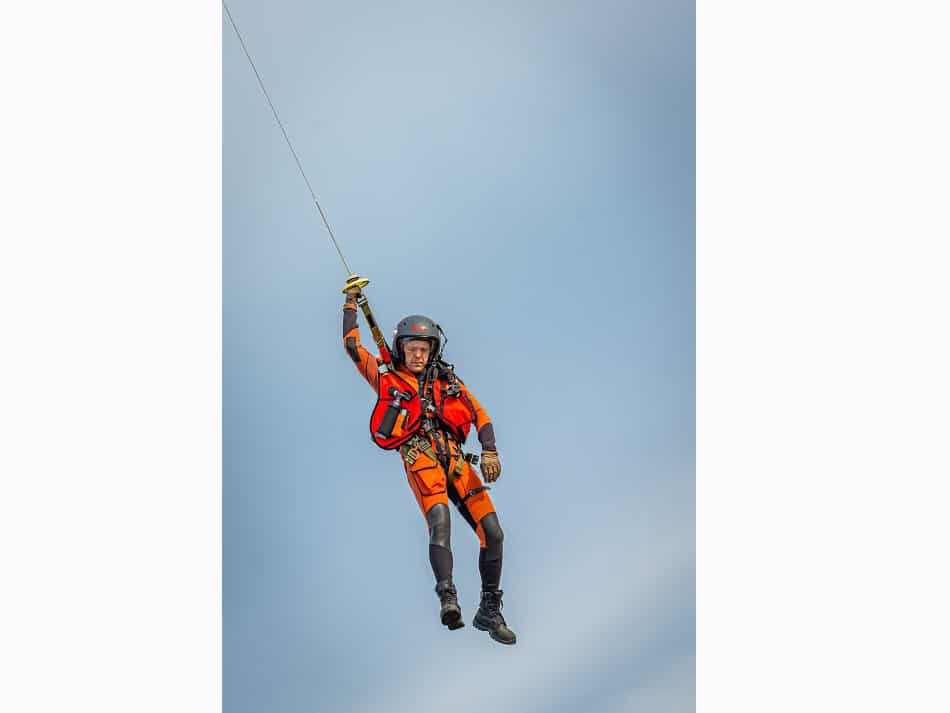
« Helicopter divers ’héexplain Master Chief Mathieu, a trainer at the Hyères Naval Air Baseère, , are recruited among aviation technicians. Théey thus require additional certification that complements their éexisting ’skills.’» Like everyone, they naturally follow the Basic Diver course, but then must complete it with very specific training. They accordingly complete two stints at the CESSAN (Training Center for Survival and Rescue of Naval Aeronautics) at the Lanvéoc-Poulmic Naval Air Base. The first allows them to learn to evacuate from a helicopter, using a submerged model in a pool where the conditions of a sea crash are recreated. The second, still at CESSAN, places them this time in the position of rescuers, ready to intervene to save injured crew members.éter un autre métier. » Comme tous, ils suivent bien sûr le cours Plongeur de bord, mais doivent ensuite le compléter par des formations très spécifiques. Ils effectuent ainsi deux stages au CESSAN (Centre d’entraînement à la survie et au sauvetage de l’Aéronautique navale), sur la BAN Lanvéoc-Poulmic. Le premier leur permet d’apprendre à évacuer d’un hélicoptère, grâce à la maquette immergée en bassin où l’on recrée les conditions d’un crash en mer. Le second, toujours au CESSAN, les place cette fois en position de sauveteurs, aptes à intervenir pour secourir des équipiers accidentés.
Des étests whereù mental toughness is essential
While the duration of the courses is relatively short, it requires a precise mental preparation before exercises. They must tirelessly repeat the actions that they will have to perform blindly to get as close to reality as possible, simulating, for example, a night crash in a rough sea. Without panicking, remembering the configuration of the cabin and the position of each instrument, they must be able to guide themselves to the outside without visual cues, by touch. They must also learn to assist an accidented crew themselves. Such exercises, even in a pool, require maintaining absolute composure.
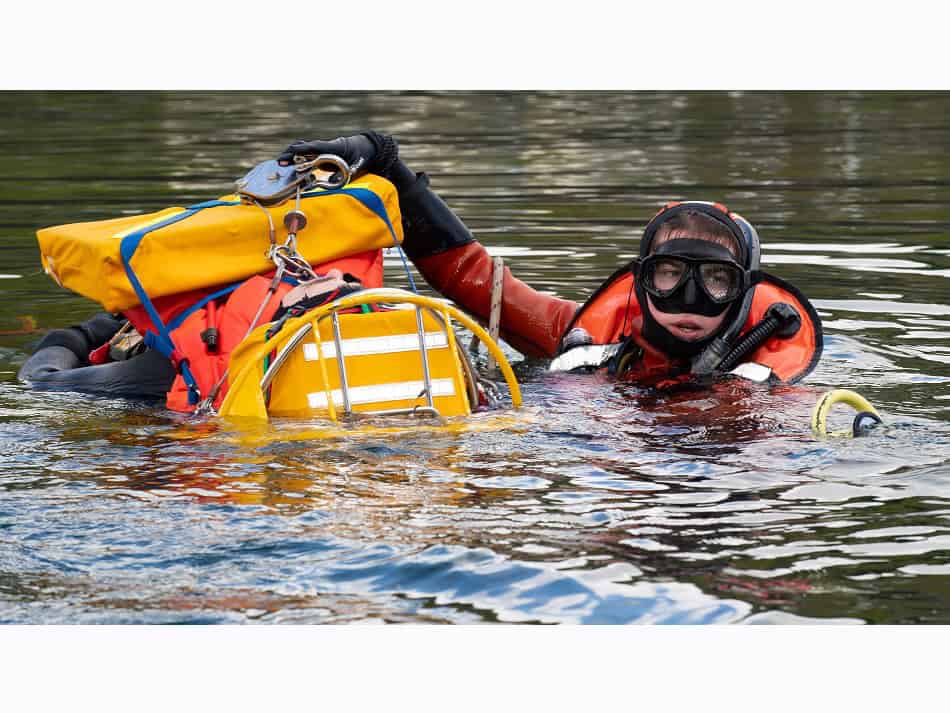
They must also, during an additional week of training in Saint-Mandrier, learn to use the ARPH (respiratory apparatus for helicopter diver) composed of 3 small cylinders of 1.5 liters each, positioned on the stomach, made of carbon fiber to minimize weight. On the School’s waterway, they practice moving inside a wreck, under difficult conditions such as with an obscured mask, to best prepare for the reality of their future interventions. They must also complete a first aid course and undergo training with the Marseille Marine Firefighters. Modules that do not always occur in the same order and take, depending on circumstances, 1 to 2 years.
Héwinch operations and sea interventions
They then carry out around twenty training interventions on shipwreck simulations, learn to respond to distressed vessels, and must then imagine the best intervention scenarios. Because, even if an onboard commander will oversee each mission, they will be alone at the bottom to make the right decisions quickly, taking into account all elements. « This distancing of attention, the ability to assess the entire environment at once, and the ability to anticipate to make good decisions in an emergency are essential qualities to become a helicopter diver » insists the instructor.
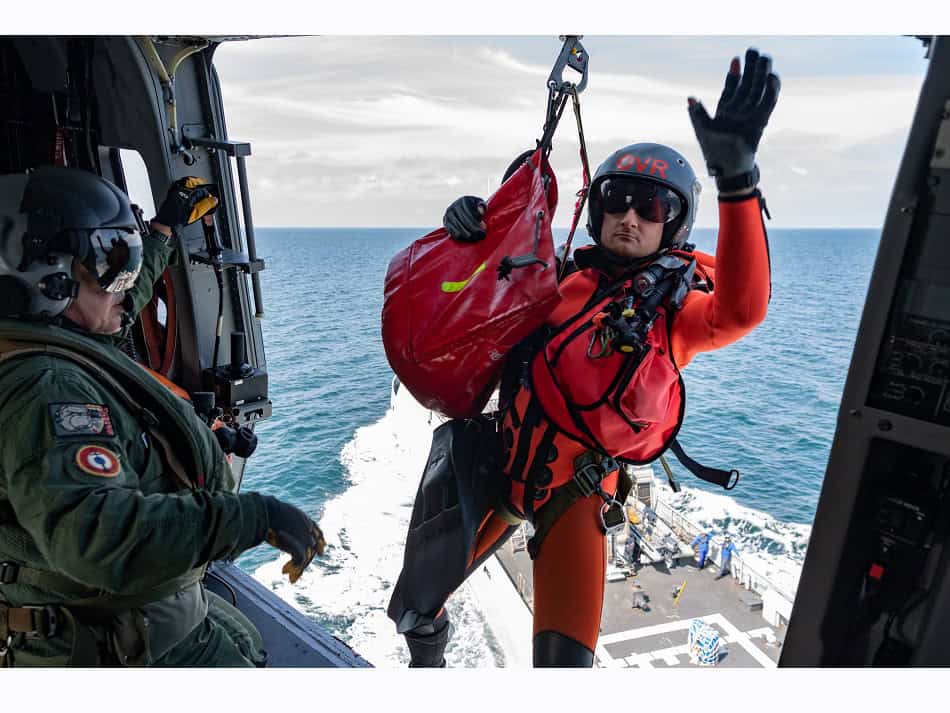
Most, at the end of their training, are embarked and train regularly to keep their reflexes and knowledge intact. But their role aboard also involves participating in helicopter maintenance. Therefore, they need to have a professional background before starting their training. « And given the responsibility and the need to be able to make decisions independently that can have serious consequences, we do not train very young recruits. Thus, they must have acquired a certain level of maturity » explains Master Chief Mathieu. Only a few new helicopter divers, usually two on the Mediterranean front and two for the Atlantic front, are trained each year.
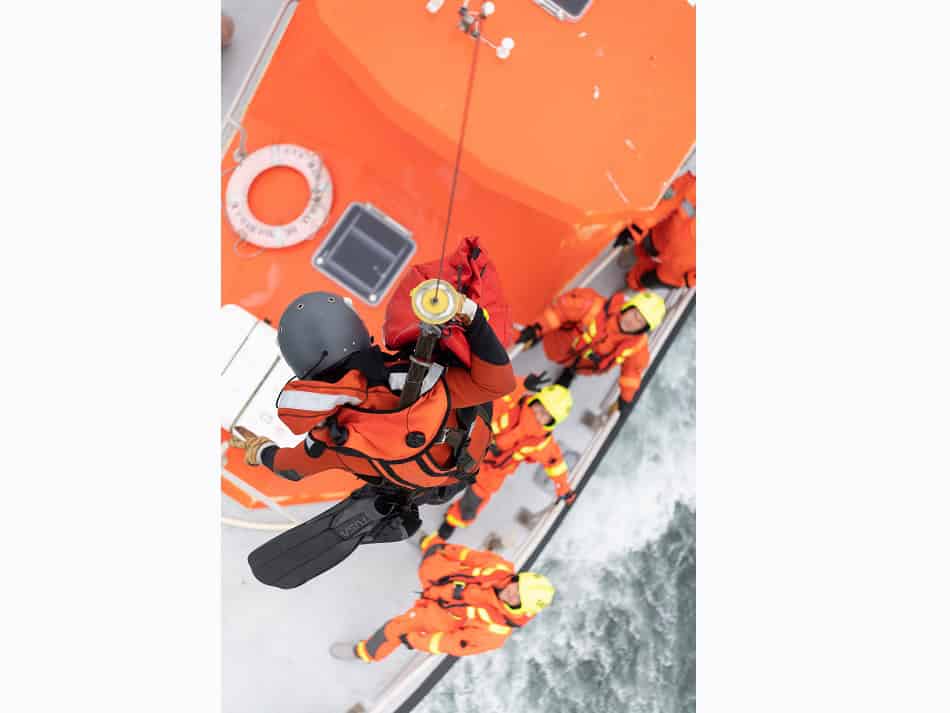
« In 15 days, I will have my operational certification and will embark aboard the Charles de Gaulle at the end of the year. It’s the culmination of more than two years of training for me, the Covid period having somewhat slowed the process since I launched my request in 2020. I started with the Basic Diver course and the first CESSAN stage in the first year, followed by the ARPH week and CESSAN 2 in 2021, then began the specific training for flights and rescue interventions. This part is undoubtedly the most complicated, as it requires learning to react very quickly to situations that cannot necessarily be predicted and are unique. It is also a period where one must be capable of significant personal investment, in terms of time and concentration, because one multiplies flights, day and night, before becoming fully operational. But really, even if it’s a long and demanding curriculum, one must not give up. The course is open to everyone, male or female, as long as a Navy aviation technical specialty has been validated, and there’s a very rewarding career at stake! »
Second Master Steve, at the end of the validation period
The preé-requisites
Being already engaged in the French Navy.
Being medically fit.
Being older than 19 and younger than 31 at the course’s start date.
Holding at least a technical aptitude certificate (BAT) in a technical specialty of naval aviation.
opening image © Benjamin Papin / Marine nationale / Défense