


Since June 2024, biologists and scientific divers have been conducting an in-depth study on red gorgonian colonies in the waters of the Calanques National Park in Marseille. This project, named BUFFER, aims to understand how this species withstands climate change.
“Guys, we need to meet. Something serious is happening!” In August 2022, marine biologist Tristan Estaque alerts his colleagues specializing in coralligenous ecosystems in Marseille. Successive marine heatwaves are decimating many species, including red gorgonians (Paramuricea clavata). Everyone diving that summer notices that the beautiful purple fans are being replaced by brown skeletons, with only a few individuals sometimes surviving.
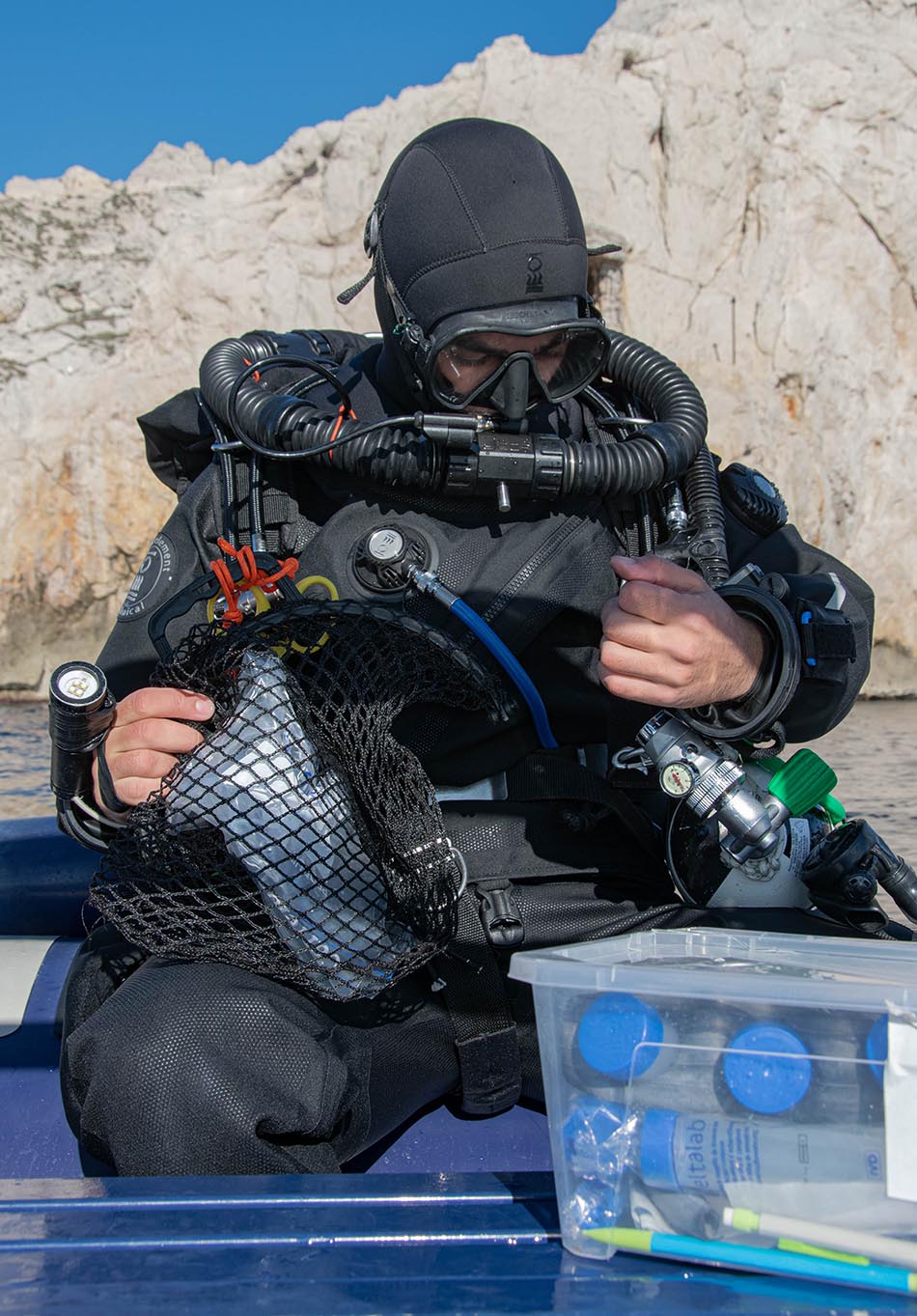
Quickly, a video conference is organized. Members of the “Coralligenous Consortium,” scattered across different laboratories, gather to discuss the situation. Among them are ecologist Joachim Garrabou, based in Spain at the Institut de Ciences del Mar (ICM) in Barcelona, and Jean-Baptiste Ledoux, molecular ecologist in Portugal at CIIMAR in Porto. Didier Aurelle, population geneticist, splits his time between MIO in Marseille and MNHM in Paris. Bastien Mérigot and Quentin Schull, from UMR MARBEC and the University of Montpellier, are in Hérault, while Stéphane Sartoretto and Nathaniel Bensoussan from IFREMER are located in Seyne-sur-Mer and Brest, respectively. Tristan Estaque, based in Marseille, joined the Septentrion Environnement association after completing his master’s in biological oceanology and marine ecology.
All divers, they meet in the bay of Marseille to conduct observation dives. Within a few weeks, they carry out a tragic census of red gorgonian mortality across about a hundred populations in the Calanques National Park. These scientists have permission to collect fragments from about twenty gorgonian colonies, located between 0 and 40 m deep, sampling both resilient colonies and those in decline. The samples are preserved in alcohol and placed in the freezer.
Millions of genetic markers
Scientific questions quickly arise. Why do some colonies withstand high temperatures better? Is there a genetic factor that promotes adaptation to these extreme conditions, or are there other factors such as physiological or microbiological elements? Can we identify super gorgonians, similar to the super corals found in French Polynesia? If so, would it be possible to restore the decimated populations from these super gorgonians?
Jean-Baptiste Ledoux emphasizes that the impact of heatwaves on red gorgonian colonies was visible down to -30 / -35 meters. “Since the effect of heatwaves was limited beyond -35 m, we wonder if deep populations could serve as a refuge and a potential for recolonization. In other words, can the larvae of gorgonians living in deeper waters recolonize surface populations?”
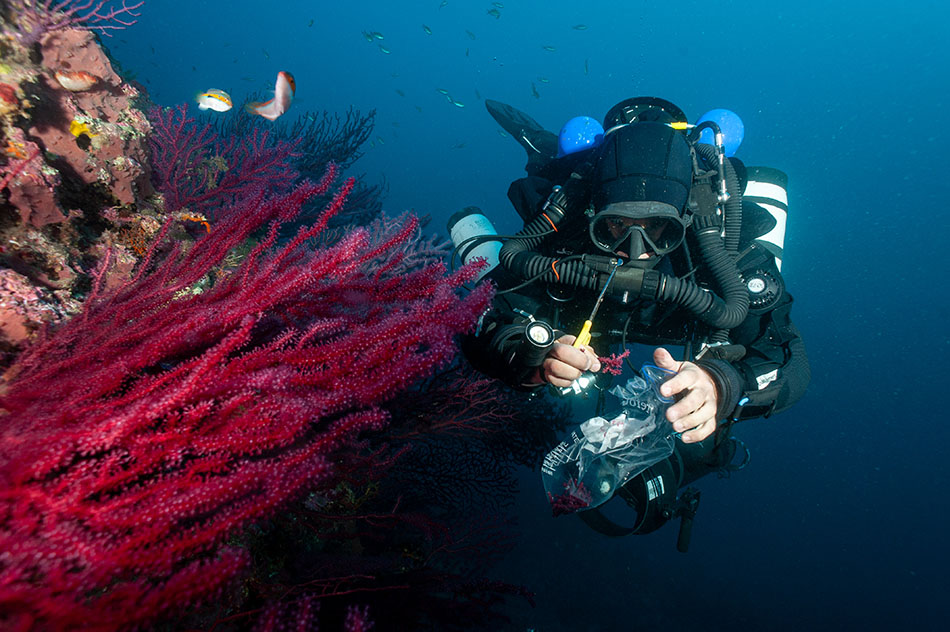
Paramuricea clavata forms habitats, just like trees in terrestrial forests. Its presence increases the complexity of the ecosystem, benefiting many species. Scientists have been studying this species for decades. As early as 2010, population genetics was analyzed using about ten markers, revealing that different gorgonian colonies are genetically loosely related. Larval recruitment is very localized.
“Technological advances in high-throughput sequencing have revolutionized the information we can extract from DNA,” explains Jean-Baptiste Ledoux. “These methods, combined with bioinformatics approaches, allow us to target thousands, even millions, of genetic markers. This offers unparalleled precision in characterizing the genetic diversity of individuals and populations, kinship relationships, genetic distance between populations, the number of individuals actually reproducing, the biological adaptation of colonies to their local environment, as well as connectivity between deep and shallow populations.”
High-throughput analysis could also determine whether the gorgonians’ resistance to underwater heatwaves is genetically based or the result of physiological acclimatization.
An ambitious project
With this perspective, Jean-Baptiste Ledoux initiates the BUFFER project, which aims to “produce scientific, political, and awareness-raising tools for the targeted conservation of a threatened ecosystem in a marine protected area.” The acronym BUFFER stands for “nature-Based solUtions to protect a temperate coral impacted by extreme climatic events / eFFective consERvation and restoration of Paramuricea clavata in the Calanques National Park.” This project is funded by the Pure Ocean foundation.
Deep dives
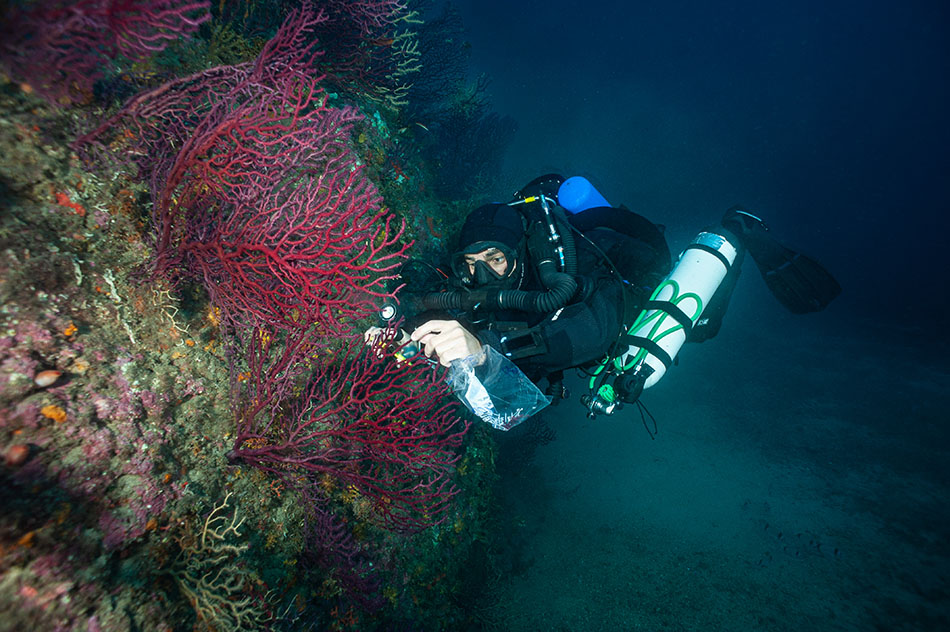
Since November 2024, Tristan Estaque and Olivier Bianchimani (Septentrion Environnement) have dived twelve times with rebreathers to sample other populations of red gorgonians in the Calanques National Park and its surroundings. In addition to the aspect of thermal stress resistance, the originality of BUFFER lies in sampling red gorgonian populations at greater depths.
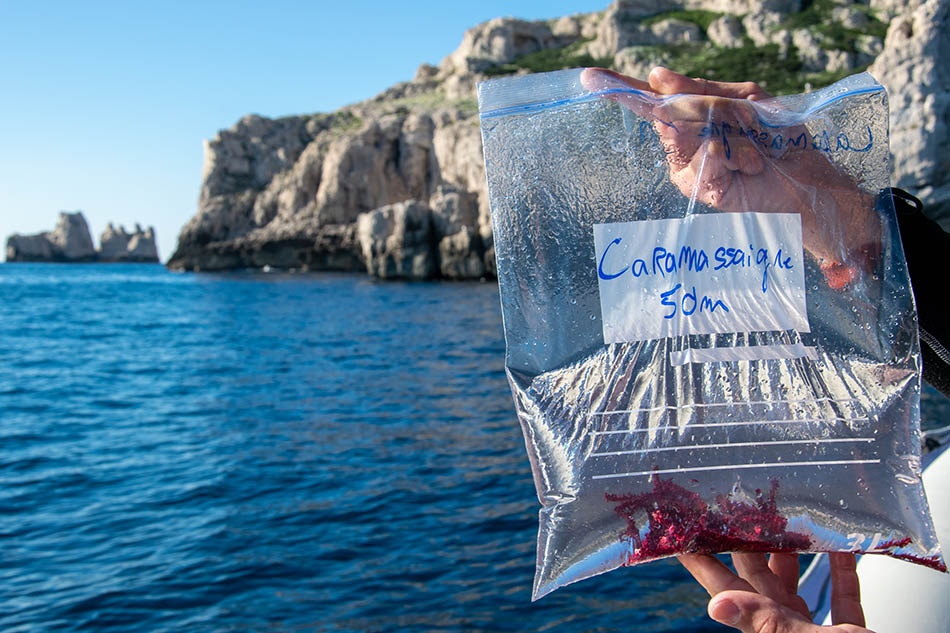
“We know the sites of the Calanques National Park well, but we do not have a genetic baseline in the mesophotic zone,” specifies Tristan, who has dived at the site of La Pierre de Cassis. From the ship Cromagnon, divers descend to -50 m, then reach a rock at -70 m, where they observe dense patches of red and yellow gorgonians, but no large colonies. Fragments of 1 to 2 cm are collected from about twenty different individuals and placed in resealable bags. After 25 minutes of work between 70 and 40 m and 50 minutes of decompression, this trimix dive lasts a total of 90 minutes.
The tip of Caramassaigne, at the island of Riou, is a renowned dive site. “Moored to a buoy, we descend to a rocky plateau at -35 m. A sandy corridor then descends to -50 m. When ascending back to -35 m, the gorgonians are partly covered in mucilage, but the populations seem to be in good condition. However, last November, we noted necroses on the branches of the gorgonians, even at -47 m! Although there has not been massive mortality, some colonies are more sensitive,” worries the biologist. Other deep dives took place in the spring at more distant sites: Beach Rock in Cassis (-70 m) and Roche des Blauquières (-80 m) in La Ciotat. In Marseille, about sixty tubes filled with ethanol contain these precious samples, carefully referenced and labeled, awaiting shipment to CIIMAR (Portugal) for DNA extraction and sequencing.
Conclusion
This study aims to better understand the ecology and connectivity of the red gorgonian, particularly the interactions between shallow and mesophotic populations. From an applied perspective, the goal is to propose concrete measures for the management of the Calanques National Park. In particular, scientists hope to identify key populations for the connectivity of the species within the park, so that mesophotic zones remain essential sanctuaries. Tristan Estaque recalls his first dives in 2017, where he observed a much higher density of gorgonians than today. The current situation highlights the urgency of protecting these fragile ecosystems in the face of the challenges posed by climate change.
This article, originally written by Alexie Valois for the print edition of PLONGEZ!, has been adapted for the web.
Photos: Septentrion Environnement