


So far, the voluntary immersion of shipwrecks is not allowed in the French Mediterranean. Even though their ecological value, due to their role as artificial reefs, is recognized by everyone, their immersion faces a number of legal obstacles, notably linked to international treaties and particularly the Barcelona Convention. Can the situation evolve?
Several international conventions come into play in the area of ship immersion, but the Barcelona Convention, a treaty for the protection of the Mediterranean waters, proves to be the major obstacle. The text is clear: since 2002, it prohibits any voluntary ship immersion. And currently, that is the official position of state services in our country, which acknowledge that maritime wrecks have biological interest but consider their immersion impossible in the Mediterranean. However, some countries, like Spain or Malta, already consider that their installation for the purpose of creating artificial reefs does not fall under the scope of the convention.
Read the Barcelona Convention differently
The spirit of the convention was legitimately to prevent the immersion of ships for cheap disposal. The State has always had a strict interpretation of the Barcelona Convention banning indeed « any scuttling at sea of ships and aircraft, » even if it was immersion as an artificial reef cleaned of its pollutants. But, unlike a scuttling that primarily serves the owner’s interest, a reef wreck serves what can be called the general interest, and this in several fields. The immersed wrecks are both life oases, nurseries, beneficial to biodiversity like any other artificial reef, whose establishment is indeed authorized in our waters. Their presence also allows local fishing to maintain its resource. They are also a major asset for the leisure economy because they offer the possibility of multiplying diving spots and thus attracting more diving tourists without overloading existing sites. Especially since most of our current wrecks, dating from the last two wars, are slowly degrading and losing their visual or ecological interest.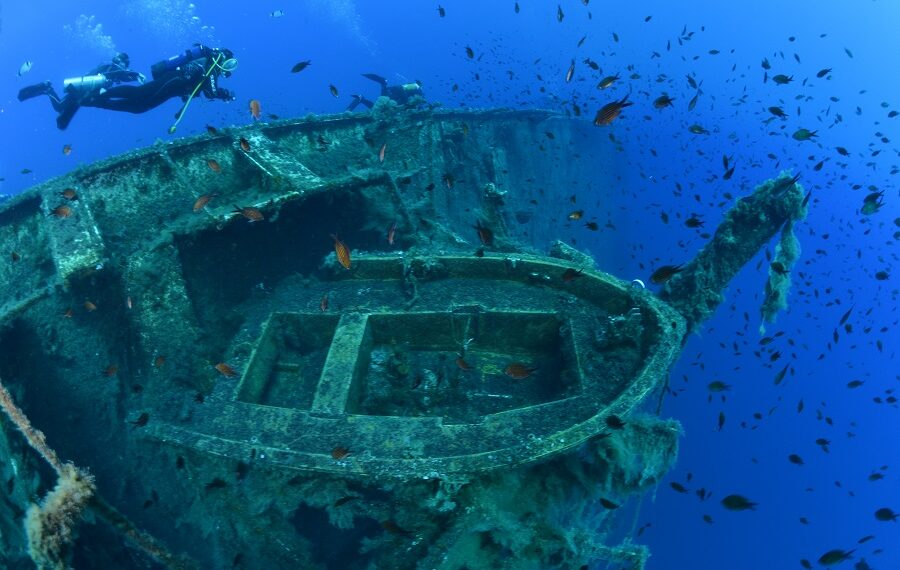 The Zenobia lifeboat, accidentally sunk in Cyprus. © Nicolas Barraqué
A nevertheless rigorous national legal framework
There will nevertheless remain a binding legal framework to respect to avoid any drift, especially concerning the depollution of ships. « The procedure to be put in place, recalls Julien Belda, depends on numerous codes, including the transport code, the general code for territorial collectivities, the general code for public property, the environmental code, the urban planning code, the rural and fishing code, the heritage code… » It will also be necessary to establish a link between all concerned instances, which are extremely numerous. The State and particularly the DDTM will be the preferred interlocutor, capable of overseeing each immersion dossier from start to finish. « Thus, it will be up to the project leader, he concludes, supported by local elected officials, fishermen… to convince state services upstream and then, after relatively lengthy and tightly regulated procedures, of the opportunity to authorize such an immersion that will have to be conceived in all its facets, from the depollution of the ship to the possible restoration of public domain, through compatibility with urban planning documents, navigation safety, monitoring means… »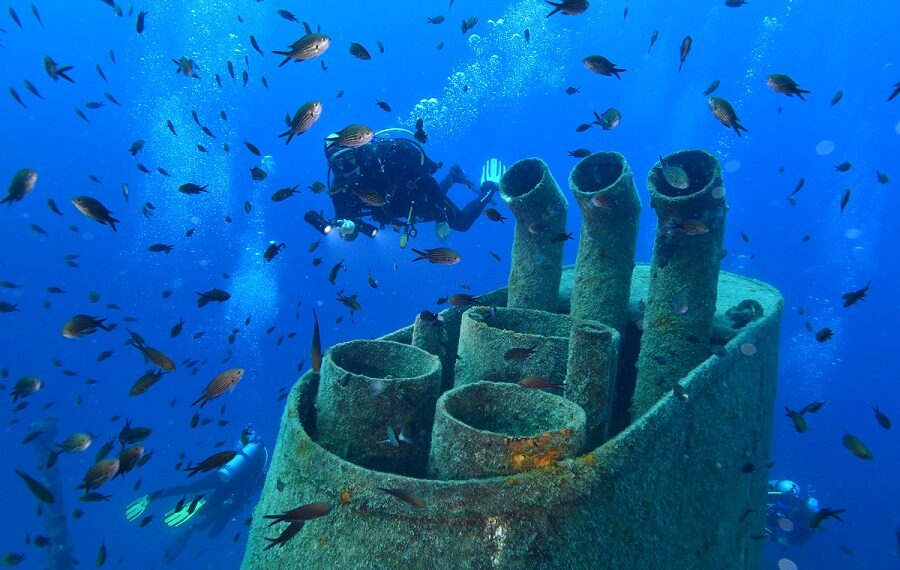 The chimneys of the Um El Faroud, voluntarily immersed in Malta. © Nicolas Barraqué
Isabelle Croizeau
TO LEARN MORE
* Julien Belda, Belda Consultant, ICO Solutions, Agence de l’eau Rhône-Méditerranée-Corse, 2022, Legal aspects of ship immersions to promote the coastal blue economy, ecological restoration, and the creation of new diving spots in the Mediterranean. Downloadable at: www.belda-consultant.com
Discover a summary of this study
WHY CONDUCT A LEGAL STUDY ON THE IMMERSION OF SHIPS TO MAKE ARTIFICIAL REEFS OR DIVING SPOTS? |
While a large number of wrecks lying on the seabed are a place of life fixation and are a delight for divers, fish, crustaceans, gorgonians, and fishermen, for nearly 20 years (since December 31, 2002), French state services no longer authorize immersion operations based largely on the Barcelona Convention on the protection of the marine environment and coastal areas of the Mediterranean.A true oasis of life, nurseries beneficial to biodiversity, diving spots allowing to relieve natural sites, most wrecks, dating from the last two wars, have degraded over time and lost their ecological appeal because they can no longer house fauna but also their tourist interest.Economically, it should be noted that diving is an economic sector which generates in Europe a revenue of 1.4 billion euros, for 3.5 million divers, 75% of whom choose the Mediterranean as a diving destination. In the Var department alone,, a recent study by the Aix Marseille Chamber of Commerce indicates that diving represents 155 structures, 50 companies, 57 associations, 200 year-round jobs , and spinoffs in the hotel and restaurant sector valued at 16 million euros in turnover.
In Cyprus, the wreck of the Swedish ferry Zenobia accounts on its own : 57,000 dives per year et a total annual income estimated at 25 million euros
The position of the state’s services until now has been to admit that maritime wrecks have biological interest but that their immersion is not possible in the Mediterranean, notably concerning the Barcelona Convention.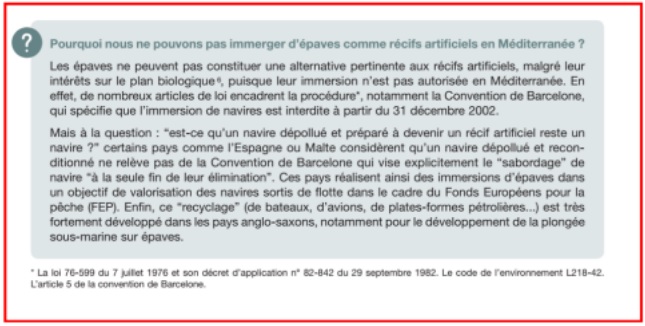 Excerpt: Cépralmar, Languedoc-Roussillon Region – Practical guide to help with the development, operation, and management of artificial reefs in Languedoc-Roussillon: 236 pages. NOTE: Except for the interpretation made of the Barcelona Convention on the theme of ship immersion which we will contest later, the above-cited document remains an indispensable reference for any person or organization interested in artificial reef immersion. Rich with all these economic and environmental virtues, there is clearly a real (general) interest in advancing the subject of wreck ship immersionsI- and breaking the « legal barriers » preventing their realization. II- It seems there are two main categories of legal barriers to these ship immersion projects to create artificial reefs in France:
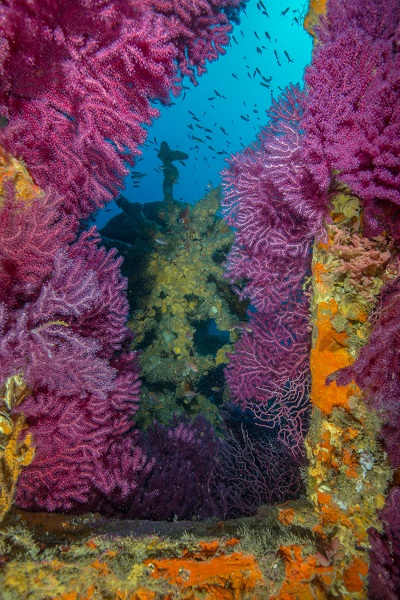
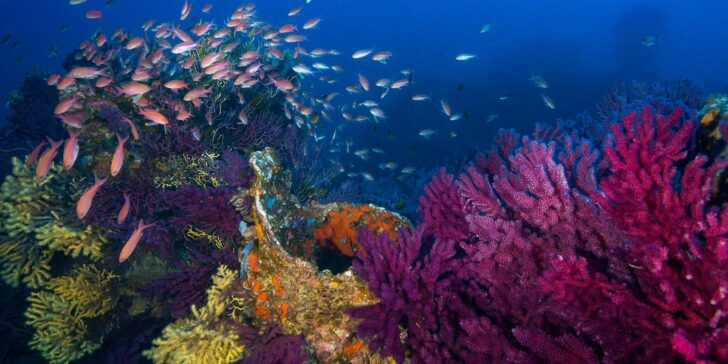 The wheel rudder of the Donator, almost invisible behind these colorful gorgonians. © Nicolas Barraqué
I- ARGUMENT AND ELEMENTS TO BREAK THE INTERNATIONAL LAW BARRIER OF THE INTERPRETATION BY THE FRENCH STATE OF THE INTERNATIONAL QU’EST L’INTERPRÉTATION PAR L’ÉTAT FRANÇAIS DE LA CONVENTION DE BARCELONA CONVENTION
A) Aberrations et points de blocage de la convention de BarceloneA) Aberrations and blockages of the Barcelona Convention If paradoxically the Barcelona Convention allows, under certain conditions, the dumping of « bulky waste, » harmful products (arsenic, lead, chromium, nickel, cyanide, cadmium, pesticides… and other radioactive delights), it purely and simply forbids « any scuttling at sea of ships and aircraft » in the Mediterranean and this, without making any distinction on the potential components of the wreck or its partial or total depollution state. Regardless of the purpose or goal pursued by the ship’s immersion, state services have undoubtedly made a strict application of the principle « It is forbidden to distinguish where the law does not distinguish » (or as the ancients said: » Regardless of the purpose or goal pursued by the ship’s immersion, state services have undoubtedly made a strict application of the principle « It is forbidden to distinguish where the law does not distinguish » (or as the ancients said: « « ) while officially admitting that maritime wrecks « represent a biological interest. »B) Theoretical study of the Barcelona ConventionWhy?First of all, because that is precisely what other countries signatories to the Barcelona Convention are doing:« It was sunk in 2013 in order to create an artificial reef with the aim of encouraging the increase of marine life in the area » (Note – Translation: It was sunk in 2013 to create an artificial reef with the aim of increasing marine life in the area).and then because:if the immersion of « ships, » « waste or other » is prohibited (in Article 4), the « platforms » or « other works » (article 4, 2d) are exceptions to this prohibition « subject to » for these latter: to be
2- immersed for purposes other than their mere elimination
In summary,
1) the immersion of a « reef ship » with the goal of creating an « artificial reef » does not constitute « ship immersion » « in the sense » of the Barcelona Convention but falls under the category of « other works placed at sea » whose immersion is allowed.C) Practically: what happens in other countries signatories to the Barcelona ConventionVery quick, absolutely non-exhaustive research (due to the language barrier in particular…) has made it possible to discover that other countries signatories to the Barcelona Convention such as Malta, Cyprus (both « sides » of the island), Croatia, Lebanon… have carried out more than twenty immersions by themselves since December 31, 2002, the date of the entry into force of the prohibition of ship immersion (Lebanon also immerses tanks, train cars, reef ships, aircraft). This practice shows that the prohibition of ship immersion by the Barcelona Convention is far from being absolute… Indeed, these immersions have been carried out without, to our knowledge, having been the subject of reprimands from the « Compliance Committee » responsible for overseeing the proper execution of the convention. Moreover, the Cypriot press indicates that some of them have even4benefited from co-financing by Europe, the European Fisheries Department, and the government regarding their positive impacts on the environment and local economy. confirm the compatibility of such projects with « our national law » and the currently applicable legal tools to eliminate the second barrier.
II- THE NATIONAL LAW BARRIER: THE STATUS OF THE SHIP (A) AND THE MANAGEMENT OF MARITIME SPACES (B) AND PUBLIC MARITIME NATURAL DOMAIN (C).
A) The notion of shipThe notion or even the very status of « ship » seems to be one of the most significant points of blockage. The trend or even position of state services (cf. supra) would be to consider that the status of ship is immutable and that therefore it could not at all be classified as « artificial reef » or « reef ship ». However, it should be noted that, quite the contrary, the classification of a ship is not « immutable » but quite fluid!The proof : a ship is necessarily destined to end up as a « maritime wreck » or « waste ». Legally, a « maritime wreck » does not have the same legal status as a « ship » (for example, the owner of the wreck can no longer avail of the liability limitation granted to ships). The same goes for the notion of waste, which is a still different legal status. In this regard, one of the jewels of the French fleet, the aircraft carrier Clemenceau, named at the end of its life, hull “Q790,” had its export for deconstruction in India refused by the Conseil d’État, France’s highest administrative court, because the judges considered this hull as « waste » (and not a ship or even a wreck) and that such exportation was not legal concerning the Basel Convention under the initially planned conditions.If the status of a ship is not immutable and it can transition to the status of « maritime wreck » or « waste, » or even a simple decorative piece positioned in the middle of a road roundabout, nothing obviously prevents it from becoming an « artificial reef » especially since the notion of an artificial reef, contrary to the ship, wreck, or waste, does not have a legally binding definition. « other work » (article 42d) whose immersion is conceivable in so far as the purpose is not its « elimination » but to promote ecological restoration and/or economic activity.
“The structures most suitable for constructing reefs are ships, whether they are wrecks or ships that have been deliberately sunk for this purpose.”
Page 3 of the document “Guidelines for the Placement of Artificial Reefs – London Convention and Protocol/UNEP” (2009)
B) Concerns and preconceptions related to the compatibility of an immersion project with the management of the natural public domainThe « reef ship » is intended to rest on the seabed and therefore on the natural maritime public domain of the State (article L2111-4 of the General Code of Public Property).
In this context, the main « blocking points » of an immersion seem to concern primarily the immersion permit (1), the authorization to occupy the natural maritime public domain (2), the regulation of the use of the site (3), and the issue of restoring the public domain at the end of the occupation (4).1) Concerning the authorization to immerse a ship at seaThis tool is provided for in the Environmental Code in articles L218-42 and following. To get to the main point, article L218-44 of the Environmental Code provides:
I.-Pby derogation from article L. 218-43, pmay be authorized :
1° The immersion of dredging spoils;
2° The immersion of ships, by the State’s representative at sea, in accordance with the treaties and agreements in force.
II.- The immersion of dredging spoils is subject to the provisions of articles L. 214-1 to L. 214-4 and L. 214-10.
III.- Immersion permits regularly issued before the publication of Ordinance No. 2005-805 of July 18, 2005, are maintained until their expiration without exceeding a period of ten years
2) Regarding the occupancy title for the anchorage of the reefThe “concession for use of the maritime public domain outside the ports” Articles R2124-1 to R2124-12 of the CG3P clearly appears, due to its versatility and procedural guarantees, as the most suitable legal tool for the anchorage of the « reef ship. »
This method of authorization of the natural maritime public domain allows various forms of works, uses and occupancy subject to an assignment:
– to public use or a public service
– ou to a general interest operation.
The ecological restoration and absence of harmful products, the heritage, cultural, or historical value of the ship, as well as the tourist activity and the significant economic benefits it induces are undoubtedly able to qualify the notion of “general interest” necessary to obtain such authorization granted by the State’s services.3) The regulation of bathing and activities around the « reef ship »
– What about the mayor’s responsibility?In this respect, it should be specified that the mayor’s police only concerns “bathing” and “nautical activities practiced from the shore with beach equipment and unregistered equipment” up to a limit set at 300 meters from the water’s edge. Beyond these specific activity sectors and « beyond the 300-meter zone, » his responsibility cannot be engaged. It is also specified that “Outside the zones and periods thus defined, swimming and nautical activities are practiced at the interested parties’ own risk.” (L.2213-23 of the General Code of Local Authorities).– What about the regulation of activities around the « reef ship »?The regulation of activities that will evolve around the « reef ship » falls under the authority of the maritime prefect, particularly within the framework of article L5242-2 of the Transport Code.
For illustration, readers can find 2 prefectural orders (dated January 11, 2007, and March 11, 2016, from the Maritime Prefecture of the Channel and the North Sea “regulating the practice of scuba diving on the wreck of the ship ‘Leopoldville,’ a declared maritime cultural asset.”– What about restoring the natural maritime public domain at the end of the authorization?In the context of public domain law, there is a strong principle known as “restoration” of the public domain by the occupant at the end of their occupation or use. Such an obligation could seem to impede the immersion of a « reef ship » insofar as, at the end of its authorization, there may be serious difficulties in restoring the maritime public domain. In this regard, it should be emphasized that contrary to a widely held belief, the principle of restoring the public domain, is not an immutable principle under the law.
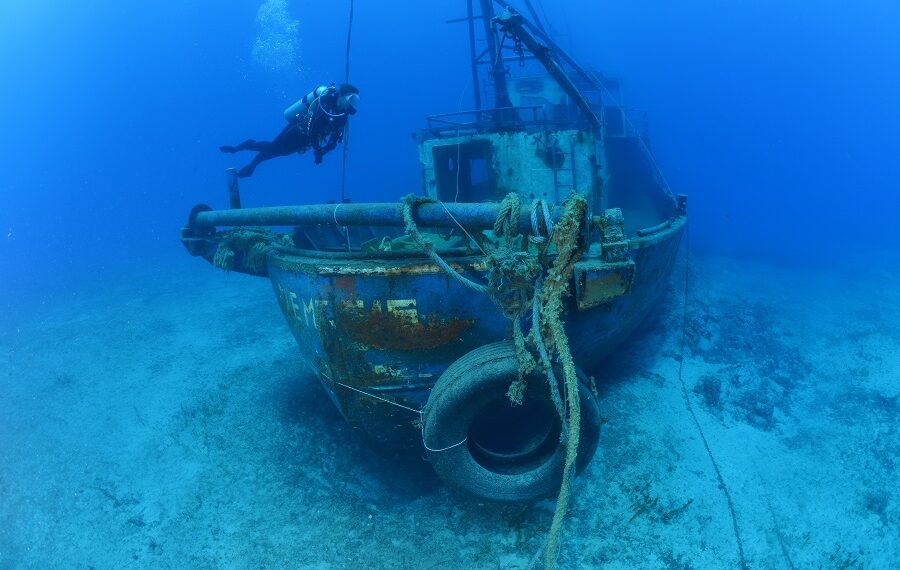 The wreck of the Nemesis, deliberately sunk in 2013 in Cyprus. © Nicolas Barraqué
Excerpt from article L2122-9 of the General Code of Public Property À at the end of the occupancy title, the works, constructions, and installations of an immovable nature existing on the occupied domain dependency must be demolished either by the authorization holder, or at their expense, unless their maintenance has been expressly provided for by the title of occupancy or que the competent authority waives, in whole or part, their demolition. The works, constructions, and installations of an immovable nature whose maintenance at the end of the occupancy title has been accepted become automatically and freely the property of the State, clear and free of any privileges and mortgages. … Furthermore, the occupancy title should provide clauses and financial guarantees ensuring that restoration is always possible.
It follows from the above that at the end of the occupancy title of the maritime public domain, the State can perfectly, after duly taking into account all socio-economic and environmental costs (for example, impacts or undesirable alterations following the removal of the ”reef ship”), consider that removal could harm other public interests (e.g., environmental degradation) and accept or request the absence of site restoration.Note that we think that restoration operations could be, or even should be, considered as “works” in the marine environment. As such, they should undergo an impact study. This point seems particularly important to us. Indeed, this new impact study should not be viewed as yet another formality but rather as a scientific approach allowing the evaluation of the relevance of maintaining the “reef ship” or restoring the public domain.
Beyond any dogmatic stance, if at the end of the authorization of the public maritime domain by the “reef ship” and at the conclusion of the impact study, a “net positive benefit” for the environment (notably with a concentration of fauna and flora), culture (heritage) or the economy can be demonstrated. The State’s services, with the agreement of the Maritime Prefect and the zone commander, may decide to maintain the “reef ship” in its location.
CONCLUSION
We have chosen only to address what we consider to be the “main blocking points” because, in our opinion, it is here that initiatives for immersing “reef ships” in the French Mediterranean prematurely and wrongly die.
The question of immersing a “reef ship” involves many other complexities, whether in terms of environmental procedures, planning, or even urbanism, … however, these seem to us to be perfectly controlled by the State’s services.
The demonstration of numerous and recent ship immersions carried out in the signatory countries of the Barcelona Convention on the one hand, and the demonstration of the non-incompatibility of these immersion projects with French law on the other hand, will, we hope, convince the French State’s services of the feasibility of immersing “reef ships” and ultimately, better yet, the start of a real policy or official strategy of immersion for a general interest objective.
Access the complete downloadable version on www.belda-consultant.com